Skip to content
The Compass Center

The Compass Center

Rabbi Amy Eilberg Presents From Enemy to Friend and the annual JCC Ann Katz Festival of Book and Arts

Rabbi Amy Eilberg Presents From Enemy to Friend and the annual JCC Ann Katz Festival of Book and Arts

November 18, 2014

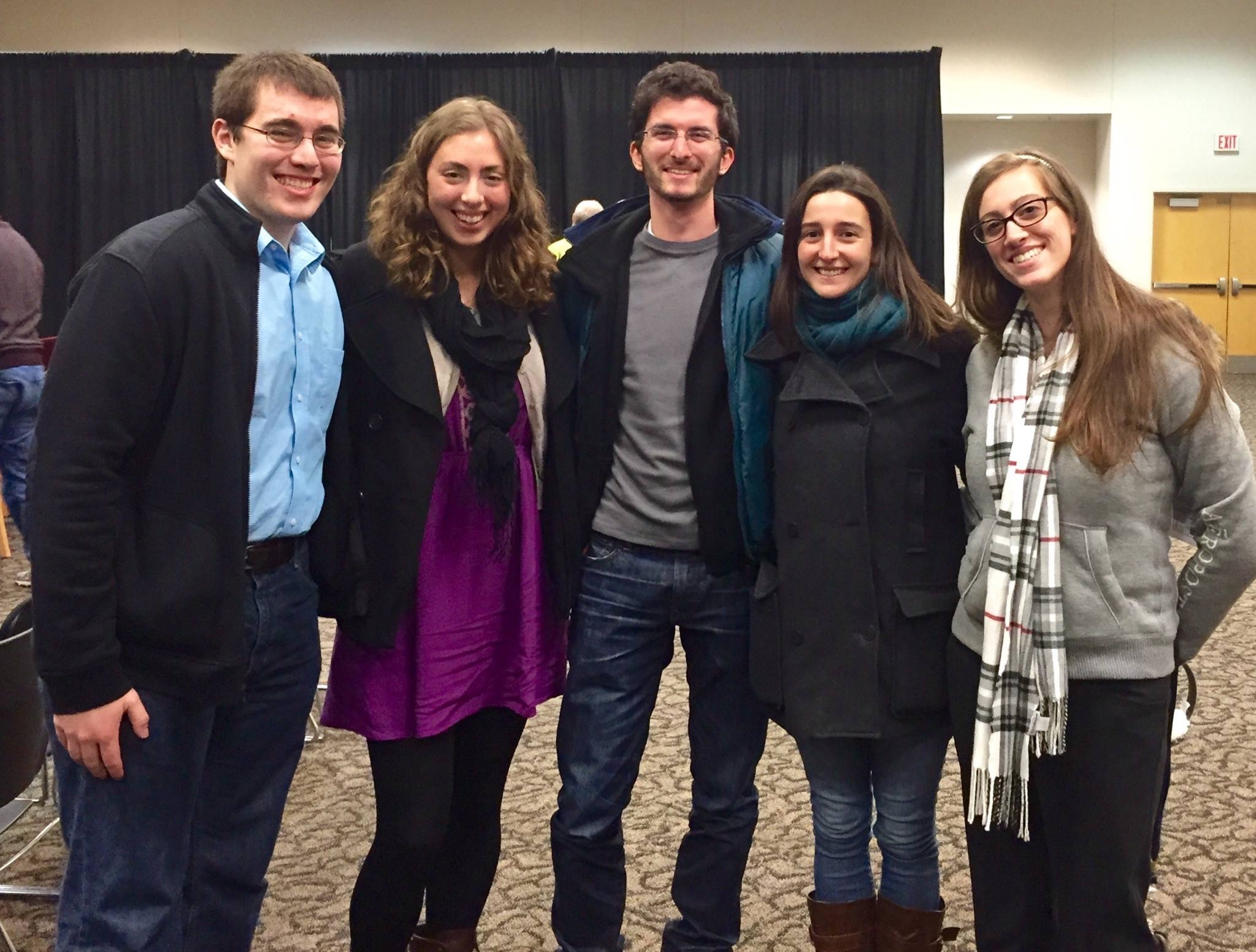
by Lea Levy – Center for Faith and Vocation Interfaith Intern attended the Ann Katz Festival of Books and Art with Butler Hillel friends on Thursday, November 13, 2014.

Who is the hero of heroes? … One who makes an enemy into a friend. –Avot d’Rabbi Natan, 23

Return evil with good and your enemy will become a devoted friend. –Koran 41:34

Rabbi Amy Eilberg, the first female ordained in a conservative synagogue, who began her career in Indianapolis, returned here this week to present her first book From Enemy to Friend: Jewish Wisdom and the Pursuit of Peace. The title is derived from the two quotes above, one from the Jewish tradition and the other from the Muslim. She described the process of writing this book to be much like giving birth. The idea for the book was conceived at several different periods in time, the first being in the wake of the second Intifada, and the another being during a trip to Israel in which she witnessed a conversation between Jewish Israeli and Arab Israeli high school students organized by a peace group. In witnessing this, she began to understand the importance of story-telling and dialogue. These humanize people. When stories are told friendships can be formed and experiences shared. In doing research on why arguments and political disagreements can turn so ugly, she discovered that the neurological explanation for this is very primal; it is fight or flight. The reason we tense up and clench our fists during a heated argument is because we feel that, since our beliefs form such a huge part of our identity, our very existence is being threatened in that moment. In order to find peace, we must realize that in any conflict the intentions are never actually to exterminate the other side, and that we should be open-minded when we enter any dialogue. In this way, we may one day achieve a sustainable peace throughout the world.

hillel

Interfaith Service Event-Tree planting-Keep Indianapolis Beautiful

Interfaith Service Event-Tree planting-Keep Indianapolis Beautiful

November 3, 2014

by Lea Levy, CFV Interfaith Intern

Lea LevyOn Saturday, October 25th, several representatives of Butler’s religious and non-religious groups came together for a day of service and dialogue. We participated in an event organized by Keep Indianapolis Beautiful, Inc., and planted 200 native Indiana trees in the Fairfax neighborhood in order to help divert storm water from the area combined sewer system. The weather was beautiful, and the event was fun and informative.

After taking part in the service event, we all drove back to the Center for Faith and Vocation for a pizza lunch and a discussion. Representatives from the Secular Student Association, Hillel, the Orthodox Christian Fellowship, and Catholics not affiliated with the Butler Catholic Community partook in a discussion about faith, service, and environment.

The conversation ebbed and flowed into many different areas of discussion, and was very interesting for every person involved. We described the importance of service and the environment in each of our faiths, and focused particularly on the symbolism of the tree, because of what we had done earlier in the day.

A tree is, in many faiths, traditions, and belief systems, a symbol of life. Trees very obviously symbolize life and the cycle of life because of the visible element of leaves changing colors, falling off, and then growing back. It can in many faiths be a symbol of life as well as life after death. It not only represents life in the religious sphere, but in a very clear scientific way as well; it provides oxygen for us to breathe and therefore live.

In telling stories and dialoguing about our different belief systems, we were able to create a very understanding environment, and all learned a lot.

Interfaith Service Event

Jewish/German Dialogue Project

Jewish/German Dialogue Project

November 3, 2014

by Lea Levy, CFV Interfaith Intern

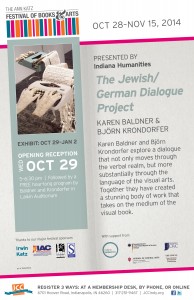
fob_jewish_german (2)On October 16, 2014, the Indianapolis’ Jewish Community Center hosted an event called the Jewish/German Dialogue Project on the opening night of their annual Ann Katz Festival of Books. This was the first event of its kind that I have ever attended. Though I have read a lot and seen a lot of movies about the Shoah, I have never been to an event in which two artists, one on either side of the conflict, have had a dialogue about their country’s histo

Karen Baldner, a German Jew, and Björn Krondorfer, a non-Jewish German, have been working together for a decade to create artwork that expresses their reaction to the Holocaust. Though they have different histories based on their religious background, they have a very intertwined past. They both grew up in Frankfurt in the 1950’s, both had a grandfather that they never knew who had passed away during or as a result of World War II, and they both went to the United States to study.

Their artwork was rich with symbolism and emotion. One piece was a book that they put together through the mail. One would add a few pages then send it to the other and they would continue in this way until the work was completed. The outer pages of the book were a goat’s profile, but as they moved more towards the center, the pages became outlines of Karen and Björn’s profiles. This symbolized the scapegoating of each other that is ultimately reconciled through dialogue. The pages with Karen’s profile showed elements of her past, and the same with Björn’s pages.

By speaking about their intertwined pasts and about the process of reconciliation and understanding of each other’s pasts, they create a beautiful and peaceful environment through their work that reaches across the abyss and creates a new German identity of understanding and coexistence.

Religion and Reconciliation in Global Perspective, Oct. 28, 2014: Positive and Radical Reconciliation

Religion and Reconciliation in Global Perspective, Oct. 28, 2014: Positive and Radical Reconciliation

November 3, 2014

by Lea Levy

Lea LevyDr. Charles Villa-Vicencio was, much like Dr. Alan Boesak, a very eloquent speaker. Though they grew up on different sides of the conflict, they had both been very involved in the struggle for human rights in South Africa, and are still fighting hard to create a reality of justice throughout the world.

Villa-Vicencio believes that full reconciliation takes several steps; negative peace, negative reconciliation, and finally, positive reconciliation. Negative peace is simply a cease-fire, and a commitment to political coexistence. It does not include reconciliation because there is no obligatory dialogue between the people, and they are not forced to respect and understand each other, simply to coexist. In negative reconciliation, there is again no violence, but there is still not a lot of dialogue. There is argument instead of fighting. There is scapegoating instead of reconciliation. Finally, positive reconciliation is the development of processes to deal with the trauma. The government must create institutions, such as the Truth and Reconciliation Commission, to deal with the past and to make reparations. The end product is the achievement of the Kingdom of G-d, a supreme peace throughout the land and an achievement of unity in the midst of diversity. Though South Africa has made reparations and have reconciled across the black and white divide, there is still a legacy of racism and many economic problems. Villa-Vicencio believes that South Africa has settled for what is easy, and has failed to keep its eyes on the goal.

Boesak agrees that South Africans have failed to keep their eyes on the goal, and that they are settling. His definition of positive reconciliation is radical reconciliation; a reconciliation that is intricately tied to justice, and restitution of hope, and religion can play a very positive or a very detrimental role in this process.


Is Reconciliation Worth it?

Is Reconciliation Worth it?

October 10, 2014

Lea LevyMs. Levy attended the Seminar on Religion and Reconciliation in Global Perspective, Sept. 23, 2014.

by Lea Levy

Dr. Boesak and Dr. Turner are both very eloquent speakers, but are both very different in the ways in which they address the crowd. It is evident why Dr. Boesak chose to be a preacher, and Dr. Turner a professor.

I think that the question of whether or not the Truth and Reconciliation Commission in South Africa was worth it is a very important question and raises many others along with it. Both Dr. Boesak and Dr. Turner agreed that it was indeed worth it, but they did also address the downsides of it, implying that even though reconciliation can be very helpful and healing to many different people, there are also many risks attached to it.

In looking at South Africa’s situation today, Dr. Boesak says that the stratification of wealth, along with terrible health problems such as the spread of HIV and AIDS throughout the population make the situation within the country not look much better than it did under Apartheid for many young South Africans. The life expectancy in the 90’s was 60 years, and today it is under 50. Many people feel that their life has not gotten much better since Apartheid was knocked down, and are questioning their feelings about reconciliation and about the sincerity and worth of it.

However, the conclusion by both speakers was that it was indeed worth it. As Dr. Turner put it, South Africa’s citizens decided to look forward and to coexist, and this was a victory within itself. Though life is not perfect in South Africa, a lot of progress has been made. Though interpersonal forgiveness does not address state and structural violence, it was able to resolve a lot of feelings that many South Africans were having, and was able to create a society that listened to each other and that is able to cope with the past in a healthy way.

Religion and Reconciliation in Global Perspective; The Risks of Reconciliation Video, Sept 23, 2014 .


The Benedict Inn: Women and Religious in the Workplace

The Benedict Inn: Women and Religious in the Workplace

September 29, 2014

by Michaela Raffin

Anyone who has ever interacted with the Benedict Inn knows that it is truly a very special place. My experience as an intern there allowed me to appreciate this. It was a totally unique internship for two main reasons. One is that everyone in a leadership role at the Benedict Inn is a woman. And two is that it allowed me to see another side of my Catholic faith that I had not been exposed to before this: the role of religious life in the Catholic Church. It is directly connected to a monastery of Benedictine nuns who run the Inn.

Sr. Mary Carol

I never thought that it was odd that I worked under all women. But it kind of was. It was unusual and is something that I probably won’t ever experience again in my career. The women at the Inn became my role models. They were driven, enthusiastic, funny, and caring. They knew when and how to get the job done and when to relax and enjoy life.

I want to be just like these women. I want to have the skills and the drive in order to accomplish not only the task at hand, but also all of my goals and dreams. I want to be caring and kind to everyone that I connect with. I want to have a relationship with God. I want to stand up for what I believe in but be empathetic to others’ viewpoints. I want to be connected to people.

Michaela's Bosses

So I will take everything that I have learned from the women at the Inn and carry it with me as a student at Butler. I can represent these women; I can be one of these women in my classroom, in my sorority, and in my career. If there is one thing that I have learned by being around the women at the Benedict Inn is that when a group of women is gathered, there is a power, an electricity, that permeates the atmosphere of that gathering. As a student at Butler, I hope to be a contributor to that energy whenever I gather with my fellow women.


Now is the Time

Now is the Time

March 21, 2014

Ellen Photoby Ellen Larson ’14

I don’t think anyone can properly prepare for graduation. You can take all the right classes, secure the high profile internships and fill your resume with campus leadership experiences but none of that prepares you for making your first career moves.

As a senior strategic communications and Spanish major, I am currently on the so-called job hunt. It’s more of a battle than a hunt to me. A month-long, exhausting, soul-searching, insecurity-filled, exciting battle that exposes you to feelings you’ve never experienced before.

I consider myself a self-reflective person, which has both helped and made this process all the more difficult. I came into college not quite sure of what I wanted to study. I jumped around a bit, from exploratory to journalism to finally landing on strategic communications and Spanish. All the while, a little, persistent and sometimes quote annoying voice kept putting the thought of education in my mind. I suppressed it, forged ahead with my public relations and advertising classes. Writing press releases, analyzing advertising campaigns, working with local clients to secure media coverage and eventually executing a semester-long campaign for a local non-profit. Now don’t get me wrong, I enjoyed every last bit of it. I love developing ideas and projects into full-blown creative and strategic campaigns. But the ever-present voice was there and was starting to get louder. “Explore education” “Teaching is the way to go”.

I compare it to that light in the distance that you see in those terror movies. You’re sitting on your couch at home cuddled under a blanket or at the movie theatre with your knees to your eyes saying ‘don’t go there you idiot’. But they do, they always do otherwise there wouldn’t be a story. So I went closer and closer to that light, started actually listening to the voice in my head and stopped hiding the feeling. I accepted that teaching is something I feel called to do and looked at all the opportunities that were out there.

Teach for America is a program that serves communities that need a little (some bigger than others) push to grow into the wonderful and innovative educational systems they can be. It’s transformative and wonderful and calls to me in all the right ways. So I applied and am currently preparing a lesson that I will teach at my final interview day in two weeks. I’m not sure where this path I’ve chosen to go down will lead. I’m excited and scared and nervous and inspired.

My favorite author, Shauna Niequist, sums it up best in her book Bittersweet. She writes about the twenty-something life and describes my emotions in an ‘I think you’re my soul-sister’ kind of way. I’m looking forward to what’s to come and enjoying this new learning process. I hope this quote resonates with you as much as it does me.

“Now is the time to figure out what kind of work you love to do. What are you good at? What makes you feel alive? What do you dream about? You can go back to school now, switch directions entirely. You can work for almost nothing, or live in another country, or volunteer long hours for something that moves you. There will be a time when finances and schedules make this a little trickier, so do it now. Try it, apply for it, get up and do it.” – Shauna Niequist

Nelson Mandela inspires me as to how I live

Nelson Mandela inspires me as to how I live

March 21, 2014

by Erin Aquino

“When I consider the life of Nelson Mandela and how he transformed South Africa, this is what comes to mind, this is how I live because of what I learned about faith, calling, reconciliation in South Africa.”

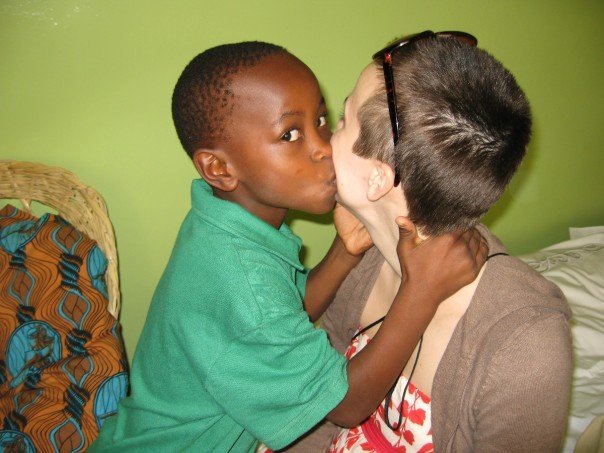
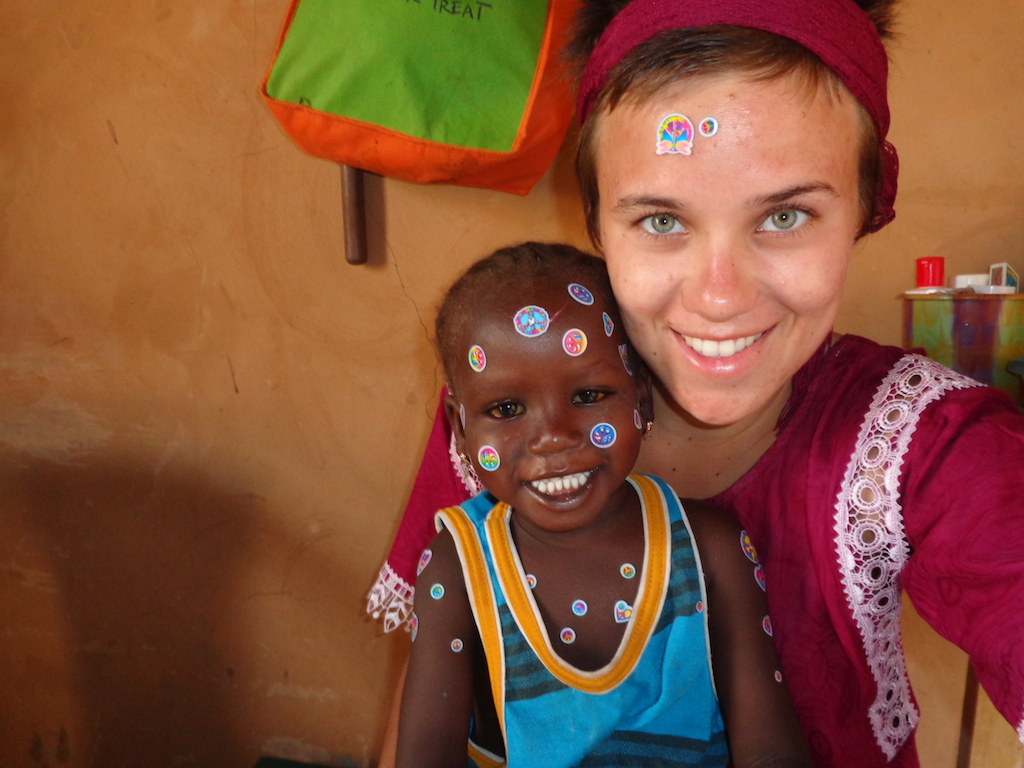
I have recently returned from my Peace Corps service in Senegal, and as I consider the life of Nelson Mandela and South Africa I immediately think of Senegal and its people who housed, fed, developed and essentially took care of me for 27 months.

I think of Aminata, Fatimata, Djiby, and Jaynaba. I think of prayer five times a day. I think of Pulaar and language superiority. Of headscarves, long skirts, and vibrant colors. Of tattered clothes, and cold feet. When kids sneak and steal each other’s food. Of death too young, and kids too skinny. Of laughter and dancing. Of not enough rice, and fifteen people around the lunch bowl. More importantly, I think of joy and friendship and community. Around the world.

Making Friends in South Africa

Community. Around the world, injustice continues. Religious persecution, racism, ethnic cleansing, hunger, fear, fighting, domestic violence, sexism, ableism, and hunger continue.

But so does Mandela. Mandela continues. Mandela continues in all of us, and around us. Mandela did not take the world and change it. No one can. He worked hard to restore equality and stand for justice. But he did not do it alone. He was inspired by others, and will continue to inspire others for generations. He laughed and danced. He was part of a community. Mandela stood for peace, and peace stands for interconnectedness, empathy, and understanding despite any purported boundary.

South Africa was my first international experience. My first experience understanding a different world, learning from it, and knowing to always learn from it. And also to use the knowledge and experience and transform it to continue to work with others to restore equality and stand for justice. To create community. And love. And never forget to laugh and dance. Just like I did with Aminata, Fatimata, Djiby, and Jaynaba.

On njaaraama no feewi. Jam tan.

(Thank you very much. Peace only.)

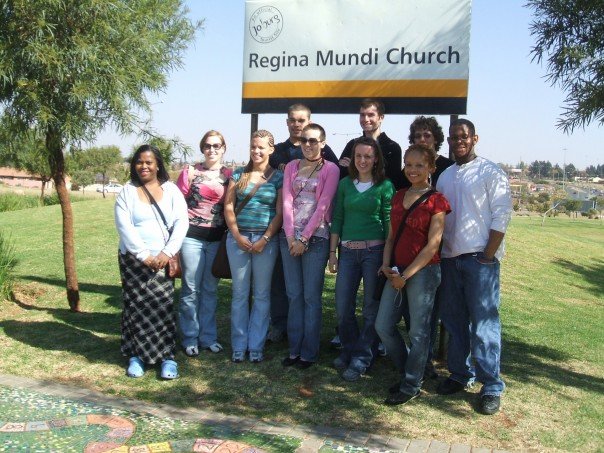
Aminata and Me in Senegal The South African Group 2007


Why I need Indiana and why I know that I can leave

Why I need Indiana and why I know that I can leave

February 19, 2014

by Rebecca Rendall

MapLast semester, I spent three and a half months studying development and social pluralism in Cameroon (see map for a little geographic guidance). Both before and after my semester abroad, I was asked many questions ranging in topics from the weather conditions to the people I met to my reasons for going to the relative merits of the country as a whole. There were (and still are) some questions that always stump me. I did not have a clear and concise way to answer “How was it?” or “Did you have fun?” I usually smiled and nodded or muttered some affirmative words. In answering questions of interested and uninterested (but polite) friends and family, I began to think about what I wish they would ask. I thought about what I would say if all the layers of social convention were stripped away and my personal ability to be vulnerable was suddenly emboldened. This is what I would say. The distance between me and my family was absolutely unbearable, but the love of my family and friends assured me that I could leave again. And this is why…

My grandmother (affectionately called Grandma Me by my brothers, my cousins and me) died on October 25, 2013. It was the day before my twenty-first birthday and the day we moved from Yaoundé to Ngaoundéré. (We moved cities within Cameroon in order to interact with the populations we were learning about in class. In this case, we moved in order to study the predominantly Muslim population.) I was supposed to Skype my grandma and my mom that day. Instead, my mom answered my call with tears in her eyes and told me that my grandma had passed away a half hour before I called. There I was, 6,341 miles from home and 6,742 miles from my grandma’s house and I could not do anything about it. Thus began the hardest week of my life so far.

Christmas 2012

Before I left to go to Cameroon, I visited my grandma, my aunt and uncle and my cousins in Minnesota because I wanted to see everyone in my family before I left the country for a semester. My grandma had two rounds left in her cycle of chemotherapy when I arrived. I went with her and my aunt to the hospital the next day for her treatment, but unfortunately her blood counts were too low, requiring a blood transfusion. This started the process of my grandma undergoing tests to see if chemo would be effective anymore. When I left for Cameroon, the results were not available yet. I left home knowing that the results could indicate whether or not my grandma would be alive when I came back in December.

As you may have guessed, the results were not positive. My grandma, along with my aunts and my mom, had to make the difficult decision to switch to palliative care, essentially trying to make her as comfortable as possible while no longer aggressively fighting the cancer. Most of this information reached me via e-mail or Facebook message from my mom, yet I remained hopeful. The gravity of the situation finally hit me on October 6, when I received an e-mail from my mom. Grandma had lost feeling in her legs. That is the day that I absolutely deteriorated. Picture a person curled up in a ball in the corner of a room sobbing uncontrollably and then times that by four. That was me.

The next month proved extremely difficult as I attempted to experience Cameroon while simultaneously trying to remain connected with my family, supporting them in any way possible. When I finally received word that my grandma had passed away, I can assure you that I was not at peace. At first, I was glad that my grandma was not suffering. Then, I was immediately angry that I was not with my family. Then, I was scared. I was already overly emotional on a daily basis. What would happen to me next? Could I still function? What was I supposed to do? This is when I realized beyond a shadow of a doubt that I would always, and I mean ALWAYS, need my family. Even from over 6,000 miles away, they remained my rock. My family seemed to play a game of “Who gets to Skype Beccah today?” My sister-in-law also set up Skype at my grandma’s memorial service so that I could watch it and feel like I was at least a part of it.

For these reasons, I know that my heart rests forever in Indiana (and wherever my family decides to disperse to). But, at the same time, I know that I can leave again in full confidence that my family will find a way to remain just that: a family. We are far from perfect. We are not always happy with each other. But we are part of a shared identity. We are the grandchildren of a beautiful woman who taught us to have an insatiable love of learning and an unquenchable thirst for God. I know that this is a bond formed on earth and in heaven. Even as we begin to slowly move farther and farther from home, one thing remains: we are family.

Dance recitalDschang picture

An Unexpected Audience with Pope Francis

An Unexpected Audience with Pope Francis

January 8, 2014

pope cropped

A routine academic conference turns into an experience of a lifetime

by Chad M. Bauman, Associate Professor of Religion, College of Liberal Arts and Sciences

There appeared to be nothing unusual about the Christianity and Freedom Conference , except, perhaps, that it was located in Rome, in the shadow of the prodigious walls that encompass Vatican City.  I’ll admit that as I prepared to attend the conference, I had humored myself by imagining that my visit there might lead to a chance encounter with the new Pope, who had already, in his short papacy, developed a reputation for slipping his security detail, abandoning the security of the papal limousine, going out into the streets, kissing babies, and exchanging skull caps with tourists.  But neither I nor those who organized and participated in the conference knew what awaited us in Rome.

The conference was sponsored by the Religious Freedom Project at the Berkley Center for Religion, Peace & World Affairs at Georgetown University.  One of the project’s aims is to bring attention to what appears to be a growing number of situations around the world where the freedoms of religious people are circumscribed.  Though the project is concerned with the freedoms of all religious people, this particular event focused on Christianity, its contribution to the development of ideas about secularism and democratic liberty in the West, and situations in which Christians are jailed, harassed, attacked, or otherwise under pressure because of their faith or their affiliation with Christianity.  I was there to talk about my research on Hindu-Christian conflict in India.

The conference was held at the Pontifical Urbaniana University, and high Catholic officials participated—Archbishop Dominique Mamberti, the Vatican’s Secretary for Relations with States, gave the opening address.  Through these connections or some other fortunate circumstance, the conference came to attention of the Pope.  Not surprisingly, perhaps, given the topic of the conference, given the fact that the Vatican represents about half of all Christians worldwide, and given that this particular Pope appears intent on improving interfaith relations, Vatican officials began to show some interest in the event.   And so, midway through the first day of the two-day conference, conference organizers announced that conference participants had been granted a private audience with Pope Francis.

P1060354
Swiss guards at the entrance of the papal residence

The next morning, grateful I had packed a suit and tie to wear, I joined the other conference participants in a walk from our hotel to the Vatican.  After going through the regular security, we were led past the colorful and venerable Swiss Guards, up several flights of beautifully-wrought stairs, into the papal residence, and finally to the capacious Sala Clementina, which glows dimly with the reflected light of stunning frescos by Renaissance artists Paul Bril, Cherubino and Giovanni Alberti, and Baldassare Croce.

The Sala Clementina
The Sala Clementina

After we waited for a few minutes, Pope Francis arrived.  He was greeted by Thomas Farr, Director of the Religious Freedom Project, and then exchanged glances, gestures, and a few short words with the rest of the group.  He was smiling and joking almost the entire time, and his tendency to throw his head back in laughter, combined with the low light of the room, resulted in his image appearing blurred in most of my pictures.  He posed for some photographs with the group, interacted with us a bit more, and then left the room.  This pope is most comfortable speaking in Spanish and Italian, and the only thing he said in English the entire time was “Pray for me,” the phrase he most regularly uses in greeting.

A close-up of Papa Francesco

I am not Catholic, but of all the popes who have served during my lifetime, it is this one who most inspires me, and who, it seems to me, shows the most potential for effecting positive change in the world.  He has already developed an admirable reputation for simplicity, demonstrated the ability, with humility, to connect with the laity and even non-Catholics, and exhibited a sincere concern for the poor.  The entire audience lasted only a few minutes, but even in that short encounter, many of the reasons why he has generated so much enthusiasm and hope, among both Catholics and non-Catholic observers, were readily apparent, and I am sincerely grateful to have had the opportunity to meet him.

Posts navigation

OLDER POSTS
NEWER POSTS

Recent Posts

  • The Jewish Community Center: Plants the Seeds for Growth and Connections
  • “Young Plato”: A Headmaster’s Refreshing Approach to Defusing Conflict
  • My Jewish Community Center Internship: An Awesome Fall
  • Religion and Artificial Minds: How AI Reflects Our Ethical Issues
  • “Mission Joy”: Overcoming Hardship and Finding Meaning Through Community

Links

  • College Well Podcast
  • Compass Conversations at Butler University Podcast
  • Dr. Brent Hege's Podcast
  • The Compass Center
  • The Compass Center on Facebook

Archives

© 2025   All Rights Reserved.