Skip to content
The Compass Center

The Compass Center

Summer at the United Methodist Church

Summer at the United Methodist Church

August 22, 2012

by Kate White

This summer I interned at the Indiana United Methodist Conference Center with the Rev. Dr. Daniel Gangler, director of communications. My interest in strategic communication and my faith background in Methodism made the internship the perfect fit for my summer experience. Not only did I gain professional experience, but a broader understanding of where my spirituality is rooted and opportunities available for communicators within the church. Also, my special ties to these causes helped me to create a more meaningful experience for myself. I almost feel overwhelmed from my whirlwind of a summer, but I’m so excited to share with you all of the insight that I’ve gained.
The first day on the job is always interesting. I set out my professional intern attire the night before, packed my lunch, rose bright and early, double-checked my GPS, allowed extra time for the commute (including Indianapolis construction!) and stepped off the elevator fifteen minutes early, bright-eyed and eagerly anticipating the unknown. Surprisingly, the first day was highly uneventful –unless you count that I left my headlights on all day and had to traipse back up to the third floor business suite to sheepishly ask my new boss to jump my car. So embarrassing you could crawl under a rock, right? Only, not so much. The incredible things that faith can do for you.
My first week or two seemed so “uneventful” because I felt amazingly comfortable –almost too comfortable. Working in a faith environment can affect your mood, work ethic, how you interact with others and ultimately your outlook on life. I found myself fitting right in because, well, I did. My boss and the rest of the staff understood the Church’s concept of “radical hospitality” and took every effort to make room for the new intern. I didn’t have to worry about my mistake of leaving my lights on because my faith told me not to worry and my co-workers reassured that it happens to the best of us. I further felt a sense of belonging at work and compatibility with the mission because I’d already been involved with The United Methodist Church for twenty years, an odd concept for a not quite 21-year-old to contemplate.
While The United Methodist Church wasn’t a foreign concept for me, I found that there was a whole lot more that I didn’t know. For instance, the organizational structure of the church extends far beyond my congregation and our pastors and their superiors. Without getting too technical, let’s just say that The United Methodist Church is a global powerhouse with several committees, global initiatives, annual meetings, active laity, various clergy and a thirst to continuously improve “to make disciples of Jesus Christ for the transformation of the world.” As you can imagine, an organization that large requires a vast amount of communication to keep the ball rolling.
To fulfill the church’s needs, there are communicators at the national, conference, district and congregational levels. Mediums include:
• publications like magazines, newsletters, mail, email and bulletins;
• electronic media such as projector screens for hymn lyrics, mission photos, YouTube videos, sermon outlines, and congregational responses;
• tools for real-time interaction like video-conference calls, live web-streaming, social media and Skype;
• and resource archives like online databases, websites, search functions and physical district resource centers.
Most communication teams are comprised of editors, writers, designers, and photographers/videographers. Thinking realistically, which nonprofit has a budget to bolster their own media team? Most communication tasks fall to the clergy and laity. This is not all bad because those closest to the subject matter tend to be the best sources of information. Nonetheless, communication is not just slapping words on a page for mass consumption. Trained communicators must provide resources and advice to enable others to communicate effectively to further the goals of the church.
So where did this intern come into play? I mainly worked with my boss scouring the national news and reformatting it to be used at the state and congregational level. This meant hours of consuming information and proof reading. With my help, congregational leaders stayed informed at the state level and became gatekeepers for their own congregations. I also became the in-house expert on social media, giving pointers here and there about tweeting and blogging. In addition to editing, I reported about long-term recovery after the March 2 tornadoes in Henryville, developed and maintained social media platforms, executed a social media campaign for the Indiana annual conference, pitched the conference events to local media outlets and contributed to a 16-page bi-monthly newsletter. I knocked out most of my bucket list, but a few things remained: writing a reader for radio and observing the church lobby for government legislation. I guess that gives me something to shoot for next summer!
Aside from my time in the office, I took advantage of my summer and my resources by contacting local church officials and asking questions, attending various congregations throughout Indianapolis, and enrolling in a Methodism course, all the while building relationships with other believers. Those experiences were just added little bonuses that helped me grow in my faith and provided context for my work in the office. I wasn’t just communicating for the sake of communication, but for a larger cause. A cause that carries my personal faith and its likeness for the transformation of Indiana and the world.
In the future I hope stay involved with Meridian Street United Methodist Church, just a few blocks from Butler’s campus, and help establish a Methodist group on campus. As far as communications in the church, who knows! This internship has given me a good foothold and taste of the opportunities that await. I think I’ll leave the rest in God’s hands.
Paging Dr. Holland

Paging Dr. Holland

July 25, 2012

SUNDAY, JULY 22, 2012

by Laura Micklich

This past Friday I accompanied my younger brother to Purdue University for a visit day, but was afforded some insight of my own. During one of the sessions designed for the families of prospective students, we discussed Dr. Holland’s six codes, which are often used to match personality types and vocations. The six types are described as being Realistic, Investigative, Artistic, Social, Enterprising and Conventional. After a brief survey, I found myself identifying mostly with the Social and Artistic areas. Social people are typically cooperative, helpful, friendly and outgoing. Artistic people are creative, original, independent and inventive. It was mentioned that all areas need Artistic people and their creativity and ingenuity…. It would then be nice to think of myself as a Social person with the ability to think outside the box. This got me thinking about my current experience with my internship at Benedict Inn, as well as my prospective career path. Am I able to fully express and utilize my personality traits at Benedict Inn? Certainly, it is a social environment. All staff members, myself included, try to make themselves available and helpful to guests at all times. Indeed, amongst the staff we work in a social environment; no one could work in the office without cooperating with one another. For example, once a program is planned, the facilities manager must be contacted to procure a date, time and location. Once this is settled, our marketing coordinator then creates a pamphlet to advertise it, which needs to be proofed by multiple people before being sent to print. Our secretary is then in charge of organizing and printing the address labels, which I often attach to the pamphlets before they are mailed out. Finally, the day of each program requires the cooperation and interaction of all staff members at Benedict Inn, from the program director and the administrator, to the housekeeper and the cook. The entire basis of most not-for-profit organizations and businesses is to provide services for others. Such a Social career allows people to work with one another to teach, serve and support others through all different types of interaction. From my experiences as a volunteer, and as an intern with Benedict Inn, I believe that I am on the right path to the vocation that will best match me and my personality and values; and, thanks to my visit to Purdue, I have been able to reflect on this in a new way.

Butler Goes to Israel and Palestine: 2012

Butler Goes to Israel and Palestine: 2012

July 16, 2012

by Loor Alshawa

In May, a group of students from Butler University travelled with Dr. James McGrath to Israel and Palestine. They flew into Tel Aviv, and visited holy and historical sites in cities including Jerusalem, Acre, Jericho, Haifa, and more. These regions in the Holy Land do not only have plenty of religious significance, but political and social importance as well. As a result of that, this visit to the Holy Land proved to ultimately be a different, but overall enlightening experience to each person that went.

I went on this trip, and it was probably one of the most life-changing nine days thus far in my life. The region has huge significance to me; I am originally Palestinian, and I am also Muslim. So I was obviously ecstatic about visiting the Holy Land, which is also where my ancestors came from. I am the first in my family to go back there; my father’s parents fled the region prior to his birth, my mother fled at the age of 5, and my sisters have never gone either. We have visited other countries in the Middle East, such as Jordan, Syria and Egypt, but never Palestine. Words cannot describe how excited not only I was, but my family as well, when we heard that Butler was taking a trip to where we are from!

Experiencing Israel and Palestine was incredible on many different levels. I got to see the beauty of the region. I got to feel the holy significance of sites such as the Dome of the Rock; it was almost like a pilgrimage to me when I got to pray in the Dome and in the Al-Aqsa Mosque because I felt so connected physically and spiritually to my religion there. Finally, I unfortunately also got to see the tension arising from the Israeli-Palestinian conflict. I witnessed tension between Israelis and Palestinians. I saw discrepancies in the quality of life in Israeli cities versus Palestinian cities. Being Palestinian myself, I unfortunately experienced discrimination in Israel. I will not elaborate on this, although I did often feel that the discrimination I had to put up with did dominate my experience in the region. However unpleasant that was, it was truly eye-opening. I gained first-hand perspective on the Israeli-Palestinian conflict that I never had before. I believe that the students with me also gained perspective that they wouldn’t have had if I, a Palestinian, was not with them. They just got to see more of what the reality of the situation over there is. And on a lighter note, they also got better deals at Palestinian-owned shops since I was better able to haggle for good deals with my fellow Palestinians! 🙂

Overall, my experience in Israel and Palestine was multifaceted. It was spiritual, it was beautiful, it was enlightening, and of course it was fun!!! I am so thankful that I got to go on this trip and have the experience of a lifetime there.

Meeting St. Benedict at Starbucks

Meeting St. Benedict at Starbucks

July 2, 2012

By Laura Micklich
SUNDAY, JULY 1, 2012
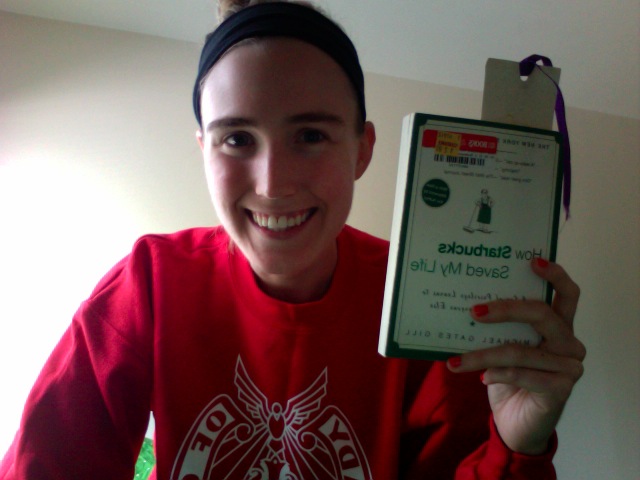
One of my little luxuries this summer has been attending Mass on Saturday nights so that I can wake up early on Sunday morning and go for a nice, long run (something that is also commonly a spiritual experience for me) and then treat myself to reading a good book at Starbucks. This morning was no exception, and I settled down (fittingly) at my neighborhood Starbucks with Michael Gates Gill’s reflection How Starbucks Saved My Life: A Son of Privilege Learns to Live Like Everyone Else, which I picked up at Half-Priced Books yesterday on a whim.
The author recounts his fall from fortune as an advertising whiz, and his second chance as a barista at a Starbucks on the Upper-West Side of New York. As I drank three of my usual order (“tall coffee with sugar-free hazelnut!” – only one of them decaf…), I was intrigued by Mr. Gill’s description of his experience as an employee of Starbucks Coffee. From his very first day, he was taught how to treat “Guests” with care and respect, making conversation with them in order to create a welcoming atmosphere and providing for their needs. Gill also realizes, through his retail service job, that work is dignifying. Work is satisfying, not only in the fact that it gives us a sense of accomplishment, but in that knowledge that we have usually provided something for others. The author explains how he took so much pride in cleaning the store, even the bathroom, for his employer and guests!
The thought struck me almost immediately upon reading this memoir how Benedictine his experience has been! In his Rule, St. Benedict wrote, “Let all guests who arrive be received as Christ,” and while his recommendation is generally intended for monastic communities, it is something that anyone in the Benedictine tradition strives for. When writing about how Starbucks treats its customers, Gill always uses the term “Guests,” reflecting the company’s attitude. And, a huge part of receiving these guests at the store involves doing the best work possible in order to meet their needs. Here, the labor so honored by Benedictines is coupled with their famous gift for hospitality to provide the best possible experience for those they encounter in this life.
Reflection has brought me to contemplate how my work experience in a Benedictine institution relates to other job positions in the world. Through my internship I have learned even more about what it means to live my Benedictine tradition, and what I have gained from this experience can be applied in my future positions. Who knew that when I casually chatted with guests at the Inn that I was involving myself in a real business practice? It just seems natural that I would let people (guests, customers or whomever they may be) know that I take an interest in their concerns and am willing to meet their needs. Everyone has something unique about them, and understanding this on behalf of a company can go a long way in business relations. I hope this philosophy is something I can demonstrate in the future to employers who have a similar outlook on serving humanity.
A big thanks to Michael Gates Gill for writing his book, as it provided me a nice read on a lovely Sunday morning and an opportunity for reflection!
By the way, what drink do you think Benedict would order at Starbucks? (He’d certainly show more moderation than I do!)

Indy 500 Fever

Indy 500 Fever

June 27, 2012

by Kate White

This summer I’m staying on campus with a program called Brain Gain. Actually, the CFV director suggested the program to me. Brain Gain enables me and other CFV interns to stay in campus housing for almost three months of the summer while working on an academic related internship. The goal is for students in the program to engage in the community and hopefully settle in Indianapolis after graduation.
In addition to the exciting Brain Gain opportunities each Wednesday, I’ve experienced the culture of Indianapolis through my internship with The United Methodist Church as well. For instance, did you know that there’s a Christian ministry for the Indy 500 racers? It’s called IndyCar Ministry. Along with my advisor, I was lucky enough to attend their breakfast the Saturday before the big race. Representatives from the entire racing community spoke: owners, rookies, and veterans. It gave me a real sense of what goes on behind the scenes at the media events and photo shoots. I’ll be honest, I’m not a diehard racing fan –I’m an Illinoisan, not a Hoosier. But this summer I got my first real taste of the Indy 500 fever.
When Ed Carpenter (IndyCar series driver and Butler alumnus!) stepped into his car on race day, the heat sweltered, engines revved and the crowds roared. A first place victory and the quenching drink from the signature milk glass could have been at the end of his 500 mile road if all went well. Amidst the jubilation and determination, somewhere in his mind he knew that his life on the line. Years of dedication, training, money, sponsorships and his life were all pending on a single race to bring the ultimate racing victory. It’s a no-brainer that those racers believe in a higher power; the smallest glitch could mean the difference between victory and defeat, life and death. That was the case with the vivacious and talented Dan Wheldon who died less than a year ago on a race track.
For drivers like Ed Carpenter and the family and friends of Dan Wheldon, IndyCar Ministry caters to the spiritual needs of the racing industry. Racing is more than a hobby or a game. It’s a lifestyle. The men and women in the racing industry must have tremendous faith to get back into that car every day. The breakfast continued with a short memorial for Wheldon and the opportunity to contribute to the organization. I’m proud to say that my advisor, a United Methodist pastor, supports the work of IndyCar Ministry. As for me, I gained a new appreciation for ministry in all aspects of life, especially when you least expect it – and I guess touring the Speedway track, viewing the garages, taking pictures with vintage racecars and gluing myself to the TV on race day wasn’t too bad either!

Discovering a Life of Purpose, Meaning and Contribution

Discovering a Life of Purpose, Meaning and Contribution

June 20, 2012

by Kate White

I didn’t think much about the Center for Faith and Vocation after my first visit. The staff and students were welcoming but I thought that the CFV wasn’t essential to my Butler experience. Like most freshmen, I didn’t comprehend what the Center was and what went on there. In hindsight, I know that the Center helps students “discover a life of meaning, purpose and contribution.” They’re there to help you through your growing pains, search for answers and provide a safe place for you to sort through whatever’s on your mind, ultimately for you to leave Butler as a better person. By sophomore year, I was unhappy with my Butler experience and disconnected with my faith. I knew I needed to make a change and the CFV was exactly what I needed.

I met with Judith Cebula, CFV director, to discuss getting more involved with the Center and the rest fell into place. I started working at the CFV five days a week, keeping the house open and promoting events as a communication intern. The work I did at the Center repaid tenfold. That’s one of the unique aspects of the CFV. Most student clubs or organizations ask you to devote your time and efforts to their cause; the benefit you gain is professional experience and some form of enjoyment. The CFV is directly geared toward your personal growth for a lasting fulfillment that extends beyond your collegiate years. The time you spend there benefits you and your future.

Not only did I gain personal fulfillment about my faith and vocation, but I found a new community of friends. At the CFV I was welcomed into a home of spiritual believers who cared about each other, regardless of their obvious differences. Their pleasant demeanors provided a calming and agreeable atmosphere. It’s the content mentality that there’s a higher meaning to life than the busy hum of writing papers and weekend social gatherings. The CFV gave me a home base to reorient myself if I ever felt off track or needing encouragement.

As you can expect, I also learned a great deal about communications over the past semester, promoting the Center on campus:

First and foremost: there’s a great need for communication. In our busy culture and especially at Butler, there’s a lot of information and clutter that we face daily. The biggest question is: how do we stand out? Advertising comes in many different forms such as social media (Facebook, twitter, blogs, websites), posters, emails and signage. I found that Facebook is good for reminding students last-minute about events and email is best used sparingly for important reminders and details.

After we determine the medium, we have to discern our message. Personally, I knew that students had misconceptions about the CFV and reservations about approaching the Blue House. We needed our messaging to reflect our purpose and communicate the less tangible philosophy of our organization. We reinforced our main goals to “discover a life of meaning, purpose and contribution.” Our messaging also clarified misunderstandings about less common terms such as “vocation” and “baccalaureate” to dispel apprehensions about our programming. We further considered the volume and timing of our messages: frequency, time of day, proximity to the event, medium, etc.

Additionally, I gradually started to understand the programming issues at Butler and how to circumvent them. Butler students simultaneously do everything under the sun, yet there are too many events for them to attend. It’s best to merge two events or common causes such as Demia, the feminist group, joining the CFV to discuss woman’s role in religion. Coming together for one event reduces programming and draws in a larger crowd. Similarly, the CFV is looking to combine its programming with academic courses to give students incentive to attend our programming. Further, we found that rather than promoting the same events that we’ve had in the past, it’s better to ask the students for feedback. There’s no sense in forcing a program that’s unnecessary in the first place.

Overall, I felt like I made progress with my skills and helped the CFV to solidify its position on campus. I learned how to maintain a Facebook page and interact with students. I clearly communicated the Center’s mission and the services they offer. I worked with the directors to adjust programming to better suit the students’ needs and gathered feedback. I additionally benefitted spiritually from my time at the Blue House and I feel better equipped to find my vocation and build a meaningful life beyond my college experiences. I’m excited for my next two years at Butler. I would highly recommend the Center for Faith and Vocation and encourage you to try it out for yourself.

My Freshman Year – What I know now that I didn’t know in August

My Freshman Year – What I know now that I didn’t know in August

April 24, 2012

by Lauren Stark

I still haven’t really grasped the fact that my freshman year will be over in a matter of days. The memories of waving goodbye to my family and sleeping that first night in my dorm room in August are still fresh in my mind. I came into college thinking I was completely prepared. I was wrong. But I’m glad I was because being unprepared has allowed me to learn some lasting lessons.

The professors really care. I always heard that Butler professors make connections with their students, but I didn’t believe it until I started classes. My first-semester English professor still jokes with me when I see him in the halls now. My First-Year Seminar professor—who knew our names on the first day of class—sat down with me for coffee to see how I was doing and what future plans he could help me with. My professors’ attention to me as a student pushed me to put forth my best work all year long.

My faith is mine to maintain. Butler is the first non-Catholic school I have attended in 12 years. I was worried about how I would maintain my faith on a campus where I wasn’t in that “Catholic bubble.” But what I have found is that my faith has grown because of Butler. I have to make the conscious decision to go to BCC Mass or to avoid meat on Fridays in Lent. I feel more connected to my faith now; it is truly mine.

Focus on school, but also make time for friends. I would definitely call myself an overachiever. In high school, I had no problem working all night on an essay or studying for a test. But in college, I have come to learn that while school is my priority, I also need to give myself time to relax with my friends. In the long run, I’m not going to remember the one sociology question I got wrong, but I will remember the nights I stayed up just a little too late laughing uncontrollably with my friends.

College is a time to broaden your horizons. There are so many different perspectives in college. In particular, I have found that learning from different faith traditions has helped me grow. Whether it’s talking with my sorority sisters at our non-denominational Bible study or listening to an interfaith panel discussion, I have found that my life is so much richer because of my greater appreciation for new ideas.

College is your chance to grow. It took me a long time to fully grasp these four ideas, and I wish I had seen this list in August. But what I also have come to know is that college is all about learning. I’m sure that I will discover more lessons over the next three years. And I also realize those three years will go by so fast but that I’ll look back on my time here as the time when I found out who I truly am.

Next Steps – Graduation and Beyond: What I Would Tell My Freshman Self

Next Steps – Graduation and Beyond: What I Would Tell My Freshman Self

April 23, 2012

by Matt Miller

If I could speak with my freshman self, rest assured that I would have plenty of advice to give. Namely, don’t waste your time and money trying to find a good Chinese restaurant in Indianapolis… One doesn’t exist. Even more importantly, don’t even think about trying a new barber here. You won’t like the results. Avoid the embarrassing Facebook photos and just wait until you go home to get a haircut.

In all seriousness though, I’ve compiled a list of what I consider to be the ten most important pieces of advice that I could give my freshman self. I should note that they’re not written in any particular order. I consider them all to be equally important.

1. Take advantage of the cultural opportunities at Butler. The “Butler Cultural Requirement” won’t be implemented until after you matriculate, so you won’t be required to attend events like ballets, recitals, or guest lectures. You need to make time and attend some though! You will be more well-rounded as a result.
2. Get to know your professors. The professors here are incredibly kind and supportive. You will come to consider several of them mentors and even friends. Know that your professors are always willing to listen and give advice, regardless of whether you want to discuss academics or not. Having a trusted adult you can confide in will be very important over the next four years.
3. Break out of your shell. Don’t be afraid to try new opportunities, even if they are outside of your comfort zone. Go to social events. Interact with new people. Join organizations. Come back early for Rush Week. You won’t regret any of it.
4. Plan for your plans to change. You’ll change your major several times at Butler, and that’s perfectly okay. In fact, it’s typical. When you realize that it’s time to make a change, don’t try to fight it. It will take time to discover what you want to do in life. Take these opportunities to reassess yourself and see how much you’ve grown as a result of this “detour.”
5. Follow your passions. While is undeniably important to maintain a high GPA and complete your major requirements in a timely manner, don’t let these things completely dictate your class schedule. Take an astronomy course. Consider learning Hebrew. Maybe even try a psychology class. Forget that your GPA might decline slightly and that the classes won’t fulfill any of your major requirements. You chose a liberal arts institution for a reason. Broaden your education.
6. Figure out who you are. It sounds strange, but I mean it. College will be your chance to get away from your family, friends, and community back home and really learn who you are. Discover your interests, beliefs, and goals (not the ones everyone expects you to have). This is an exciting time, so don’t let it freak you out!
7. Establish a routine and stick to it. Time management will be key. As soon as you can, outline a schedule that will allow you to get your work done without pulling all-nighters. Completing the assigned reading is important, but so is sleep!
8. Make time for yourself. College is tough. It will exhaust you physically and mentally. Ensure that you set some time aside to just relax. Watch a movie. Take a walk. It doesn’t matter what you do as long as you step away from the books for a while.
9. Be thankful. You’re going to do well in college, but it won’t be a solo effort. There will be a great number of people who will you help along the way. Make sure they know that their efforts don’t go unnoticed! Take time to tell these people that you care about them and sincerely appreciate their guidance. Please don’t wait until it’s too late.
10. Cherish your time here. I know it sounds cliché, but really take this piece of advice to heart. Savor every moment. Your four years at Butler will be gone before you know it so make the most of your time here. I understand that you don’t particularly enjoy group projects or class discussions. I can also empathize with your concern that you might be randomly assigned to a horrible roommate. However, these moments and events that you dread will actually give rise to some of your fondest memories as an undergraduate. (By the way, your freshman year roommate is awesome. You’ll consider him a great friend for years to come.) Please don’t waste your time hoping for graduation to get here any sooner than it already will. Trust me when I say that when it does come time to graduate, you will wish that you had more time here.

I’m graduating in 26 days: What I would tell my Freshman Self.

I’m graduating in 26 days: What I would tell my Freshman Self.

April 16, 2012

by Hannah Wysong

*This list is not exhaustive.  It is not what I would write if asked to give advice to freshmen in general, it is advice I would give my freshman self. 

1. Buy rain boots immediately; Butler’s sidewalks flood every time it rains. 

2. Don’t be afraid to go places (or do things) by yourself.  This does not just include campus organization meetings, but places around the city, like the IMA or the library.  Traveling (even locally) is empowering and an experience from which you can learn a lot. 

3. Quality of friends is much more important than quantity of friends.  It is good to meet a lot of new people, but you don’t have to be best friends with everyone.

4. People (probably including you) are almost always going to be friends with people they live near.  Proximity has so much to do with connections.  It’s not necessarily good or bad, just good to be aware of.

5. The world is bigger than Butler.  Definitely get involved on campus; it is so important to know what’s available, what’s going on, and how campus works.  However, there are many other communities with which to get involved: off-campus religious communities, an off-campus job, an organization in Indianapolis.  You can create communities in places other than Butler.  In addition, do not stress about missing out on something on campus (an event, an organization, a job, etc) because there is so much more to the world than Butler. 

Girls Night Out

Girls Night Out

March 27, 2012

SATURDAY, MARCH 24, 2012

by Laura Micklich

Last night, it all came together.
For months, Benedict Inn has been planning Girls Night Out, a new event for the organization. Our wonderful & ingenious marketing coordinator took over most of the planning when duty called, and has seen it through to the end; and what a great end it was!
Last night, 33 women (by my final count) came to Benedict Inn for an evening of special time with their girl friends. The women were offered mini-manicures, massages, t’ai chi, card making, jewelry making, vendors to shop from, and, of course, a delicious dessert bar. Then, to top it all off, all the vendors donated door prizes for us to give away. It was a fantastic evening, and some women even decided to stay overnight and make it a “slumber party!”
However, what I love most about Girls Night Out is that it didn’t just benefit the women who came, but other women and their families as well. Part of the proceeds from last night’s event will be donated to The Julian Center in Indianapolis to support those affected by domestic violence.
Working on Girls Night Out has further shown me the grace of Benedict Inn, and people, in two ways. First, I have seen how much passion someone can bring to planning an event such as this. I know how exhausting, and sometimes frustrating, the process has been for our marketing coordinator, but I can honestly say that I have never seen someone so committed to making sure everything came out so perfectly. I have, and everyone at BI has, such a great appreciation for all the hours and dollars she spent to pull off this program. Second, I am even more convinced of the important role that the Inn has in the local community. I think it is so cool that we can host an event that serves both the women who attend and the greater community at the same time. Last night I was able to see the smiles and hear the laughter of the attendees, but I can also imagine the effects the donations will have for the families aided by The Julian Center.
What’s next for us? Well, of course we have plenty of more events & programs coming up, but we also hope to bring back Girls Night Out bigger & better next year!
For more information on The Julian Center and its services, please feel free to visit their website: http://www.juliancenter.org/

Posts navigation

OLDER POSTS
NEWER POSTS

Recent Posts

  • In Good Faith: Finding Meaning and Purpose
  • My Internship with the Neighborhood Christian Legal Clinic: A Testament to Loving Your Neighbor
  • The Jewish Community Center: Plants the Seeds for Growth and Connections
  • “Young Plato”: A Headmaster’s Refreshing Approach to Defusing Conflict
  • My Jewish Community Center Internship: An Awesome Fall

Links

  • College Well Podcast
  • Compass Conversations at Butler University Podcast
  • Dr. Brent Hege's Podcast
  • The Compass Center
  • The Compass Center on Facebook

Archives

© 2026   All Rights Reserved.