Category: Careers & Connections

  • From the Tennis Court to the Courtroom: Christina Fugate’s ‘04 Journey From Student Athlete to Law Firm Partner

    From the Tennis Court to the Courtroom: Christina Fugate’s ‘04 Journey From Student Athlete to Law Firm Partner

    Written by Brad Seehausen
    Marketing and Communications Intern, Lacy School of Business ’26

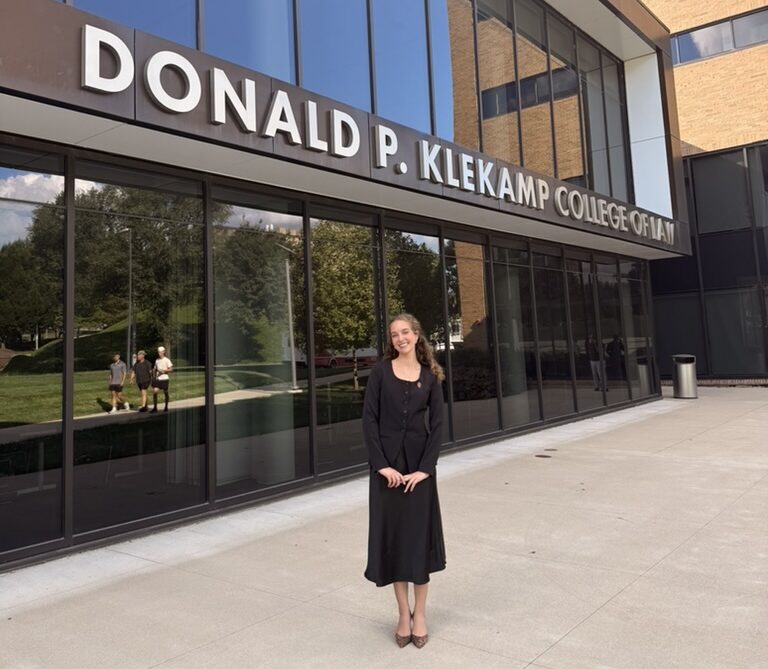
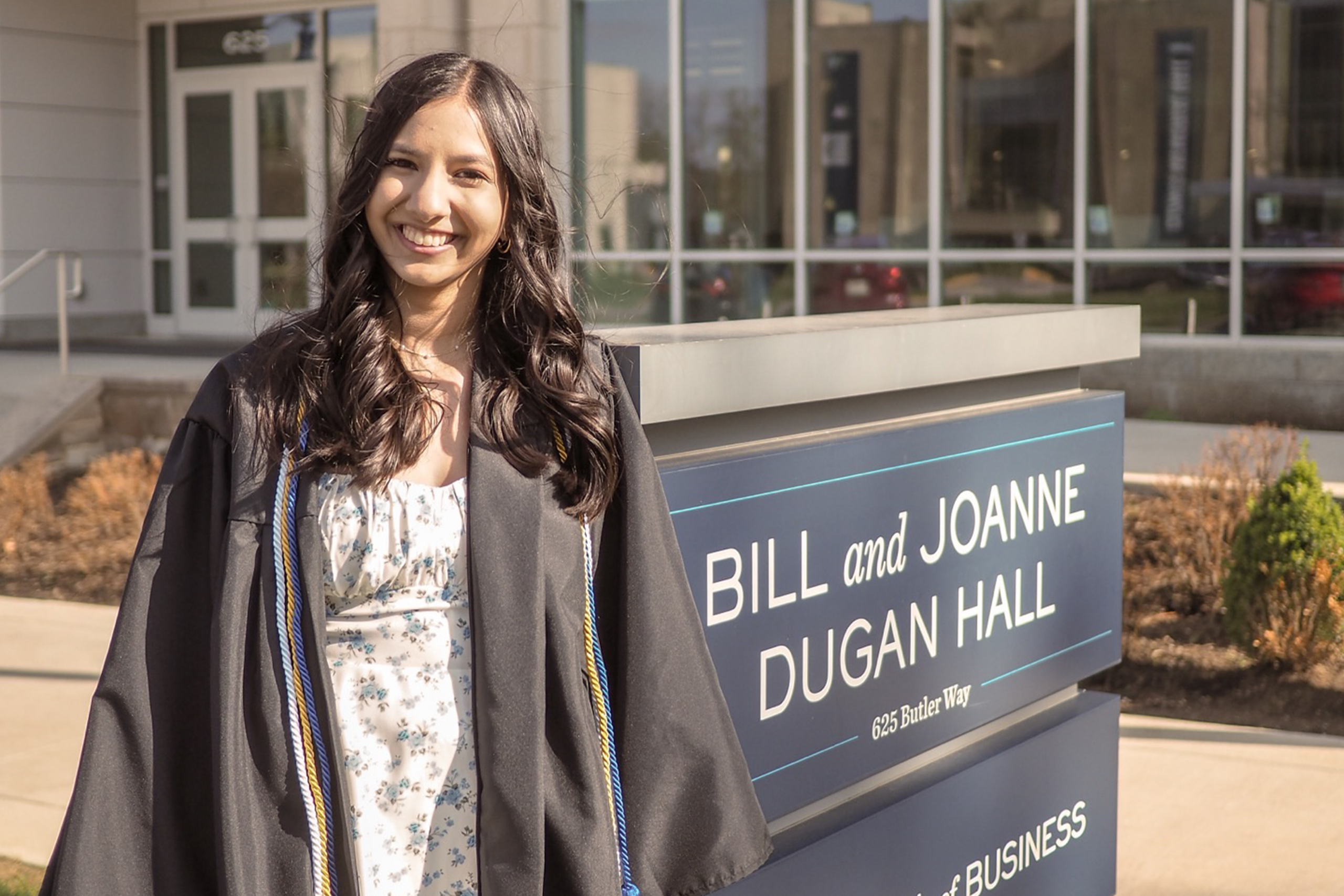
    For some, the path from student-athlete finance major to Juris Doctor to law firm partner may not seem obvious. But for Christina Fugate ’04, the connection between her education and legal career was always there. Now, a few decades into her career, she continues to give back to the Lacy School of Business while serving as partner at Ice Miller.
    “I grew up in a small town in Wisconsin, and when I was being recruited for tennis, I knew I wanted to be in the city, and Indianapolis was the perfect fit for something bigger than where I grew up,” Christina says. 

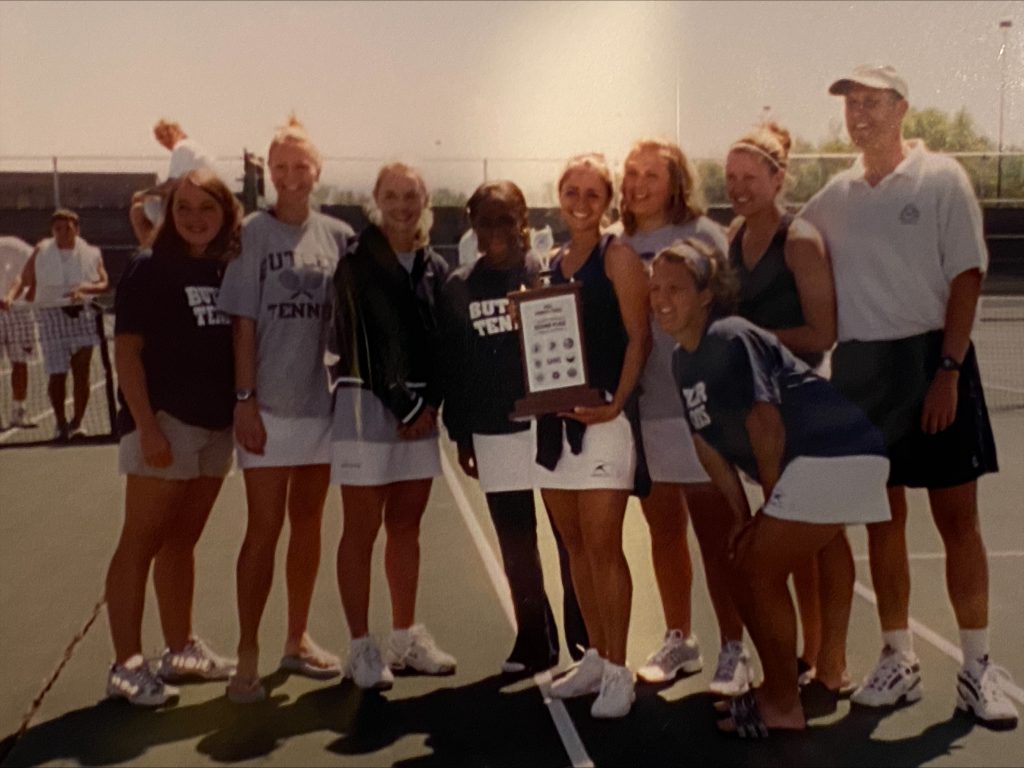
    Christina with by her tennis teammates.

    When she wasn’t rallying on the tennis courts, Christina was completing her undergraduate finance degree at the Lacy School of Business, subsequently interning at two separate law firms. 

    “What really was helpful is the hands-on experience education that you get at Lacy. It’s not just sitting in a lecture all day. You’re doing real life work in real life scenarios, which forces you out of your comfort zone,” Christina says. 

    After completing a role in which she assisted in preparing evidence for court cases, Christina knew she wanted to pursue a legal degree. She did just that, completing her Juris Doctor at the IU McKinney School of Law in 2007. 

    After graduating, Christina’s passion for law culminated into her starting position as a clerk for IceMiller. From this, Christina launched into franchise law, her area of expertise. Despite her practice, she acknowledges that her status at the firm means much more than just her title. 

    “I wear a lot of different hats at the firm. I lead our franchise and distribution practice at the firm, whether it’s helping companies become franchised or avoid being franchised. I also am involved with commercial litigation, representing our large clients,” Christina mentions. 

    Apart from her technical aspects of her position, Christina also wears the “mentor hat” for upcoming members in her firm. She understands the importance of having a pipeline of well-trained, young lawyers for the firm, and aims to foster growth among them.

    Her contributions to young professionals do not stop at her firm. Outside of her practice, Christina can be found reinvesting her resources and knowledge back into the Lacy School of Business as the Chair of the Dean’s Advisory Council. Here, she and other business professionals, in both the Lacy School of Business and the greater Indianapolis area, work to develop ideas that will elevate LSB’s offerings to enhance the current student experience. 

    “We are the eyes and the ears of the community, and it’s on us to help develop Lacy around such values.” 

    Her reasoning to give back? It has to do with the foundation that Lacy has made in Indianapolis. 

    “Butler is an important institution in the Indianapolis community. It’s been around for a really long time, and has helped shape the city. We’ve got a great alumni base in all different industries, and I think it’s important to continue to be involved,” she says. 

    Through her career, Christina has accumulated numerous titles, awards, and accolades, including IBJ’s 40 under 40, a certified Legal Eagle, and a Super Lawyer, among many others. 

    When asked what these awards were a result of, Christina’s insights surpassed superlatives. 

    “While these accolades are flattering, I have never really thought about them. I simply think about what I’m doing at the moment. I’ve always worked hard, for my family, for my clients, and it has all been enjoyable, just being in the moment.”

    Christina’s advice to others who seek success? Be adaptable, be in the moment, have what she calls at her firm an “entrepreneurial spirit,” and most importantly, enjoy what you do. 

    “I think you’re off track in life when you wake up, unhappy with what you have to do for work, with your circumstances. It’s important to reflect on what makes you happy. Reflect on where you’ve been, and think about what your goals are and what you want to do in the future, and use your support system to help you get back to where you want to be,” she offers.

    Outside of her practice, Christina maintains an active lifestyle, and is still an avid tennis player. She cites exercise as a key hobby in her day-to-day life, alongside being a self-descript “Uber Driver” for her two children. Christina’s love for driving doesn’t just stop at carpooling to school. Growing up, she fostered a love for motorsports and racing through her father and grandfather, and currently serves on the Board of Directors for Road America, a motorsports circuit in Wisconsin, which hosts various races, including the locally based IndyCar series. 

    “We have a unique board, being that it has 3 women on it. It’s very unusual for the motorsports field, and it is something that I’m very proud of,” she mentions. 

    It’s clear that the Indy-Wisconsin connection is strong for Christina, showcasing her love for her origins as well as where she’s decided to plant her roots. 

    Beginning at and shaped by Lacy, through law school, and now as an established professional, Christina continues to prove that success is in store for those who work hard, regardless of how the path may look. 

  • Designed for the CPA and Beyond: Kitty Reddy ’25 on Her MPAcc Experience

    Designed for the CPA and Beyond: Kitty Reddy ’25 on Her MPAcc Experience

    For Kitty Reddy ’25, accounting isn’t just about numbers – it’s about purpose.

    When Kitty arrived at the Lacy School of Business from Peoria, Illinois, she wasn’t simply searching for a degree. She was looking for a place that would prepare her for the rigor of the CPA exams while helping her build a career aligned with the kind of impact she wanted to have. She found that foundation – and more – in Lacy’s Master of Professional Accounting (MPAcc) program.

    “I knew I wanted to be fully prepared for the CPA exams,” Kitty says. “And this program really focuses on understanding, not just memorizing.”

    That distinction matters. Designed intentionally around CPA exam content and outcomes, the MPAcc program doesn’t just help students pass exams; it helps them think like professionals. With a 100% placement rate, the program equips students with technical expertise, confidence, and momentum to move seamlessly into meaningful careers.

    Kitty’s journey toward accounting began as an undergraduate at LSB, where she enrolled in 2021 and quickly discovered both a passion for the field and a community that supported her growth. Immersed in a curriculum that challenged her to think critically and apply concepts in real-world ways, she built a strong academic foundation while engaging deeply on campus as a member of Pi Beta Phi, Alpha Kappa Psi, and the Lacy Business Scholars program.

    As graduation approached in May 2025, Kitty reflected on the environment that had shaped her so profoundly. Rather than looking elsewhere for graduate school, she made the decision to continue her education at Butler, beginning the MPAcc program in August 2025.

    “It felt like the natural next step,” she shares. “I already knew the faculty, the expectations, and the culture. I wanted to keep learning in a place where I felt both supported and challenged.”

    But Kitty’s professional direction was shaped by more than coursework alone. After witnessing her father undergo multiple surgeries and losing a cousin to leukemia, she felt a strong pull toward the healthcare field – not as a provider, but as someone who could make a difference behind the scenes.

    “I knew I wasn’t meant to be on the clinical side,” she says. “But I still wanted to make a difference in that space.”

    That realization led her to pair accounting with a minor in healthcare management, combining analytical skills with compassion and purpose. Her goal became clear: to work in healthcare accounting, supporting hospitals and healthcare systems through thoughtful tax planning and financial strategy.

    “I want to contribute in a way that still impacts people’s lives,” she says.

    At the Lacy School of Business, Kitty found more than academic preparation, she found a community invested in her success. Small class sizes allowed faculty to truly know her as a learner, offering mentorship that went beyond the classroom and helping her refine her goals with clarity and confidence.

    “The people here want you to succeed,” Kitty says. “You’re not just another student; you’re someone they’re investing in.”

    That environment has shaped not only her technical abilities, but her belief in herself.

    “Looking back, I’ve grown so much,” she reflects. “Not just in what I know, but in how I approach challenges and think about my future.”

    Through internships and Butler’s Meet the Firms career fair, Kitty explored a range of possibilities within accounting – from healthcare-focused firms to public tax – gaining firsthand exposure to different paths within the profession. Those experiences culminated in securing a full-time position as a Tax Associate at Crowe, where she will begin her career after completing her graduate studies and CPA exams.

    Even now, as she balances MPAcc coursework, a part-time role with Butler’s Advancement Center, and studying for the CPA exams, Kitty is seeing the value of her education in real time.

    “As I’ve started studying, I’ve realized how much of the material we’ve already covered,” she says. “I feel more prepared than I would have otherwise.”

    That preparation is intentional, and at the heart of the MPAcc program. By emphasizing understanding over memorization and application over theory alone, the curriculum prepares students not just for exams, but for long-term success in the profession.

    Some moments along that journey, however, extend beyond academics.

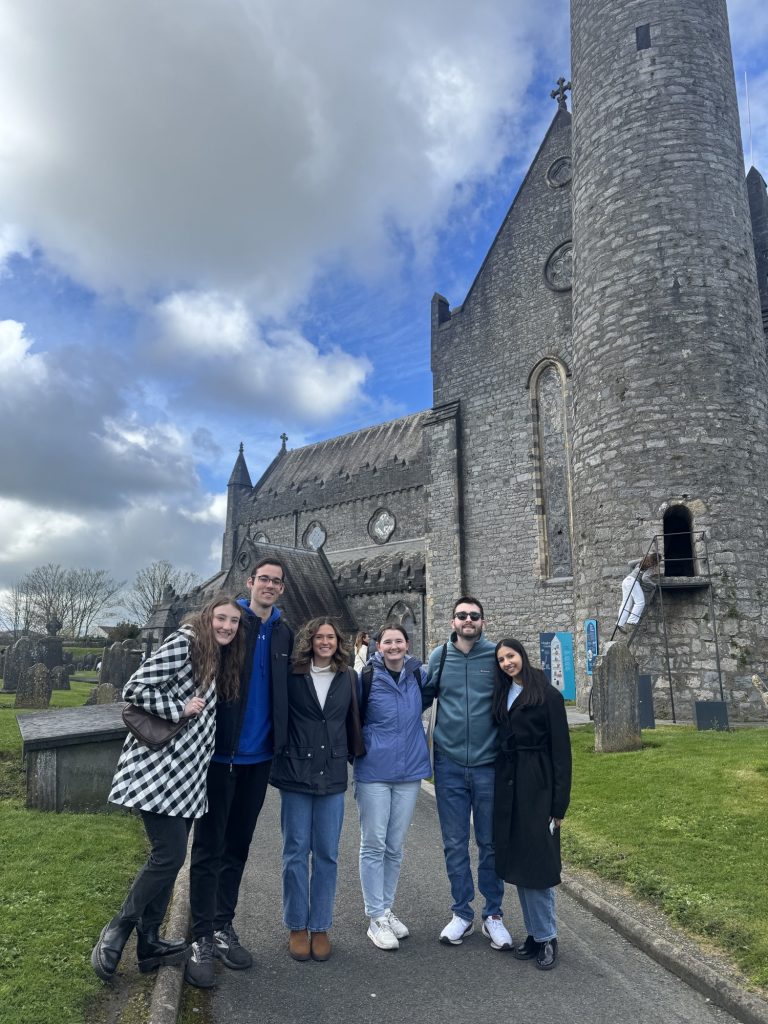
    During a study abroad experience in Ireland, where Kitty and her classmates examined international tax systems and global business practices, she experienced a personal milestone that made the experience even more meaningful: she got engaged. Her fiancé, John Cunningham, is also a graduate student at Lacy, underscoring just how deeply connected the community becomes.

    “What made it so special was being able to share that moment in a place that was already such a big part of my growth,” Kitty says. “It felt like everything came full circle.”

    The experience expanded her perspective on global accounting and international career possibilities, while also strengthening the relationships that define the Lacy experience – with classmates, faculty, and her future.

    “At Lacy, you grow academically, professionally, and personally,” she says. “That experience showed me all of that at once.”

    At its core, Kitty’s story is one of intention. She’s not simply earning a master’s degree – she’s building a career that reflects who she is, what she’s experienced, and the impact she hopes to make.

    Her advice for students considering the MPAcc program?

    “Take advantage of every opportunity,” she says. “There are so many paths in accounting. The more you explore, the more confident you’ll feel in where you’re going.”

  • Building the Future of Small Business Ownership: Entrepreneurship Through Acquisition Conference

    Building the Future of Small Business Ownership: Entrepreneurship Through Acquisition Conference

    On Tuesday, March 10, the Lacy School of Business hosted the inaugural Indiana Entrepreneurship Through Acquisition (ETA) Indy Conference, drawing over 350 entrepreneurs, operators, investors, advisors, lenders, and community partners from across Indiana and the broader Midwest.

    With 40 speakers and two tracks of programming running from morning through evening, the event marked a milestone for a region full of legacy businesses, founders nearing retirement, and a rising generation eager to step into ownership.

    From the moment attendees arrived, the energy made one thing clear: Indiana is ready to invest in the future of these businesses.

    Before the first session even began, conversations flowed easily – first time searchers exploring their next step, small business owners thinking about transition, and operators reflecting on what it really takes to run a company after close.

    The opening keynote by Chelsea Wood of the Acquisition Lab tapped into that shared sense of purpose, emphasizing ETA’s role in preserving the small businesses that anchor communities – businesses that sustain jobs, support families, and form the backbone of local economies. Across Indiana alone, thousands of owners are approaching retirement without succession plans. ETA, as the keynote highlighted, isn’t just about buying companies; it’s about stewarding something worth preserving.

    “In Indiana alone, tens of thousands of baby-boomer–owned businesses will change hands in the next decade – many of them in just the next five years. What’s alarming isn’t the volume, but the lack of preparation. Fewer than half of owners have a written succession plan, and nearly half of transitions happen unexpectedly due to health, family, economic stress, or sudden life events,” Nick Smarrelli, director of entrepreneurship, said. “If we don’t build a stronger ETA community now – one that learns together, shares best practices, and connects capital, operators, and students – we risk losing businesses, jobs, and the local legacies that define our communities. The Lacy School of Business has both the responsibility and the platform to help unify this work across the state – not for Butler’s benefit alone, but in the best interest of Indiana’s people, employers, and future.”

    Throughout the day, panels, interviews, and hands-on presentations gave attendees a grounded look at the realities of the acquisition journey. Sessions explored how to build a thoughtful buy box, how governments and communities are supporting local ownership transitions, and how buyers can evaluate businesses beyond surface-level financials. Technical discussions on valuation and diligence helped attendees understand the difference between reported numbers and true cash flow, while other panels broke down what it takes to move a deal from handshake to a bankable, legally sound close.

    Financing emerged as a defining theme – SBA lenders, debt partners, and advisors offered candid insight into assembling a capital stack for a first acquisition and what makes a searcher stand out as credible. Operators also spoke openly about the emotional realities of ETA, from the uncertainty of the search process to the responsibility of leading a team on day one. Many attendees noted how refreshing it was to hear honest accounts of the first 100 days, culture-building, and the long-term professionalization that comes after closing.

    Between sessions, campus buzzed with conversations about deals being evaluated, industries of interest, and opportunities for collaboration. Students asked operators what life looks like after buying a business; advisors shared guidance; lenders made introductions; and owners told the stories behind the companies they built. Those moments – spontaneous, unplanned, and full of possibility – became the heartbeat of the day.

    As the final reception wound down and attendees left with full notebooks and new connections, one thing was unmistakable: the conversations begun at ETA Indy will continue – through searches launched, deals explored, and businesses passed thoughtfully to the next generation of leaders. The inaugural conference laid the foundation for a growing community rooted in stewardship, opportunity, and a shared commitment to strengthening the region’s small business ecosystem.

  • Building Indiana’s Next Generation of Innovators: First Collegiate Entrepreneurs Summit

    Building Indiana’s Next Generation of Innovators: First Collegiate Entrepreneurs Summit

    On Friday, February 27, more than 250 students from 17 universities arrived at the 16 Tech Innovation District in Indianapolis for the inaugural Collegiate Entrepreneurs Summit, a statewide gathering created to bring student innovators together, spark new collaborations, and strengthen Indiana’s entrepreneurial network.

    The summit was more than an event – it was the result of a multi-organization planning committee led by Butler University’s Lacy School of Business, 16 Tech, CICP, and INtercollegiate Entrepreneurs. For months, these four groups worked together to design a student-centered experience that could bring Indiana’s entrepreneurial community closer and create a truly statewide ecosystem.

    What began as a simple idea among a small group of campus leaders grew into one of the largest student entrepreneurship events the state has hosted, marking a significant milestone for both Indiana’s innovation community and for LSB, which served as a co‑host, challenge partner, and event sponsor.

    Throughout the day, The AMP at 16 Tech transformed into a hub of activity as students participated in workshops, founder conversations, peer discussions, and hands on sessions that explored the many pathways available to those interested in building, creating, or problem solving.

    “It was one of the few spaces where everyone shared the same drive to build something new,” said Preston Asher, a finance and entrepreneurship & innovation double major. “You could walk up to any table and immediately start talking ideas.”

    A central component of the day was the Anchor & Accelerate Innovation Challenge. More than 40 intercollegiate teams formed quickly to analyze a structured business problem, develop a market-ready concept, and present their ideas under tight deadlines. The challenge emphasized creative problem solving over polished prototypes, encouraging students to focus on clarity, feasibility, and real world application.

    LSB delivered a standout showing. Eight Butler teams participated in the challenge, and LSB students secured both first and second place overall – a major accomplishment given the number of competing institutions. First place was awarded to Jenna Burd and Lily Laffond, whose concept impressed judges for its innovation and practical potential. Second place went to Trevor Storm and Preston Asher, offering Butler a clean sweep of the top two positions and reinforcing the strength of LSB’s experiential learning approach.

    “The challenge pushed us to think fast, communicate clearly, and trust our instincts,” Preston said. “Everything we’ve learned at LSB showed up in those moments, and it felt like we were genuinely prepared.”

    Lily described the challenge as eye opening, especially around the problem her team tackled. “Our team was tasked with solving the problem of lost tribal knowledge and workforce productivity within the manufacturing sector,” she said. “We created LeanLens, an AI software tool built into industrial grade goggles. Before this, I had no idea that manufacturing makes up 27% of Indiana’s GDP. Given how archaic many systems still are, the industry is well suited for AI disruption.”

    Beyond the competition, the summit offered a rare opportunity for students to connect across campuses in a way that had never existed before. For Lily, these conversations became a highlight of the entire day. “I left the conference feeling energized with ideas,” she said. “Talking to students all over the Hoosier state about what they’re building was inspiring. The best part of a network like this is the shared commitment to helping one another succeed.”

    She also noted a clear difference in how Butler students showed up: “Given that out of 40+ teams, the top two were from Butler – that’s a testament to the program. One key distinction I noticed was the strong emphasis Butler students place on soft skills and relationship building. Rather than simply presenting financials and metrics, they prioritize building genuine rapport and connecting meaningfully with judges.”

    Leadership from INtercollegiate Entrepreneurs – the student run organization that helped spearhead the event – echoed this sentiment, emphasizing the importance of building statewide community rather than isolated campus level efforts. With students attending from Indiana, Illinois, and Virginia, the summit highlighted just how quickly this network is expanding and how crucial collaboration will be in supporting student founders in the years ahead.

    “I’ve been watching Butler’s presence in the ecosystem grow – the building of partnerships, the credibility compounding – and the summit was the moment all of it became visible at once,” Iman Noor D. Braham, an MBA candidate concentrating in finance and entrepreneurship & innovation, said.

    “Meeting students from other universities was eye opening,” Preston added. “It helped me see how strong Butler’s entrepreneurship culture really is. People kept saying they could tell we were well supported and well prepared.”

    Students left the summit carrying new ideas, new relationships, and a stronger sense of what entrepreneurship can look like in any field, whether launching a startup or driving innovation within an existing organization. “I walked away with a better understanding of entrepreneurial storytelling,” Lily said. “Venture capitalists invest in businesses, but they also invest in founders. Being able to articulate my purpose, positioning, and vision is a key differentiator.”

    The inaugural Collegiate Entrepreneurs Summit represented the beginning of something larger: a shared effort to empower student founders, elevate Indiana’s entrepreneurial ecosystem, and build a statewide community grounded in collaboration rather than competition.

    For Iman, the summit confirmed a broader shift already underway in Indiana. “Indiana is at a genuinely exciting moment,” she shared. “I’ve seen what emerging ecosystems look like in different markets, and this feels like the window where the people showing up now will shape what it becomes.”

    “I walked away with more confidence – not just in my ideas, but in the direction Indiana’s innovation ecosystem is heading,” Preston said. “It feels like there’s real momentum, and Butler is right in the middle of it.”

  • A Day That Changes How Students See Their Future: Inside the Lacy Business Scholars Experience

    A Day That Changes How Students See Their Future: Inside the Lacy Business Scholars Experience

    The Lacy School of Business prides itself on creating moments where students can see their potential more clearly than ever before. Each year, the Lacy Business Scholars Program becomes one of those moments – a day when high‑achieving prospective students step onto campus and, often for the first time, begin to picture what their future could look like here.

    There’s a noticeable shift in the air when Scholars arrive. Some walk in with quiet confidence; others carry the kind of nervous excitement that comes with being recognized for something big. But quickly, a sense of connection forms – students realizing they’re surrounded by peers who worked just as hard to earn this recognition, families recognizing that they’re entering a community that sees their student’s potential.

    What begins as a campus visit soon becomes something far more meaningful.

    Throughout the day, the high school seniors meet the people who make the Lacy School of Business what it is: the faculty who challenge students to think globally and lead ethically; the current students who talk candidly about their experiences; and the alumni who return to share how their time at LSB propelled them to where they are now.

    The stories are different, but the themes are consistent. Hands-on learning that starts from day one. Opportunities to work with real companies on real challenges. Global programs that broaden perspectives and spark new ambitions. A community that encourages curiosity, resilience, and confidence.

    Hearing about the First‑Year Business Experience or Real Business Experience is one thing. Seeing how those programs shape students – how they strengthen their voice, sharpen their judgment, and build their professional identity – is something else entirely.

    And it’s often in those conversations that Scholars begin to lean in a little more. To imagine themselves presenting a business solution, managing an investment fund, or leading a project team. To recognize that this is a place where their ideas won’t just be heard – they’ll be expected.

    Parents and families often find their own meaningful moments during the day. In conversations with alumni and school leadership, they hear honest reflections about what makes the LSB experience transformative: the mentorship, the rigor, the support, and the confidence that emerges when students are trusted with real responsibility.

    These conversations provide something essential: reassurance. A sense that the opportunities talked about aren’t hypothetical; they’re happening every day for students who were once sitting exactly where these Scholars sit now.

    As the day comes to a close, another important realization sets in: this is only the beginning. Many Scholars will soon take part in their virtual scholarship interviews, a meaningful next step in the process that allows them to showcase who they are and what they hope to contribute. It’s more than an interview – it’s an opportunity to articulate their goals, their curiosity, and the drive that brought them here in the first place. For many, preparing for these interviews becomes the moment they realize how much they already have to offer.

    By the end of the day, something subtle but important happens. Students who arrived curious leave with clarity. They understand not just what the Lacy School of Business offers, but what it can help them become. The upcoming interviews feel less like an evaluation and more like a conversation they’re ready for – an extension of the confidence and direction they’ve gained throughout the day.

    Above all, they leave with a feeling LSB hope’s every student finds here: the sense that they are capable, supported, and ready for whatever comes next.

    At the Lacy School of Business, that’s what the Scholars Program is all about. Not just showcasing programs and opportunities, but welcoming students into a community that believes deeply in their potential – and is invested in seeing them thrive.

  • Preparing the Next Generation of Supply Chain Leaders — One Forklift at a Time

    Preparing the Next Generation of Supply Chain Leaders — One Forklift at a Time

    Inside a bustling 30,000-square-foot warehouse in Plainfield, Indiana, Lacy School of Business students aren’t just studying logistics – they’re living it. Through a new agreement with the Vincennes University Logistics Training and Education Center (VU LTEC), students in LSB’s supply chain and operations program are gaining hands-on experience in a modern, fully functioning distribution center with the Butler Experiential Logistics Lab.

    The facility features everything you’d expect in a professional logistics environment: storage systems, racking, safety equipment, forklifts, power jacks, pick-to-light order fulfillment, truck loading docks, and even industrial robots and cobots (collaborative robots). It’s an immersive space where students can move beyond theory to truly understand how products flow from supplier to customer. 

    “Professor Siegler and I began working with the VU LTEC team in 2019,” Matthew Caito, a Lecturer in Operations Management, said. “Since that time, we’ve visited their facilities with a few students a couple of times each year, and we’ve noted that students almost always leave excited and with a better understanding of operations and supply chains.” 

    This collaboration between Butler and VU LTEC was designed to bridge the gap between classroom concepts and real-world logistics. By stepping into the warehouse, students learn to apply what they’ve studied – inventory control, process optimization, warehouse safety, and supply chain technology – in a tangible, fast-paced setting. 

    For LSB, it’s another step in its commitment to experiential education – ensuring students graduate not only with knowledge but with the confidence to use it. 

    “It is important for us as faculty to really connect our students with the reality of industry beyond what we read in textbooks and discuss in class,” Professor Caito said. “This program really brings to life the very concepts we discuss in class: the importance of safety, materials-handling equipment, work optimization, learning curves, and storage/retrieval systems. And show me a student who doesn’t want to share a picture of themselves driving a new forklift!” 

    During their sessions at VU LTEC, students participate in a variety of simulations that reflect the complexity and collaboration of real-world logistics. They might manage an incoming shipment, fulfill orders using pick-to-light technology, or optimize warehouse layout for efficiency and safety. 

    Some exercises even include a competitive element – challenging students to meet accuracy goals, complete orders faster, or troubleshoot process errors as they go. Afterward, faculty debrief sessions help students reflect on what worked, what didn’t, and how they’d improve next time. 

    “Our new program is designed to reinforce what we learn in the classroom and give students a greater sense of confidence when discussing what they’re learning,” he said. “Calculating the return on investment for automation, walking through a working distribution center, loading pallets into racks, and seeing trailers secured for loading show students what it takes to design and operate a facility safely and effectively. We’re also working to develop the soft skills these students will need to be impactful leaders in the decades to come.” 

    The new collaboration with VU LTEC is more than just a learning experience – it’s a steppingstone toward career readiness. Students leave the warehouse with a deeper understanding of supply chain operations and the confidence to enter internships and jobs where they can make an immediate impact. 

    “I really enjoyed the experience. It provided me with a lot of insight into warehouse management and put our class discussions into perspective,” Mindy Smith, an Economics and Supply Chain major, said. “I was eager to try the equipment and pick-to-light system. My favorite part of the experience was the opportunity to operate the forklift. Overall, I felt like this lab was impactful and applicable to my ambitions as a supply chain major.” 

    “It was definitely one of the coolest out-of-the-classroom experiences I’ve had at Butler so far,” Will Zander, a senior Finance and Entrepreneurship major, added.

    With logistics and supply chain management among the fastest-growing career fields in Indiana and across the country, this kind of hands-on training gives LSB students a competitive advantage. They’re not only prepared to join the workforce – they’re ready to lead it. 

  • Experiential Learning Opportunities – Go Beyond the Classroom

    Experiential Learning Opportunities – Go Beyond the Classroom

    At the Lacy School of Business, the Supply Chain Department is excited to offer a lineup of experiential learning opportunities open to all Butler students, faculty, and staff. These hands-on experiences give you a chance to see supply chains, manufacturing, and logistics in action at some of Indiana’s leading organizations.

    All visits are optional and open to the Butler community. For students currently enrolled in courses with Professors Jane Siegler, Matthew Caito, or Joe Cripe, attending one or more visits and submitting a one-page reflection may allow you to replace a grade on a quiz or discussion board.

    Explore the opportunities below and see what’s happening beyond the classroom!

    Butler Experiential Logistics Lab (BELL) Tour
    RSVP below – spots are limited!

    About:
    Butler has partnered with the Vincennes University Logistics Training and Education Center (VULTEC), a modern Supply Chain Lab and functioning distribution center spanning ~30,000 sq. ft. in Plainfield. Students get hands-on experience with modern storage systems, racking, safety equipment, forklifts, power jacks (students can operate them), pick-to-light order fulfillment, truck loading docks, and industrial robotics.

    When: Dates and times vary.
    Where: 1610 Reeves Rd, Plainfield, IN 46168
    Drive time from Butler: ~40 minutes (carpooling may be available – indicate on RSVP)
    Cost: FREE – limited availability, first come first serve.
    In order for registration to be complete, you MUST also complete this required form.

    Allegion’s 2025 Manufacturing Day

    Thursday, October 2 from 9:00 AM – 12:30 PM
    Status: Full – registration closed

    About:
    Allegion is a global manufacturer of security products and solutions. Students will explore diverse career paths in engineering, IT, robotics, design, R&D, and production. This tour showcases how technology and innovation drive manufacturing growth and highlights opportunities for the next generation of professionals.

    Where: 2720 Tobey Drive, Indianapolis, IN 46219
    Drive time from Butler: ~20 minutes (carpooling may be available – indicate on RSVP)
    Cost: FREE – limited availability, first come first serve.
    Registration is now closed.

    Amazon Fulfillment Center Tour

    Monday, October 6 from 3:00 PM – 5:30 PM (arrive no later than 2:45 PM)

    About:
    Tour one of Amazon’s largest fulfillment centers in Indiana and witness the supply chain in action. Students will learn how Amazon uses robotics, automation, and real-time data to move products through storage, picking, packing, and shipping. This visit highlights the scale and speed of operations, as well as career paths that support Amazon’s global network.

    Where: 4255 Anson Boulevard, Whitestown, IN 46075
    Drive time from Butler: ~35 minutes (carpooling may be available – indicate on RSVP)
    Cost: FREE – limited availability, first come first serve.

    Adidas Indy Site Visit

    Tuesday, October 7 from 2:45 PM – 5:00 PM
    Status: Full – registration closed

    About:
    Meet directors overseeing Manufacturing and Distribution, as well as department heads at Adidas Indy. Students will see one of Indianapolis’ largest manufacturing employers in action with screen printing, embroidery, and heat transfer for garments and uniforms for U.S. professional and NCAA teams. This site uses a work center layout designed for speed to market, so many supply chain concepts from class will be visible in real time.

    Where: 8677 Impact Ct, Indianapolis, IN 46219
    Drive time from Butler: ~25 minutes (carpooling may be available – indicate on RSVP)
    Cost: FREE – limited availability, first come first serve.
    Registration is now closed.

    Heartland Foods Manufacturing Site Visit (Graduate Students Only)

    Friday, October 10 from 8:00 AM – 9:30 AM

    About:
    Heartland Foods is a major food manufacturer in Indianapolis. Students will tour the production floor and see high-speed manufacturing lines in action, gaining insight into the processes, technologies, and safety standards that keep food production efficient and reliable. Important: All attendees must wear closed-toe shoes; no jewelry is allowed for safety reasons.

    Where: 4929 W 86th Street, Indianapolis, IN 46268
    Drive time from Butler: ~20 minutes (carpooling may be available – indicate on RSVP)
    Cost: FREE – limited availability, first come first serve.