Blog

  • Paid internship in DC for minority students in STEM fields

    Below is an e-mail snippet about a paid internship opportunity in Science Policy this summer in Washington D.C.  To qualify you must be a member of a group “underrepresented in (science, technology engineering and mathematics (STEM) disciplines” and you must be a STEM major.  STS itself is not obviously a STEM major, but if you have a second major in something like engineering, biology or chemistry, you would be perfect to apply, and it may be that an STS major with appropriate STEM background would be considered.  If you are interested in this opportunity, we can try to confirm whether you meet the requirements to send in an application.  Here’s the e-mail:

    ———————————————-

    From Shirley McBay, President of QEM Network

    This is an early alert regarding a Science Policy-focused Summer Internship Program (SSIP) conducted by the Quality Education for Minorities (QEM) Network with support from the National Science Foundation (NSF).  Attached you will find an application packet we would like you to share with your graduate and undergraduate students from groups underrepresented in science, technology, engineering, and mathematics (STEM), particularly, but not limited to, students interested in pursuing careers in science policy or science education. Also, you will find attached a flyer describing this summer internship opportunity. We ask that you download and post the flyer on your departmental bulletin board to further ensure that students are aware of these opportunities.

    The ten-week, Washington, DC-based internship (May 27–August 1, 2014) is made possible through a grant to the QEM  Network from NSF. Students who successfully complete the internship will receive a taxable stipend, $3,000 for undergraduates and $4,000 for graduate students, paid in three installments over the course of the summer. The students also will receive housing at George Washington University with other QEM interns as well as round-trip airfare and ground travel reimbursement.

    During the internship, students will have an opportunity to: (1) increase their understanding of how science policy is made; (2) further develop their potential for becoming leaders and proponents of increased participation in science and engineering by students from underrepresented minority groups; (3) become knowledgeable about potential/actual barriers preventing minority students from receiving a high quality mathematics/science education; and (4) become familiar with policies, programs, and strategies being implemented to address such issues. The students also will strengthen their research, communications, and other professional skills, and develop a peer network that includes QEM summer interns from across the country.

    A student who wishes to participate in the internship must currently be a STEM major at an accredited institution and have successfully completed at least the sophomore year before the start of the internship program. An applicant also must be returning to a degree-granting institution the following academic year, either at the undergraduate or graduate level. Graduating seniors must be already admitted to and planning to enter graduate school in Fall 2014 to be eligible.

    Please distribute the application packet to eligible students and feel free to duplicate as needed. The application deadline is Friday, February 14, 2014; however, applications can be submitted prior to the deadline. On-line copies of the application are available for download at http://www.qem.org/internship.htm#NSF <http://www.qem.org/internship.htm#NSF> .

    The internship is a wonderful educational opportunity and we would greatly appreciate your encouraging students to apply who could benefit from this experience.


    QEM NSF Internship Flyer

  • Course Search can now be trusted!

    You can now look up STS courses on Course Search.  When you get there:

    • Select the browse tab
    • Select “College of Liberal Arts and Sciences” or “Interdisciplinary Studies” in the first drop-down
    • Select “Science, Technology and Society” in the second drop-down
    • Select Spring 2014

    This should match the information on the one page handout I posted earlier, but it will give you up-to-date information on enrollments, so you can see if a class is filling up.

    You still can’t trust your degree audit, but we’ll get that fixed soon.


  • The Indianapolis Community Requirement (ICR)

    Butler’s new core includes the Indianapolis Community Requirement, which requires you to take a course that meets certain requirements for active engagement in the community.  You may well have already taken one.  Please check your degree requirements to see where you stand.  If you haven’t, you need this to graduate, so juniors (and especially seniors!!!) should look to take an ICR course.  Click here for Courses offered Spring 2014 that satisfy the Indianapolis Community Requirement


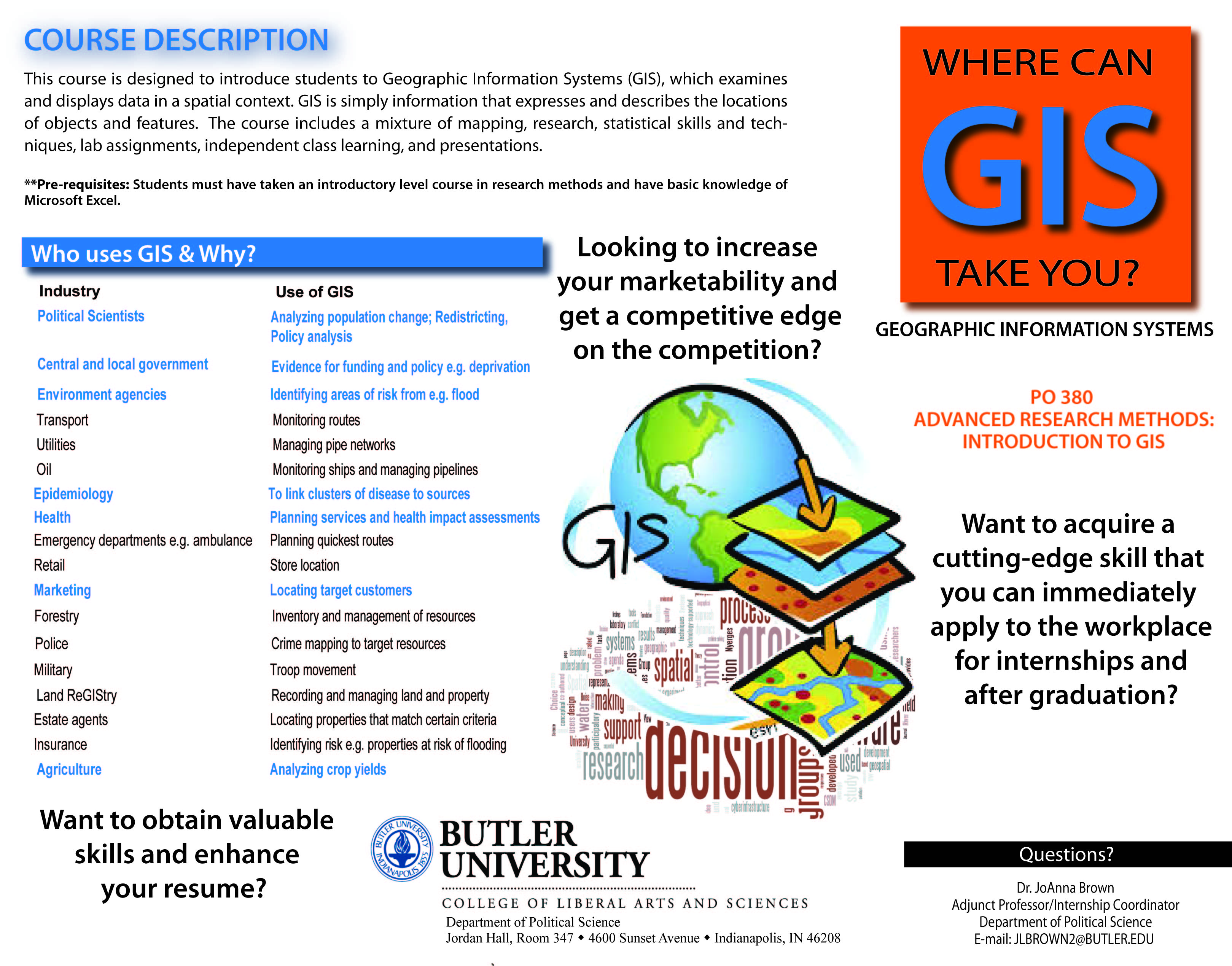
  • Geographic Information Systems (GIS) course

    PageLines- Butler-Logo.pngPageLines- ButlerLogo.jpg The following course taught this spring in the political science is an interesting opportunity for STS majorsPO 380 Advanced Research Methods Course Flier_print

  • And here are the STS courses for Spring 2014

    At this link you will find STS courses Spring 2014, both core course and electives.   You should use this list for your planning.  (Course search currently lists some STS courses incorrectly; I will let you know when I’ve got that fixed.)

    As you plan your schedule, here are some things to keep in mind:

    • If you haven’t taken ST200, take it.
    • If you have taken ST200, consider taking ST320, which satisfies the STS core, and also can count as an elective if you have already taken ST330.  If you are a junior or senior, you can take both concurrently.
    • Natural world courses: We have slightly changed our rules regarding NW courses in STS.  You may count one course toward your 15 hours of the STS science requirement.  Additionally, you may take selected NW courses to count as STS electives (though you cannot count a single course to both requirements).  The courses that can be used as NW electives are on the course list, and only a single NW course can count towards your elective requirement.
    • Prerequisites: Please note that a good number of our electives have pre-requisites in the disciplines where they are taught.  If you don’t have the pre-requisites and you are interested in the course, you can contact the instructor to see if they will waive the requirement.  If you see a set of courses that you are interested in that you might take in a future semester (say if you are interested in economics courses on health care or energy), you should consider taking the pre-requisites now so you can enroll in a later term.

    Please try to make one of the STS advising meetings.  We’ll have lots to talk about.

  • STS to add a new faculty member next Fall

    unknownWe are very pleased to announce that we will, for the first time, be hiring a full-time faculty member with a primary appointment in Science, Technology and Society.  A full-time faculty member will allow us to increase the regularity and variety of course offerings.

    The search for a new person is already underway.  We expect to bring candidates to campus in the spring, with our new hire teaching next fall.

    Thanks to all of our students, whose commitment to the STS program has made this possible! We will be asking you to participate in our search in the spring.

  • Sylvia Earle on Sustainable Seas Tuesday @ 7:30PM

    Come see National Geographic Explorer Sylvia Earle

    Sylvia Earle

    on the question for Sustainable Seas, Tuesday October 15 at 7:30 PM in the Reilly Room.  This event satisfies the BCR requirement as well as the STS co-curricular requirement.

  • Advising meetings for spring 2014 during week of October 21

    Advising officially arrives a week from today.  There will be a two-week advising period beginning Oct. 21.  Self Service registration begins two weeks after that, beginning Nov. 4.  To help you prepare for advising it is very important that you come to one of two advising meetings we’ll be holding next week.  The dates and times are as follows:

    Tuesday October 22: 12:15 – 1:00
    Thursday October 24, 5:15-6:00

    Both will be held in Jordan Hall 238.

    We will be providing Jimmy John’s — so you won’t go away hungry.  Mary will be following up with a request for you to RSVP, so we can get an accurate food count.

    Watch the Blog, as I’ve got quite a bit of advising information (including of course a class list)  to send your way in the next week.


  • Adventures in Interning ~ Taylor Brown


    Taylor Brown, Junior STS Major

                 To be honest, when I applied for the Operational Excellence Internship at GlaxoSmithKline, I did not really know what I was applying for. Nevertheless, I applied, interviewed, and received the position. I began working on May 20, 2013 and immediately started learning all about the company, my department, and what it means to be part of the workforce.  

                   During my summer at GSK, I worked closely with the manufacturing and packaging departments in the TUMS factory, which is located in St. Louis, MO, only thirty minutes from my house. I quickly learned that I would not be treated as an “innocent intern” and would be held to the same standards as the full-time employees. Because GSK must abide by FDA and OSHA guidelines, I had to complete many standard operating procedures, SOPS, and undergo extensive training on how to handle the product and wear the proper protective gowning.

                   During my time as an intern, I was able to utilize the technical writing skills I have learned during my Butler career. I authored two manuals that are currently being used a points of reference during site-wide training. I was also able to write a new SOP, which will be used in the manufacturing departments. I completed daily operations tasks, such as efficiency analysis, participating in safety meetings, and performing quality experiments in the site’s chemistry lab.

                   At the end of my internship, I left GSK with an awareness of what it means to be part of the workforce as well as a strong sense of accomplishment in the science-writing field. The experience also opened my eyes to the manufacturing world which I hope to be a more permanent part of in the future.

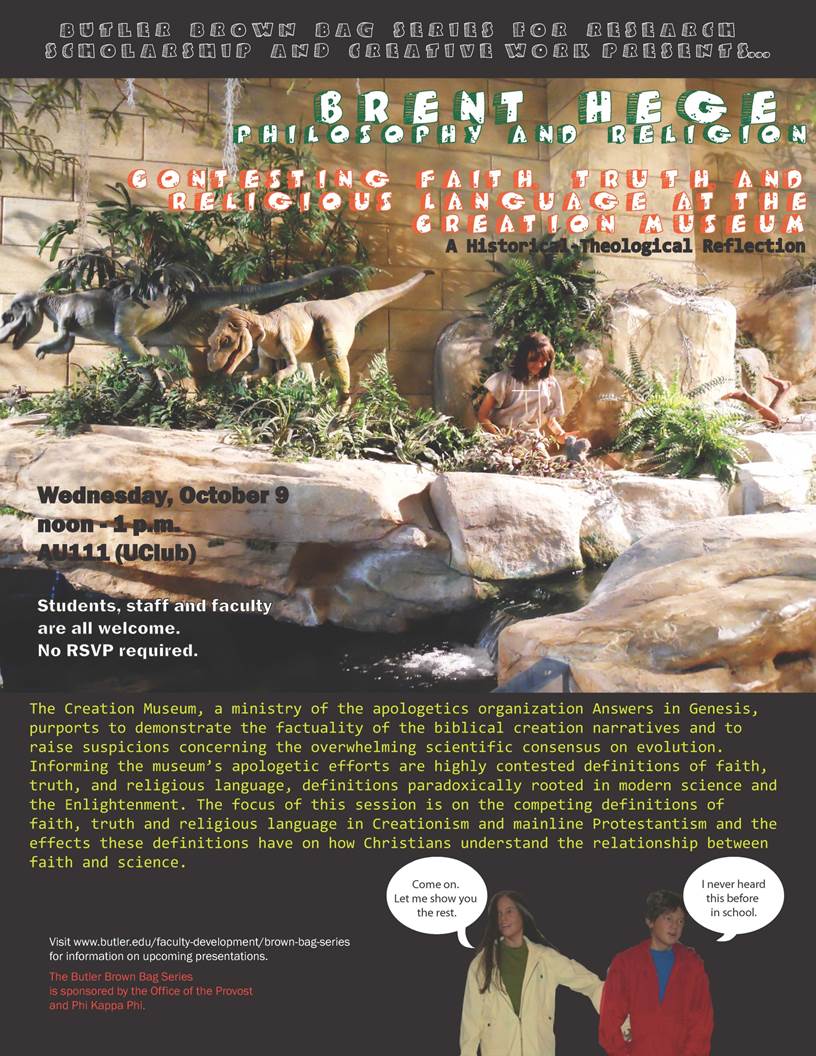
  • Brent Hege on Science and Faith at the Creation Museum

    Come to this great event, available for STS co-curricular credit.  12-1 in AU 111, Wednesday October 9
    heges