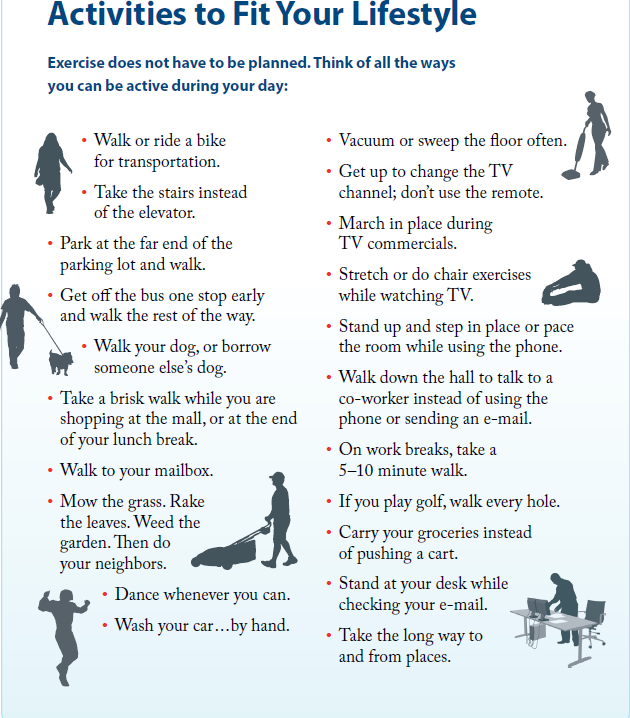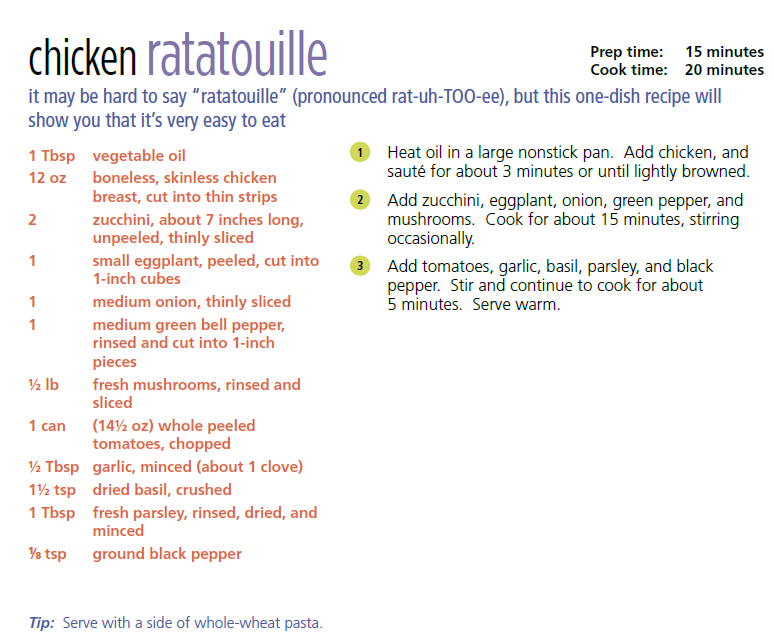

https://healthyeating.nhlbi.nih.gov/default.aspx?AspxAutoDetectCookieSupport=1


The most popular day to exercise is “tomorrow.”
To pump up your motivation, we know the classic tips: find a workout partner so you’re accountable, make your intentions known so you feel social pressure, set a deadline like running a 5K or your 20th reunion. Now, it’s not to say that these tips don’t work. They do. It’s just that we’ve heard them before.
So how about six tips you’ve never heard of? For all of us whose favorite curls are the cheese kind, here are six ways to get a running start.
Tip #1: Remember a good exercise experience.
A study found that you can use memory to enhance motivation. Study participants who described a positive exercise memory were not only more motivated to exercise, they actually exercised more over the next week than those who weren’t prompted to remember. So stash your medal from the 5K when you ran your personal record with your exercise clothes, pack your power walking playlist with songs from the wedding where you danced all night, or tape a picture of the view from the summit of your favorite hike next to your boots. The good memories may pave the way to a good sweat.
Tip #2: Don’t aim to “exercise;” instead, play a sport.
A 2005 study found that when participants were asked about reasons for playing a sport, they thought of intrinsic reasons, like enjoyment and challenge. Reasons to “exercise,” however, were extrinsic and focused on things like appearance, weight, and stress management.
Psychology 101 will tell you that intrinsic motivation makes you more likely to start and stick with a new habit. So sign up for softball, join the masters’ swim team, play ultimate Frisbee, or simply tweak your mindset: your Saturday afternoon bike ride suddenly becomes the sport of cycling.
Tip #3: Don’t work out next to the fittest person at the gym.
A creative 2007 study examined how your fellow gym-goers affect your workout. Researchers hung out around the lateral pull-down machine at a college gym. When a woman started using it, a super-fit female confederate started using the next machine over. Half the time, she wore a tank top and shorts. The other half of the time, she wore pants with extra thigh padding and a baggy sweatshirt. In a third control condition, the confederate didn’t work out at all.
What happened? Women working out next to the tank top used their machine for a shorter amount of time than the other two conditions. And, when researchers later approached and asked women to take a short survey, they reported lower body satisfaction. By contrast, women working out next to the baggy sweatshirt exercised longer and didn’t suffer the same hit to body image.
What does this mean for women? Run on a treadmill behind a 19-year-old in size 0 booty shorts and you’ll probably leave sooner and feel bad about yourself. Run on a treadmill behind a average-looking person and you’ll likely leave after a good workout with your body image intact.
Tip #4: Don’t motivate yourself by thinking about your muffin top or flabby abs.
Yes, you heard that right. Both men and women often motivate themselves to exercise by thinking about their appearance. But it turns out this approach backfires.
A 2014 study found that frequent exercise goes along with a positive body image, which was defined as appreciating one’s body, focusing on how it feels, and being satisfied with what it can do. Makes sense so far. But, for gym bunnies whose main goal was just to look hot, all three components of positive body image weakened no matter how much they exercised. The take home? Consider changing your focus to something other than your thighs or tummy.
Tip #5: Customize your workout in little ways.
The power of small choices was demonstrated in a brand new 2014 study where participants who chose the sequence of their exercises did more sets and reps than those who were given a predetermined sequence. So don’t just slavishly follow the order on your lifting log or go down the line of weight machines. Think about what you want to do and you just may find yourself doing more.
Tip #6: Stop thinking of yourself as lazy.
Think of yourself as someone who exercises, or someone who is healthy, or whatever exercise-friendly identity you’d like to adopt. The human psyche goes to great lengths, sometimes unconsciously, to be consistent with one’s identity. So thinking of yourself as a harried, stressed-out person creates a self-fulfilling prophecy with little room for exercise. But thinking of yourself as a really busy healthy person might create just the tweak your mindset needs.
So even if you’re someone who thinks running late counts as exercise, try out your favorite of these six tips. We’ll be on our way to being healthier before we can lift another cheese curl.
http://everybodywalk.org/exercise-motivation-6-tips-youve-never-heard-of/
 Dementia is the loss of mental abilities severe enough to interfere with your daily life. The symptoms include language difficulty, loss of recent memory and poor judgment. It generally takes hold after age 80.
Alzheimer’s disease (AD) accounts for 60% to 80% of dementia cases, and can strike as early as age 45. It is caused by progressive nerve damage to the brain that leads to memory loss, impaired thinking and verbal communication, as well as personality changes. A person who is suspected of having AD may live for 2 to 20 years with the condition. Alzheimer’s can only be diagnosed by autopsy after death.
Can we prevent AD? Short of effective medicines to come, scientists recommend we focus on related factors we have some control over: cardiovascular health, diabetes, obesity and exercise. Here are some recent findings:
Cardiovascular disease:
It has declined in the U.S. along with the rate of dementia since 1982, according to a 30-year Framingham Heart study. Primary reasons are better control of blood pressure and heart disease. Yet, even as heart failure and stroke dropped during this time, 2 risk factors for dementia have increased: diabetes and obesity.
BEST DEFENSE: Reduce your heart risks to also protect your brain.
Diabetes:
Studies show type 2 diabetes increases the rate of mental decline, based on memory test scores and likely due to elevated insulin levels. One theory is that the same enzyme needed to break down excess insulin (in type 2) can also degrade beta-amyloid, a protein related to AD brain damage.
BEST DEFENSE: Start watching your blood sugar to help prevent or control type 2 diabetes.
Obesity:
How can a big belly damage your brain? It may be the deep layer of visceral fat cells in the abdomen that’s at fault. This fat produces hormones that can raise insulin levels and diabetes risk. A 36-year study of 6,500 Kaiser Permanente members ages 40 to 45 found that people who were overweight and had large bellies were 2.3 times more likely to get dementia than those who had a normal weight and belly size.
BEST DEFENSE: Ask your health care provider for a healthy weight-loss program that trims your waist.
Exercise:
Staying physically active is good for mental health. New studies detail these effects on brain health, suggesting that vigorous exercise may be 1 of the most powerful protections against AD. Among older adults with increased genetic risk for Alzheimer’s, those who exercised regularly maintained normal healthy brains; when they began sitting too much, the positive effects began to reverse.
 BEST DEFENSE: These results required at least 3 hours per week of strenuous physical activity, the kind that produces some sweating and heart pumping at 70% to 80% of your maximum heart rate.
Dementia is a widespread concern. Based on a survey of 2,700 people age 18-plus in the U.S. and Europe, Alzheimer’s is the most feared disease, after cancer, in their future. And with good reason when you know its far-reaching effects: Many years of dependence take a staggering emotional, physical and economic toll on families and health care. The prevalence of dementia is large and will rise sharply as baby boomers age.
http://www.personalbest.com/PersonalBestHealthlines/ViewArticle.aspx?article=5017
With school upon us, this snack recipe may be just what you need for the after-school bunch at your home. You may want to substitute pumpkin or sunflower seeds too, especially if there is a peanut allergy.
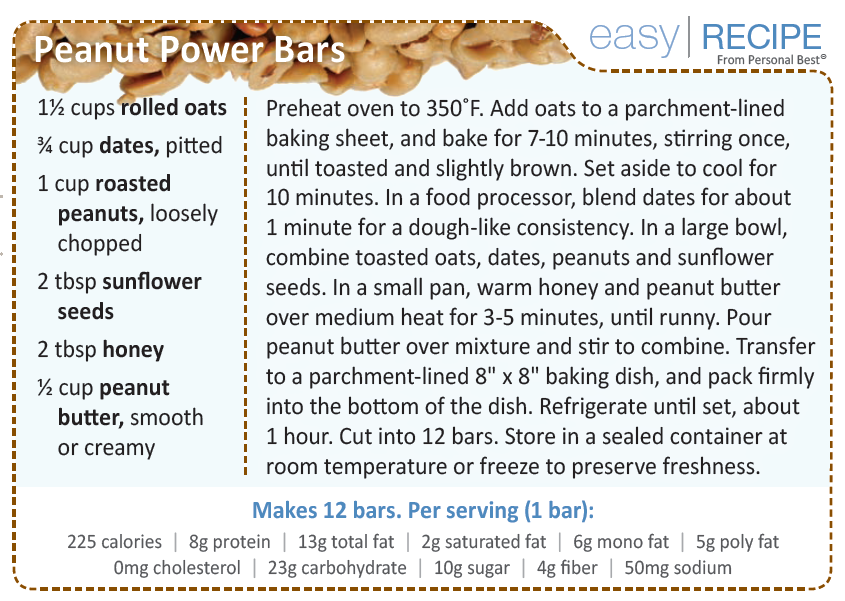
http://www.personalbest.com/PersonalBestHealthlines/recipes/897.pdf
This gallery contains 2 photos.
(Indiana 8 year old contest winner in the 2016 White House State Dinner Cookbook Recipe competition) • 592 calories • 21g fat • 47g carbohydrates • 56g protein INGREDIENTS for the Chicken Tikka: 1 pound chicken breast, boneless, skinless, cubed … Continue reading
http://www.personalbest.com/PersonalBestHealthlines/ViewArticle.aspx?article=5023
Healthy Eating: Conversation starters 
Sometimes a family member or friend needs encouragement to make a healthy change. Try these tips to start a conversation about eating healthy.


For vaccine guidelines for adults, children, those who are pregnant and health care workers, check out the CDC webpage for information at:
http://www.cdc.gov/vaccines/index.html
When you look in the mirror, do you like what you see?

Is your body image positive or negative? If your answer is negative, you are not alone. Many women in the United States feel pressured to measure up to a certain social and cultural ideal of beauty, which can lead to poor body image. Women are constantly bombarded with “Barbie Doll-like” images. By presenting an ideal that is so difficult to achieve and maintain, the cosmetic and diet product industries are assured of growth and profits. It’s no accident that youth is increasingly promoted, along with thinness, as an essential criterion of beauty. The message we’re hearing is either “all women need to lose weight” or that the natural aging process is a “disastrous” fate.
Learning to love what you see in the mirror
And don’t forget your kids!
Parents’ attitudes about appearance and diet can affect their kids’ attitudes.
We all want to look our best, but a healthy body is not always linked to appearance. In fact, healthy bodies come in all shapes and sizes! Changing your body image means changing the way you think about your body. At the same time, healthy lifestyle choices are also key to improving body image.
More information on About body image