Regular Screening Yields Many Benefits in Colorectal Cancer Survival Rates

Can colorectal polyps and cancer be found early?

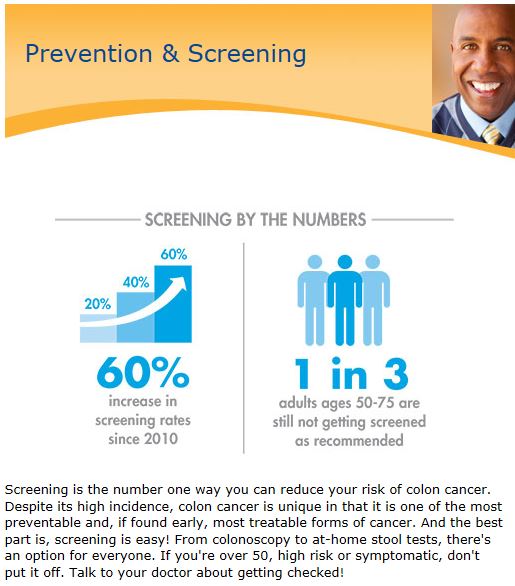
Regular screening can often find colorectal cancer early, when it is most likely to be curable. In many people, screening can also prevent colorectal cancer altogether. This is because some polyps, or growths, can be found and removed before they have the chance to turn into cancer.

Tests used to screen for colorectal cancer include:

  • Guaiac-based fecal occult blood test (gFOBT) and fecal immunochemical test (FIT): Samples of stool (feces) are checked for blood, which might be a sign of a polyp or cancer.
  • Stool DNA test: A sample of stool is checked for certain abnormal sections of DNA (genetic material) from cancer or polyp cells.
  • Sigmoidoscopy: A flexible, lighted tube is put into the rectum and lower colon to check for polyps and cancer.
  • Colonoscopy: A longer, flexible tube is used to look at the entire colon and rectum.
  • Double contrast barium enema: This is an x-ray test of the colon and rectum.
  • CT colonography (virtual colonoscopy): This is a type of CT scan of the colon and rectum.

gFOBT, FIT, and stool DNA testing mainly find cancer, but can find some polyps.

Sigmoidoscopy, colonoscopy, double contrast barium enema, and CT colonography are good at finding cancer and polyps. Polyps found before they become cancer can be removed, so these tests may prevent colorectal cancer. This is why these tests are preferred if they are available and you are willing to have them.

Please Listen To This Podcast and learn the Vital Signs for Colorectal Cancer

This podcast is based on the November 2013 CDC Vital Signs report. Colorectal cancer screening saves lives, but only if you get tested. If you’re between 50 and 75, talk with your doctor about which test is best for you. If you have inflammatory bowel disease or a family history of colorectal cancer or polyps, ask your doctor if you should start screening before age 50. Created: 11/5/2013 by Centers for Disease Control and Prevention (CDC). Date Released: 11/5/2013. Series Name: CDC Vital Minute.


March Personal Best

2015-mar-biking PB


We apologize for the inconvenience, apparently the links were not correct for this month’s Personal Best.  The issue has been resolved and the links have been updated.  Happy Reading!


In this issue:

  • Boost Your Mood With Exercise
  • Baby Boomers: Staying Well into Old Age
  • Reversing the Obesity Epidemic
  • Move More, Work Better
  • 5 Secrets to Teaching a Workshop
  • Choosing Time Management Tools
  • Smart Mortgage Moves
  • Protecting Your Credit
  • Housekeeping on a Budget
  • Tablet Ergonomics
  • Fighting Fatigue
  • 8 Pesticide Precautions
  • 5 Food Habits You Can Fix

American Cancer Society Guidelines – Diet and activity factors that affect risks for Colorectal cancer

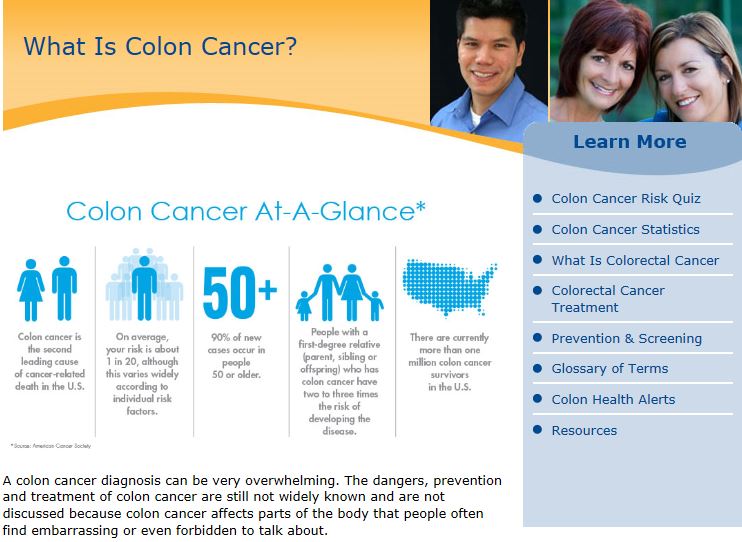
The risk of colorectal cancer is higher for those with relatives who have had colorectal cancer or polyps. Risk may also be increased by long-term tobacco use and excessive alcohol use. Several studies have found a higher risk of colorectal cancer with increased alcohol intake, especially among men.

Most studies have found that being overweight or obese increases the risk of colorectal cancer in both men and women, but the link seems to be stronger in men. Having more belly fat (that is, a larger waistline) has also been linked to colorectal cancer.

Overall, diets that are high in vegetables, fruits, and whole grains (and low in red and processed meats) have been linked with lower colorectal cancer risk, although it’s not exactly clear which factors are important. Many studies have found a link between red meat or processed meat intake and colorectal cancer risk.

Studies show a lower risk of colorectal cancer and polyps with increasing levels of activity. Moderate activity on a regular basis lowers the risk, but vigorous activity may have an even greater benefit.

In recent years, some large studies have suggested that fiber intake, especially from whole grains, may lower colorectal cancer risk. Research in this area is still under way.

Several studies have found that calcium, vitamin D, or a combination of the two may help protect against colorectal cancer. But because of the possible increased risk of prostate cancer in men with high calcium intake, the ACS does not recommend increasing calcium intake specifically to try to lower cancer risk.

At this time, the best advice about diet and activity to possibly reduce the risk of colorectal cancer is to:

  • Increase the intensity and amount of physical activity.
  • Limit intake of red and processed meats.
  • Get the recommended levels of calcium and vitamin D.
  • Eat more vegetables and fruits.
  • Avoid obesity and weight gain around the midsection.
  • Avoid excess alcohol.

It is also very important to follow the ACS guidelines for regular colorectal screening because finding and removing polyps in the colon can help prevent colorectal cancer.

Will increasing physical activity lower cancer risk?


reenahp

A Do-Anywhere, 15-Minute Fat-Blasting Workout

Yes. People who get moderate to vigorous levels of physical activity are at a lower risk of developing several cancers, including those of the breast, colon, and endometrium (lining of the uterus), as well as advanced forms of prostate cancer. For some cancers, this risk is lowered whether or not the activity affects the person’s weight.

Data for a direct effect on the risk of developing other cancers is more limited. Even so, physical activity is a key factor in reaching and staying at a healthy body weight, and being overweight or obese has been linked with many types of cancer. Physical activity is also helpful in lowering the risk of heart disease, diabetes, and other diseases.

6 Steps To Lower Your Cancer Risk

acsCouple riding bikes in countryside

6 Steps to Help Lower Your Cancer Risk

Cancer is often unpredictable, but there are things everyone can do to help reduce their cancer risk or improve their chances of beating the disease if they do get it. What’s more, some of those same behaviors can also help lower your risk for other serious diseases, and boost your odds of living a longer, healthier life.

1. Get regular cancer screening tests.
Regular screening tests can catch some cancers early, when they’re small, have not spread, and are easier to treat. With cervical and colon cancers, these tests can even prevent cancer from developing in the first place. Talk with your doctor about the tests for breast, cervical, colon, lung, and prostate cancers.

2. Get to and stay at a healthy weight.
Being overweight or obese is a risk factor for many cancers, including breast, colon, endometrium, kidney, esophagus, and pancreatic cancer. You can control your weight through regular exercise and healthy eating.

3. Exercise regularly.
Physical activity has been shown to lower the risk of several types of cancer, including breast, endometrium, prostate, and colon cancer. It also reduces the risk of other serious diseases such as diabetes and heart disease.

Adults should get at least 150 minutes of moderate-intensity activity (equal to a brisk walk) or 75 minutes of vigorous activity (makes your heartbeat and breathing faster, and makes you sweat) each week, preferably spread throughout the week.
Kids should get at least 1 hour of moderate- or vigorous-intensity activity each day, with vigorous activity at least 3 days each week.

4. Eat a healthy diet.
Studies show that eating a lot of different vegetables and fruits, whole grains, and fish or poultry is linked with a lower risk of developing certain cancers. On the other hand, eating more processed and red meat is linked with a higher risk of developing certain cancers. The American Cancer Society recommends:

Eating at least 2½ cups of vegetables and fruits each day
Eating less red meat (beef, pork, and lamb) and less processed meat (bacon, sausage, luncheon meats, and hot dogs)
Choosing breads, pastas, and cereals made from whole grains instead of refined grains, and brown rice instead of white
Eating fewer sweets

5. Avoid tobacco.
Tobacco use in the US is responsible for nearly 1 out of every 5 deaths — about 480,000 early deaths each year. About 80% of lung cancer deaths and 30% of all cancer deaths are caused by tobacco use.

If you don’t use tobacco products, don’t start. If you do, quit. For help, visit cancer.org/quitsmoking, or call the American Cancer Society at 1-800-227-2345.

6. Limit alcohol.
Research has shown that alcohol can increase your risk for certain kinds of cancer, including breast, mouth, throat, voice box, esophagus, liver, colon and rectal cancer. The more alcohol you drink, the higher your risk.

Men should have no more than 2 drinks a day and women no more than 1.
One drink is equal to about 12 ounces of beer, 5 ounces of wine, or 1.5 ounces of 80-proof liquor.