

Written by Brad Seehausen
Marketing and Communications Intern, Lacy School of Business ’26
After being named Regional Champions, Lacy School of Business students Jack Maier and Mariah Richardson advanced to the national Data4Good Competition at Johns Hopkins University, showcasing their predictive models on AI use in the classroom to a panel of expert judges.
Competing against top programs from across the country, the duo applied their skills from MS365, LSB’s business analytics course, to develop models focused on improving AI accuracy and reducing misinformation in educational settings. Their work built on Python programming and Microsoft Excel expertise, combined with innovative problem-solving and independent research.
Their success was part of a remarkable showing for Butler: 16 of the top 17 teams in the regional points-based competition were from LSB, and 50 of 53 students in MS366 earned Microsoft AI-900 certification, including Jack and Mariah — a testament to the technical excellence fostered in the program.
Building on their coursework and independent research, Jack and Mariah, along with their teammates, tackled a complex challenge using predictive models they hadn’t encountered before. Their task involved an ever-increasing ethical issue in modern education settings: AI use in the classroom, and more specifically, determining its accuracy. “We broke the problem into our ability to predict whether an AI output would be factual or inaccurate,” Mariah, a finance and entrepreneurship and innovation major, explained.
While being a large point of contention in education, Jack and Mariah agreed on the fragility of AI use in the classroom. Jack, who is the treasurer for his fraternity, offered that uninformed use of AI is not the way to go when it comes to using AI as a tool. “I think there’s an ethical way to use AI in the classroom, and then there’s an unethical way to use it. You need to know what you’re talking about when you ask AI to create a certain code for you. I think it’s important to improve efficiency and accuracy of your own knowledge rather than to just get the answer, straight up,” Jack, an accounting and finance major, detailed.
After laboring over the project, Jack and Mariah were the two selected from their regional team to represent LSB at Johns Hopkins in the national competition. Their plan was relatively simple: Catch a flight to Baltimore, present their findings to a panel of judges, and fly back. However, after numerous hours stuck at the Indianapolis airport, Jack and Mariah’s flight was canceled. But, after a last minute notice from the judges, Mariah and Jack threw on business professional attire, and proceeded to give their presentation virtually instead of in-person.
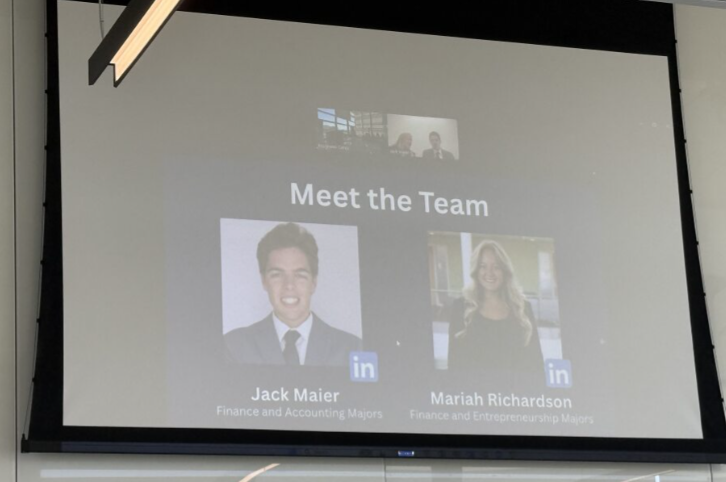
Despite a plane-sized wrench that prevented them from presenting in person, Jack and Mariah adapted quickly, delivering a polished virtual presentation that demonstrated professionalism and resilience under pressure. “We learned a lot about overcoming things that pop up suddenly, like a flight getting canceled and working under pressure. It was a learning experience,” Mariah commented.
The team, through both hard work and overcoming obstacles, were able to give an effective presentation to the judges at the Data4Good competition. “Every team has its strengths. I really liked competing with others, and it’s where you get the most to learn from. Getting to build off of one another, and getting a close simulation to the real world, I genuinely enjoyed it,” Mariah stated.
The two attribute their success mainly to the course work in MS365, as well as to Professor Matthew Lanham, who has close ties to the competition, championing its importance in the context of modern education. “He’s a super positive and smart professor. He was part of the judging for the state section of the competition, but he ensured that we would pay attention in class,” Mariah said. “We really couldn’t have done it without him, so I just want to give a shout out to him and the class as well,” Jack added.
Jack and Mariah’s accomplishments reflect both their talent and the strength of LSB’s analytics curriculum in preparing students for real-world challenges.