At the Lacy School of Business, learning to think like an entrepreneur can start with a simple question: What problem could I solve?
For sophomore finance major and Division I soccer player Hudson Sullivan, that question has led to two startup ventures, countless hours of trial and error, and a growing understanding of what it takes to turn an idea into a business.
Hudson co-founded Performix in January 2026, a personalized soccer training platform, with his father. He’s also building College Marketplace, a student-to-student marketplace designed specifically for college campuses. Neither venture began with a detailed business plan or years of technical experience. In fact, when Hudson started building apps, he didn’t know how to code.
What he did have was curiosity, a willingness to learn, and a habit of noticing problems that others might overlook.
“I wasn’t always somebody who was interested in creating things,” he says. “A lot of that came from seeing what my dad was doing and becoming more interested in entrepreneurship over time.”
That curiosity has since become a hands-on education in entrepreneurship, one that continues to evolve through his experiences as a student and athlete.
Hudson’s entrepreneurial journey began with a challenge he knew firsthand.
As a soccer player, he often went to the field for extra training without knowing exactly what he should work on that day. He wanted a better way to train, so he helped develop Performix, an app that creates personalized training plans based on an athlete’s goals, available equipment and training environment.
Building the app introduced him to a new set of challenges: debugging, troubleshooting, and figuring out how to turn an idea into something people could actually use.
Those lessons became the foundation for his next venture.
The idea for College Marketplace came from another familiar experience. College students regularly buy and sell items, but broad public marketplaces often mean navigating listings from strangers and coordinating transactions with people outside their campus community.
Hudson envisioned something different: a marketplace limited to verified students at individual universities.
There was just one problem. He didn’t know how to code.
Rather than letting that stop him, he started researching. He spent hours asking questions, learning from AI tools and teaching himself as he built. What began as curiosity gradually turned into a functioning platform.
“It was basically a lot of research,” he says. “Just asking questions, learning, and figuring things out one step at a time.”
The learning curve wasn’t always smooth. During testing, the platform worked perfectly with a handful of listings. As the number of listings increased, everything crashed.
Hudson had to think beyond getting the product to work. If College Marketplace was going to expand to universities across the country, it needed to handle that growth.
“If the goal is to eventually have something at every university, then it has to be able to handle that kind of scale,” he says.
But the technical hurdles proved easier than the business challenge that followed.
After launching College Marketplace, the Texas native discovered that building a product and building a user base are two very different things. Students would join the platform, but without enough listings, they had little reason to return. Generating consistent activity on campus after campus became increasingly difficult.
Instead of holding onto the original model, he began exploring a different approach: licensing the platform directly to universities so schools could offer students a trusted campus marketplace from day one.
The experience changed how he evaluates business ideas.
“Is it a need-to-have business or a nice-to-have business?” he asks. “Understanding the difference is really important.”
For the sophomore, entrepreneurship has become as much about understanding people and their needs as it is about building a product.
His approach to entrepreneurship reflects a mindset he also brings to life as a student-athlete: discipline, adaptability, and a willingness to keep working when things don’t go as planned.
His days begin around 7 a.m. with soccer. Practices and workouts consume much of his mornings, while classes fill his afternoons. Homework comes first in the evenings. Then, after his other responsibilities are complete, he turns to his startups.

Many of his biggest milestones have come late at night, after training sessions, assignments, and team responsibilities are finished.
“It’s about making the most of the time you have,” the defender says. “In sports, there are injuries, challenges and times when things don’t go your way. Business is very similar. You have to keep working and keep finding solutions.”
When Hudson transferred to Butler this year, he found a business school environment that has added a new dimension to that process.
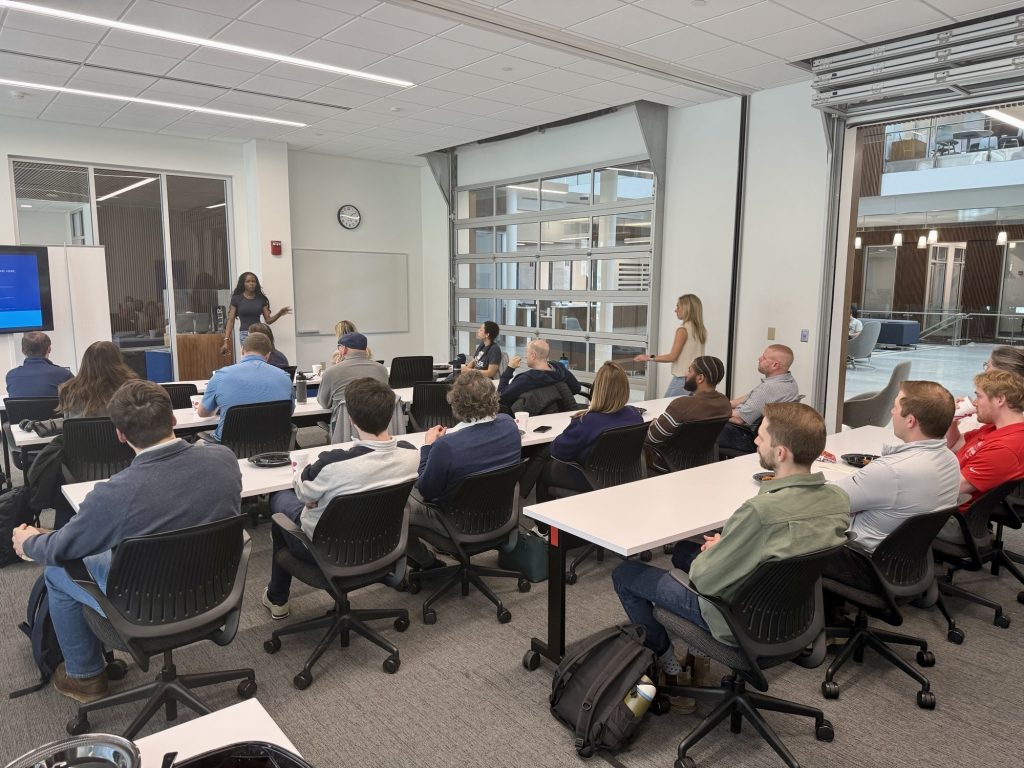
At the Lacy School of Business, conversations about entrepreneurship extend beyond coursework. He’s connected with classmates eager to workshop ideas, teammates pursuing business degrees, and faculty members who bring different perspectives to the challenges he’s working through.
One experience has stood out in particular: an entrepreneurship course taught by lecturer Nick Smarrelli.
What started as a late addition to his schedule quickly became one of the most valuable parts of his semester.
“Being able to talk through ideas and get feedback has been really helpful,” he says. “It’s connected me with people and helped me think differently about what I’m building.”
For Hudson, those connections have reinforced the value of being surrounded by people who are willing to engage with his ideas and challenge the way he thinks about them. Entrepreneurship can be a solitary process, especially when much of the work happens late at night, but he has found a community where he can talk through possibilities and learn from others.
As he works toward securing the first university partnership for College Marketplace and growing Performix, he continues to approach entrepreneurship the same way he started: by identifying a problem and figuring out how to solve it.
His advice to other students who have an idea but aren’t sure where to begin is simple.
“Talk to people,” he says. “Get feedback. See if it’s something that solves a real problem. That’s the best first step.”
Hudson’s journey is still unfolding. He’s testing ideas, learning from setbacks and figuring out what it takes to build businesses that last. He doesn’t have every answer, and he’s learning that he doesn’t need to have them all before getting started.
At the Lacy School of Business, his experience reflects the value of pairing individual initiative with a community of people who can help students ask better questions, explore possibilities, and keep moving forward.
Sometimes, building something meaningful starts with knowing exactly what you want to solve. Other times, it starts with being willing to figure it out.