
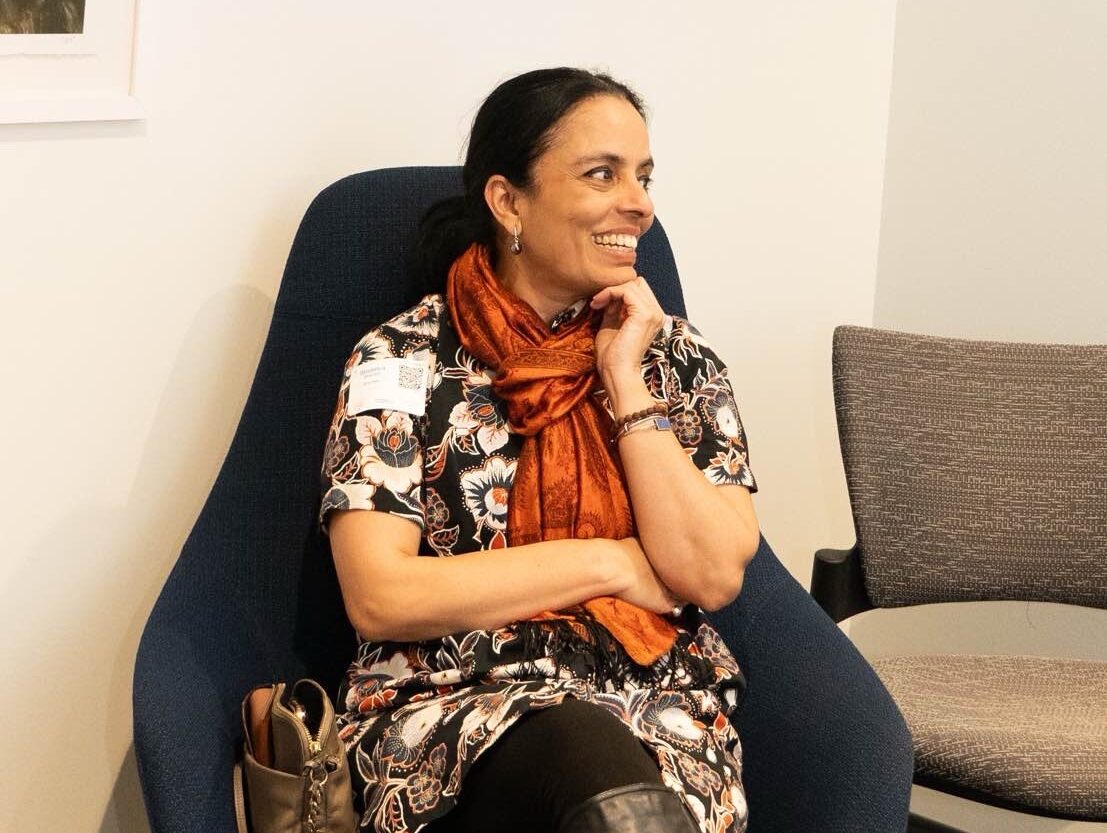
When Dr. Shubhra Sharma looks back on how she became an entrepreneur, it doesn’t begin with a business plan, a pitch competition, or even a desire to start a company. It begins with 45 diaries.
After her father passed away, Dr. Sharma, an anthropologist by training, inherited his diaries. While reading through them, she came across a series of numbers that didn’t make sense to her. She asked her mother about them and uncovered a story she never expected.
Her parents had spent about 25 years developing a scalp formula made with just four organic ingredients. For Dr. Sharma, the discovery revealed more than an interesting family story. She saw a potential problem to solve, a story to tell, and a way to connect with people. She had never studied business. But she launched a business anyway.
Now, about a decade after starting Cria, Dr. Sharma brings that experience into the classroom as an entrepreneurship professor at the Lacy School of Business. Her experience has shaped a philosophy that goes beyond teaching students how to build a business plan. She believes entrepreneurship isn’t simply about having a great idea and finding the courage to pursue it. She sees that idea of the “brilliant entrepreneur” as one of the myths surrounding entrepreneurship.
“You have to make decisions with incomplete information and with absolute lack of certainty,” she says.
In her Real Business Experience course, students aren’t simply asked to create a polished business plan. They begin with a possibility and a story, then experience what happens when that idea encounters real constraints.
Students have one semester to develop an idea, execute it, and close the company. Along the way, they have to make decisions, rethink their assumptions and respond when something doesn’t work.
“I want them to experience what it means to start with the possibility, but also a story,” she says. “And then, how does reality confront it in ways that they will have to pivot, they’ll have to rethink, they would have to revise.”
Rather than viewing those challenges as evidence that they aren’t good at entrepreneurship, students can begin to see them as problems they are capable of solving. One of the most important ideas Dr. Sharma wants students to take away from her classroom is that entrepreneurship isn’t just for people who plan to start their own companies.
She sees it as an ability to engage with possibility and recognize something that could be different and ask questions. That could mean looking at something as ordinary as a pillowcase and asking how it could be redesigned to solve a specific problem.
In her own travels, Dr. Sharma found inspiration in an unexpected place. While visiting Naxos, Greece, she learned about Ariadne, a figure from Greek mythology. Dr. Sharma noticed a statue of Ariadne that seemed to receive little attention. She began asking questions. Why wasn’t anyone paying attention to her? Why wasn’t her story being highlighted? Why had she become almost invisible within the larger narrative? For Dr. Sharma, that process of noticing what others overlook is at the heart of entrepreneurship.
“To me, I think that’s what entrepreneurship literally is. It’s like taking something that people have forgotten, have made invisible over time, and making it visible,” she says.
That mindset also makes entrepreneurship relevant to students across the Lacy School of Business, regardless of their intended career path. A student who plans to pursue accounting, finance, or another field can still benefit from learning how to identify problems, ask questions, imagine possibilities, and test ideas.
That philosophy is reflected in the way Dr. Sharma approaches her courses at Butler. In addition to Real Business Experience, she has taught First Year Business Experience FBE, RBE, Business of Storytelling, and Impact Practicum, part of the MBA Program. In these courses, she sees the value of giving students opportunities to learn through doing rather than simply learning concepts from a textbook.
“Experiences teach you things that a textbook may not,” she says.
Real Business Experience, in particular, gives students the opportunity to experience the uncertainty, frustration and problem-solving that come with creating something in real time. Students are given resources, skills and space to imagine, but they also have to confront constraints and determine whether their ideas can actually work.
“I want them to know what it feels like to have an idea, what it means to put it out in the world, to have somebody challenge it, to discover that, oh my God, something didn’t work,” she said.
The lesson isn’t that every idea will succeed. It’s that students can learn what to do when it doesn’t. That approach can be especially meaningful for students who arrive at Butler without knowing exactly where their interests will take them.
For students who aren’t sure where they fit, she encourages them to start with questions rather than answers. What problems do you notice in your everyday life? What experiences keep coming back to you? What stories matter to you? What have you noticed that other people might be overlooking? Her goal is for students to give themselves permission to imagine before immediately worrying about whether an idea is practical.
“The starting point has to be allowing yourself to imagine,” she says. “Allowing yourself to imagine what an idea could become in real life. My goal is to have them leave having experienced themselves as capable of creating something that didn’t exist before.”
For Dr. Sharma, that experience is valuable far beyond entrepreneurship. It is a lesson in what students can do when they are willing to notice, question, imagine and then put an idea into the world. At Butler’s Lacy School of Business, entrepreneurship isn’t just about learning how to start a company. It can be an opportunity to discover how you think, what you notice and what you’re capable of creating.