Category: Faculty Insights

  • A Lifetime of Curiosity: Professor Chad Miller’s Path in Technology and Mentorship

    A Lifetime of Curiosity: Professor Chad Miller’s Path in Technology and Mentorship

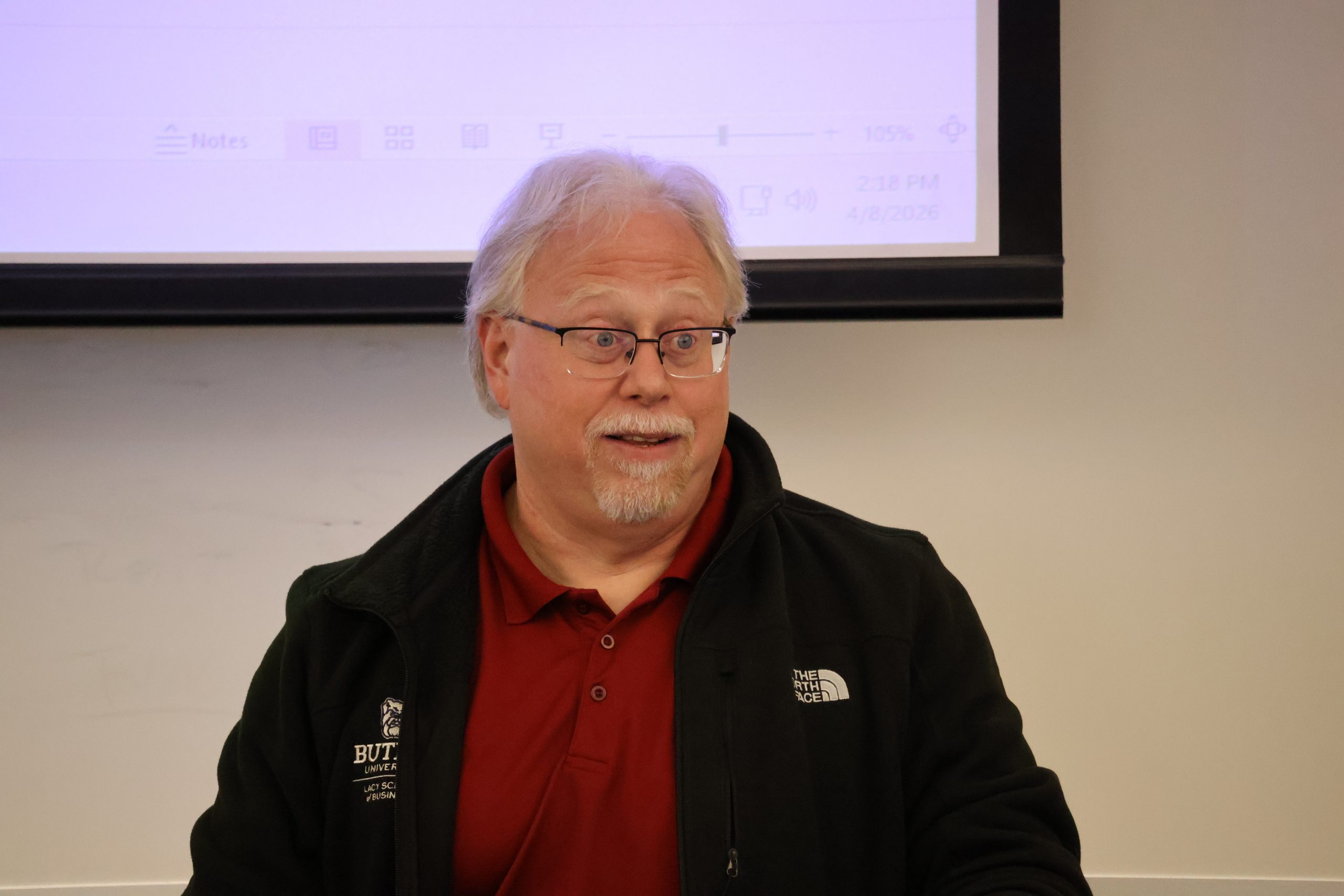
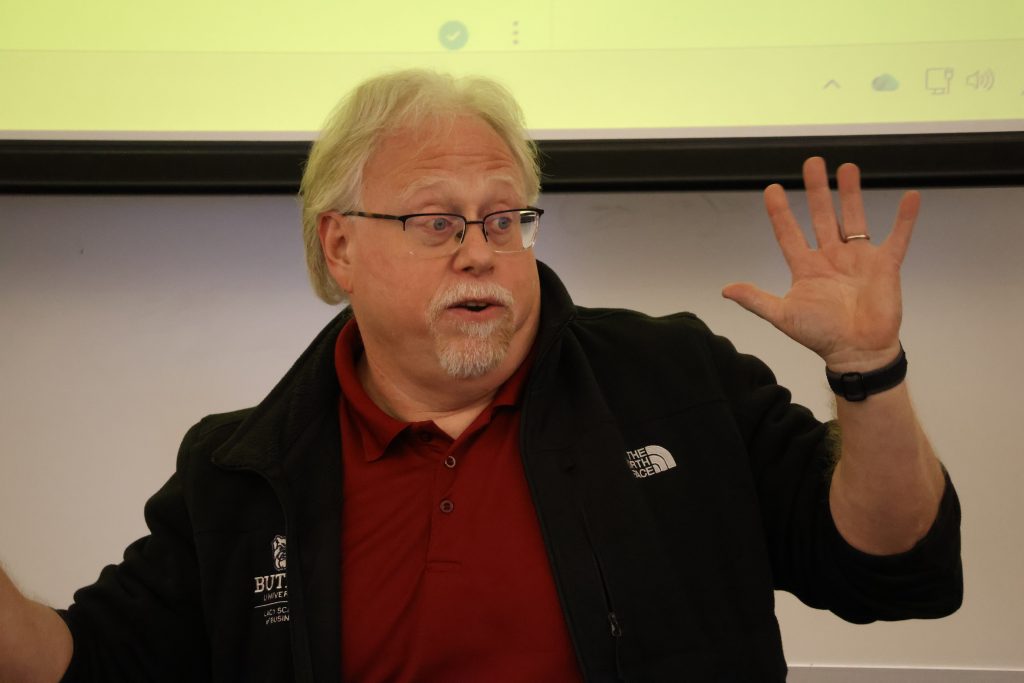
    When Professor Chad Miller talks about his career in technology, he often starts with a memory from when he was just 13 years old.

    “I remember teaching BASIC on a Timex Sinclair Z80 computer to a room full of eight- and nine-year-olds,” he says. “It was chaotic, fun, and challenging all at once. That experience taught me early on that technology is more than just machines. It’s about people, problem-solving, and helping others see what’s possible.”

    That curiosity, combined with a desire to teach and empower others, would shape the next three decades of his life.

    After earning a double major in Integrated Science and Mathematics at Northwestern University, Professor Miller stepped directly into a Systems Analyst role at Eli Lilly and Company. There, he designed and developed a data-driven, client/server tool to support FDA submissions.

    “It wasn’t just about coding or databases,” he explains. “It was about building something that could actually make a difference for people. That sense of impact has guided every decision I’ve made since.”

    The Ohio native’s career path has been anything but linear, but it’s all connected by a single thread: using technology to solve complex problems while empowering others to grow alongside him. After six years at Eli Lilly, he and his family moved to Evansville, Indiana, where he helped Shoe Carnival navigate a challenging technical transition.

    “We were fixing systems, building networks, and training staff – all while keeping the business running day-to-day. It was stressful, but incredibly rewarding,” he recalls.

    From there, he transitioned into consulting at C/Soft, architecting networking and system integrations for multiple clients, before taking on staff positions in Butler IT, and later taking  IT leadership roles at Butler University and MJ Insurance. At MJ Insurance, Professor Miller served as Chief Information Officer, overseeing enterprise-wide technology strategy, managing an eight-person team, and guiding a $1 million budget.

    He led a complete overhaul of IT infrastructure, orchestrated two full building migrations, managed a pandemic transition to remote work, and led his team to build the company’s first data warehouse to serve as a single source of truth.

    “People often think IT is just about computers,” he says. “But really, it’s about trust, collaboration, and enabling others to do their best work. That’s what I focused on – transforming IT from a cost center to a strategic partner.”

    Professor Miller has also maintained a strong and enduring connection to Butler University throughout his career. From serving as Senior Director of Technology Development to multiple adjunct and faculty roles, he has contributed to the campus community in a variety of ways.

    “I’ve always felt a part of Butler,” he says. “Whether it was supporting systems, mentoring students, or teaching, Butler has been a place where curiosity, collaboration, and people matter. It feels like home, and that sense of belonging drives everything I do here.”

    Now a Lecturer in Business Technology and Analytics at the Lacy School of Business, he brings this perspective into the classroom, helping students connect the technical aspects of IT with real-world business strategy.

    “I want students to see how technology intersects with business outcomes,” he explains. “It’s not enough to know how to build a system – you have to understand why, how it impacts people, and how it creates value.”

    He draws on decades of experience in enterprise architecture, data governance, and organizational strategy to provide students with real-world context. His teaching philosophy mirrors his approach to leadership: thoughtful, supportive, and future-focused. He always tells students that mistakes aren’t failures – they’re opportunities to learn and pivot.

    “The best leaders are the ones who can guide teams through uncertainty while still moving forward,” he says.

    Professor Miller’s commitment to mentorship extends beyond the classroom. As an Executive Career Mentor, he advises students, alumni, and executives, helping them navigate career transitions and develop leadership skills.

    “Even after 32 years in IT, I’m energized by innovation and learning,” he says. “Technology changes every day, but problem-solving, collaboration, and mentorship – those are timeless skills.”

    His story is a reminder that technology careers are not just about code, networks, or systems; they’re about curiosity, perseverance, and people. From teaching BASIC in a small basement to shaping enterprise-wide IT strategy, and now inspiring the next generation of business leaders, Professor Miller has spent a lifetime building systems and developing leaders.

    “At the end of the day,” he says, “I hope students remember that it’s not just what you know – it’s how you use it to help others succeed.”

  • The Art of Teaching: Celebrating Dr. Larry Lad’s Legacy

    The Art of Teaching: Celebrating Dr. Larry Lad’s Legacy

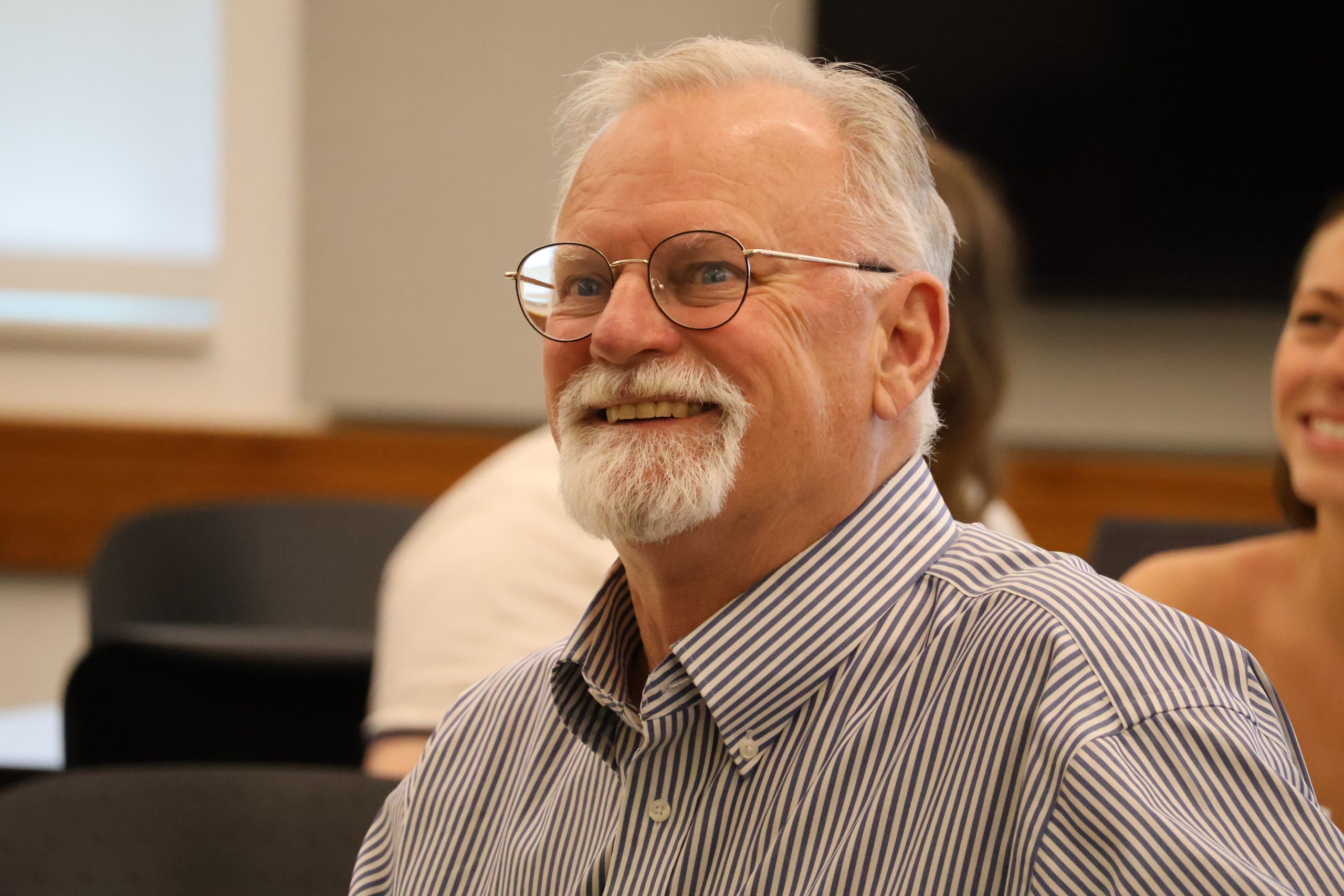
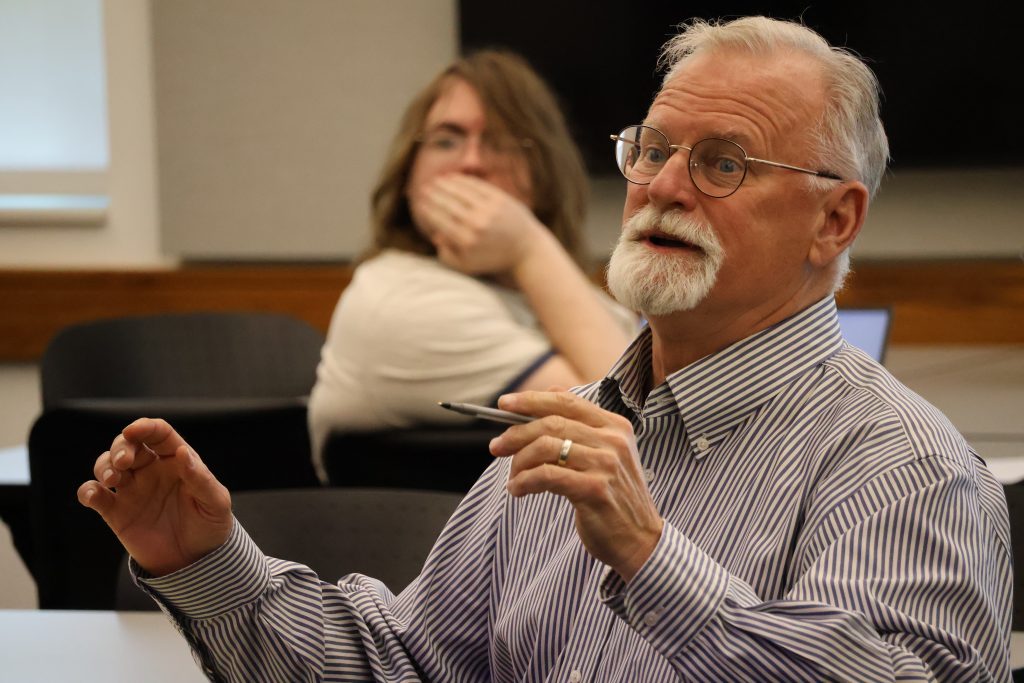
    After more than 35 years of shaping minds and inspiring future leaders, Dr. Larry Lad is preparing to retire this June – leaving behind a legacy defined by creativity, mindfulness, and deep human connection.

    Since joining the Lacy School of Business in 1991, Dr. Lad has brought a distinctive and powerful perspective to the classroom. For him, teaching has never been just about delivering content, it has been about creating moments that spark reflection, evoke emotion, and inspire self-discovery.

    “We are all artists searching for the canvas to express ourselves,” he often says. That belief has guided his entire career, transforming his courses into dynamic spaces where ideas, emotions, and experiences come together. In his classroom, students don’t just learn strategy – they learn how to see the world differently.

    Before joining Butler, Dr. Lad spent time teaching at the Kelley School of Business at Indiana University and working in executive education, experiences that broadened his perspective and deepened his appreciation for the classroom. After those roles, he felt drawn back to the energy of teaching in a university setting.

    “I missed the classroom,” the associate professor of management shares. “And Butler felt like the right place at the right time. A place that was on the move.”

    Since that moment, he has been a constant and guiding presence through decades of transformation: teaching across eras marked by five presidents, five deans, and remarkable growth within the university. Along the way, he has taught more than 6,000 students across undergraduate, MBA, and executive education programs, each one leaving with more than knowledge – they leave with perspective.

    “Students may forget the content,” he reflects, “but I hope they remember that I cared. That there was passion in the classroom.”

    That care is unmistakable.

    Dr. Lad’s courses consistently challenge students to think beyond the textbook, connecting strategy to leadership, and leadership to life. One of his signature assignments, developed more than 20 years ago, asks students to create a personal leadership development plan, linking business principles to their own lives and futures.

    “Strategy isn’t just about a company,” he explains. “It’s about your life, how you make decisions, how you prepare for the future, and how you see your role in the world.”

    At the heart of his teaching is a belief in mindfulness: the idea that awareness, reflection, and presence are essential to both leadership and learning. He encourages students to pause, consider, and feel – to recognize not just outcomes, but meaning.

    That philosophy extends beyond business and into his creative practice. As both a published poet and visual artist, Dr. Lad brings creativity into everything he does. Whether guiding collaborative art projects or incorporating poetry into his lessons, he invites students to engage with ideas in ways that reach beyond logic alone.

    “Art taps into all the senses,” he says. “It helps us experience awe, and when we experience awe, we learn differently.”

    Throughout his time at LSB, Dr. Lad has also been a dedicated servant-leader. He has served on Faculty Senate multiple times, contributed to the university’s growth and evolution, and remained actively engaged in the broader community through service, including his volunteer work with Second Helpings and other initiatives addressing hunger and homelessness.

    “It’s the relationships that matter most,” he says. “The classroom, working with colleagues, serving the community; those moments stay with you.”

    He has also been a witness to, and a contributor to, Butler’s rise as a nationally recognized institution.

    “It’s been incredible to watch the university grow,” he shares. “The programs, the faculty, the students – we’ve built something truly special. And we walk our talk. There’s an authenticity here that students can feel.”

    That authenticity has defined his work from the very beginning.

    Across his career, Dr. Lad has also taught internationally and at other leading institutions, including Purdue, LSU, and Harvard, extending his influence well beyond Butler. His research explores mindfulness, strategy, and business ethics, with publications in respected academic journals, further reinforcing his commitment to thoughtful, human-centered business education.

    As he prepares to retire, Dr. Lad reflects on his journey with gratitude and pride.

    “It’s been a great ride,” he says, pausing with emotion. “And it’s also been a privilege.”

    In recognition of his distinguished career and lasting contributions to the university, the Board of Trustees has awarded Dr. Lad emeritus status, effective upon his retirement.

    Retirement, however, is not an ending – it’s a new canvas.

    Dr. Lad looks forward to spending more time in his art studio, continuing his creative work, and eventually relocating to Nashville to be closer to his family. He also plans to remain engaged in service, particularly around issues of hunger and homelessness, causes that have long been close to his heart.

    “I’ve done my art to make the art,” he says. “Now it’s time to share it in new ways.”

    Though he is stepping away from the classroom, his impact will endure – in the thousands of students he has taught, the colleagues he has inspired, and the countless lives he has influenced.

    Because at its core, Dr. Larry Lad’s legacy is not just about teaching business.

    It is about teaching people how to see differently, think deeply, and lead with purpose.

    And that is a work of art.

    If you want to find Larry over the next year before he heads to Nashville, you can find him in his studio in the Factory Arts District.

  • Investing in Potential: How Professor Nick Smarrelli Shapes Future Entrepreneurs

    Investing in Potential: How Professor Nick Smarrelli Shapes Future Entrepreneurs

    For Professor Nick Smarrelli, entrepreneurship didn’t begin with a bold idea or a breakthrough moment. It started, ironically, with a club he created in college because it didn’t exist yet.

    As a finance and psychology major at St. Louis University, he was convinced his future was in corporate leadership. He imagined climbing the ladder of a Fortune 500 company, not co-founding tech startups. And yet, that early instinct – to start something simply because it wasn’t there – would become the quiet through line of his career.

    “I began the entrepreneurship club not because I wanted to be an entrepreneur,” he said with a laugh. “It was just the only club that didn’t exist yet. It let me build something, create opportunities, and practice leadership. Entrepreneurship came early, but it was almost by accident.”

    After graduation, Professor Smarrelli joined Ingersoll Rand and lived the kind of global life young professionals dream about. He moved from St. Louis to New York, then to Shanghai, then Charlotte, Atlanta, and eventually Indianapolis – all with the same company. But somewhere between flights, hotel rooms, and elite frequent-flyer status, the path he once imagined stopped feeling like his.

    One morning, sitting on a plane for the fourth time that week, he experienced what he calls his “Ghost of Christmas Future” moment.

    “I looked around and realized – this is the next 40 years if I don’t change something,” the entrepreneurship and innovation lecturer said. “I took out my BlackBerry, texted two college friends who were starting a business, and said, ‘I want in. I don’t care what the salary is.’ Three months later, I was co-building my first company.”

    That leap began a 15‑year journey as a founder, investor, and eventually CEO – leading companies like Ryvit and GadellNet through periods of intense growth. The secret to that success, he insists, had little to do with marketing or strategy.

    “I always say 98% of leadership is psychology and 2% is business,” Professor Smarrelli said. “People are the complex part. People are the differentiator.”

    That belief is what drove him back to graduate school for a master’s degree in industrial & organizational psychology at Harvard University – and what ultimately brought him to the Lacy School of Business.

    “Butler is incredibly thoughtful and nimble,” the director of entrepreneurship said. “Higher education is under pressure to stay relevant. LSB has proven repeatedly that we can evolve quickly to serve students better. That’s what drew me here.”

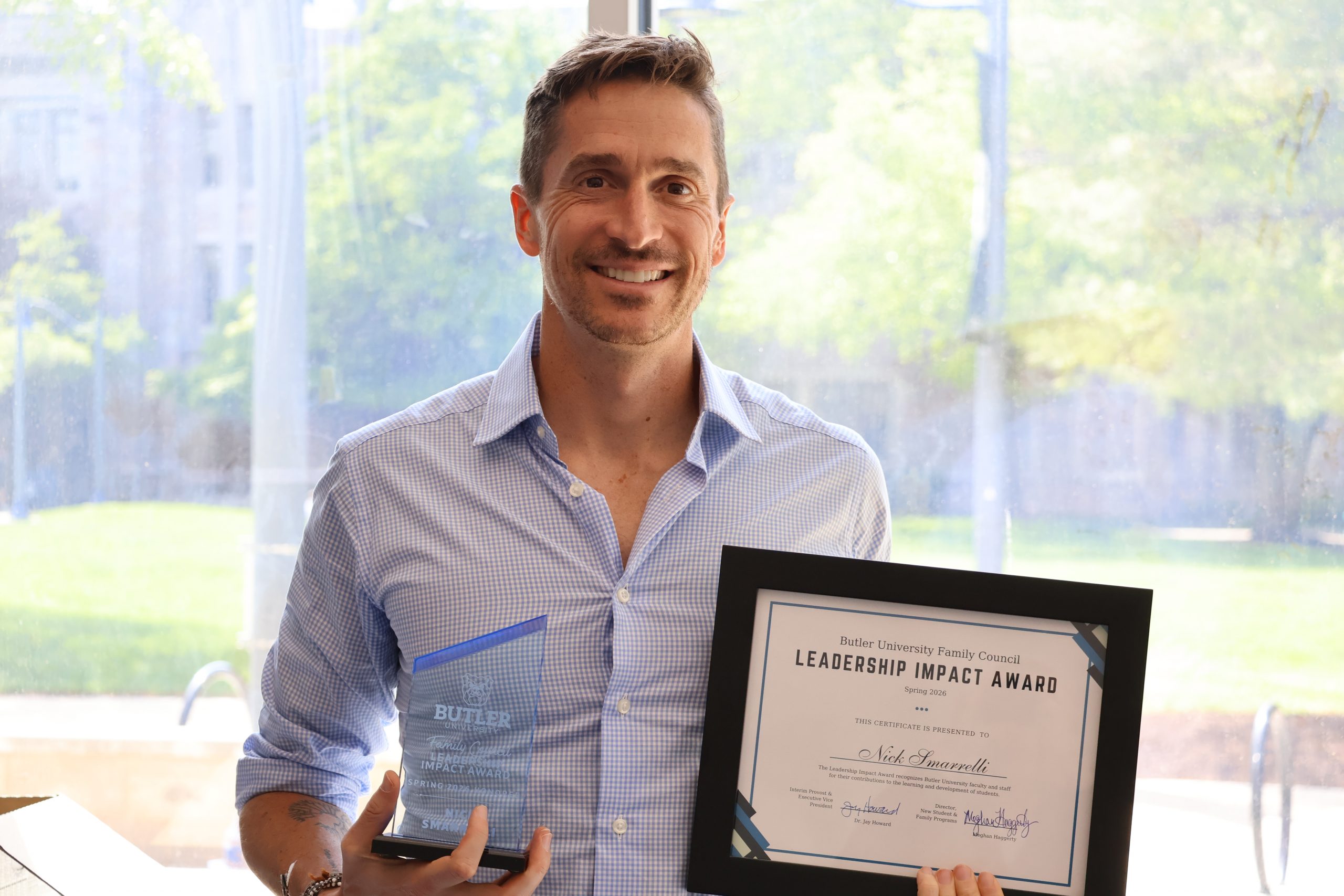
    That impact was formally recognized when Professor Smarrelli was named a Spring 2026 Leadership Impact Award recipient by the Butler University Family Council. Nominated by the families of Butler students, the award honors faculty and staff whose leadership makes a lasting difference in students’ learning and development.

    He was recognized for his hands‑on, real‑world approach to entrepreneurship education, deep investment in students beyond the classroom, and unwavering belief in their potential.

    Inside the classroom, Professor Smarrelli teaches the way he leads: with honesty, energy, and stories. Lots of stories.

    “There’s not a class that goes by where I don’t tell a story,” he said. “Students can tell I’m still figuring out this teaching thing – and that I’m willing to share everything I’ve learned, including the mistakes.”

    It’s why students connect with him not just as a professor, but as a mentor. His classes are filled with real-world cases, guest speakers from his professional network, and lessons shaped by 20+ years of scaling teams and building culture.

    Professor Smarrelli lights up most when he sees students doing something for the first time: pitching an idea, traveling to a new city, testing a business concept, or experiencing the spark of real confidence.

    Outside the classroom, Professor Smarrelli is an ultramarathon runner who has completed seven 100-mile races, and endurance sports shape nearly every part of his leadership philosophy.

    “Big, scary goals are achieved in tiny steps,” he said. “Success is consistency over intensity. Rest matters. And no one does big things alone – there’s always a support system behind the scenes.”

    That philosophy is the foundation of his forthcoming book, Next Two Steps, which explores how small, sustainable habits unlock long-term growth.

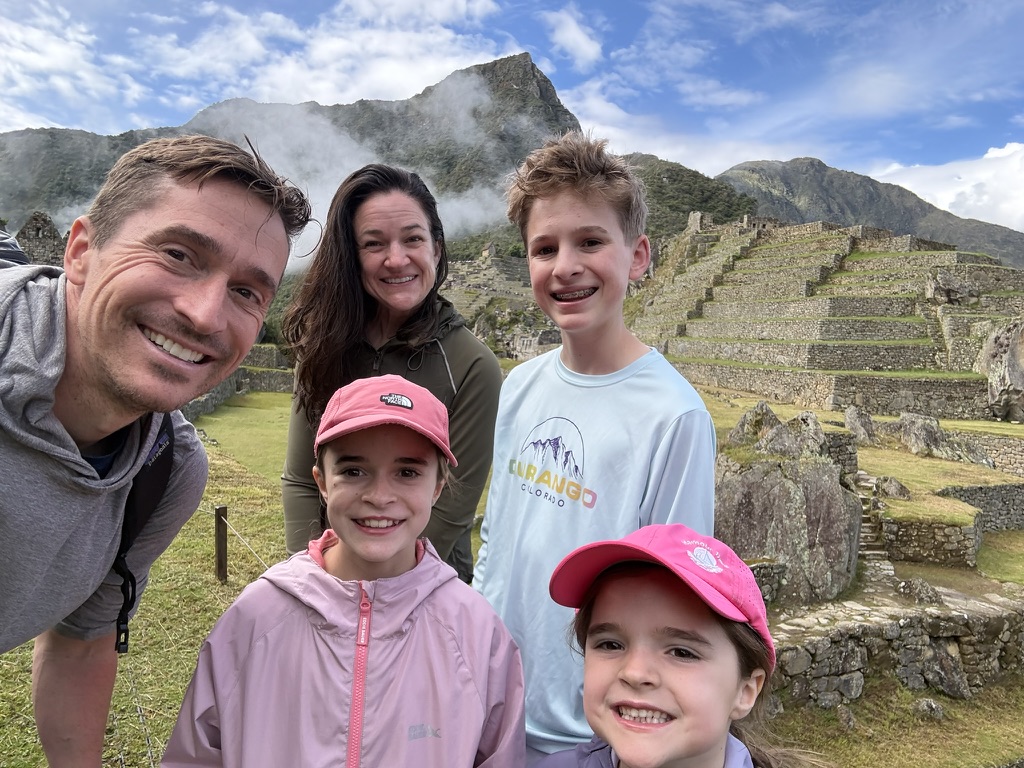
    Beyond his teaching and writing, Professor Smarrelli is deeply involved in the Indianapolis community, serving on boards focused on youth, education, and early-intervention support. At home, he and his wife are raising three children – ages 13, 10, and 6 – who he describes as “the center of everything.”

    As he looks ahead, his purpose is clear: invest in people so they can realize their potential.

    “I want students to see the humanity behind business – the people behind the spreadsheets and forecasts,” Professor Smarrelli said. “If I can help them take the next step, believe in themselves, or find a path they didn’t know they could walk – that’s the impact I want.”

    When asked what he’d tell his younger self, he paused.

    “Care less about what people think,” he said. “It’s going to be hard, but it’s going to be worth it. And remember: no one is thinking about you as much as you think they are. So go do the thing.”

  • Beyond the Numbers: Dr. Ronia Hawash’s Approach to Economics

    Beyond the Numbers: Dr. Ronia Hawash’s Approach to Economics

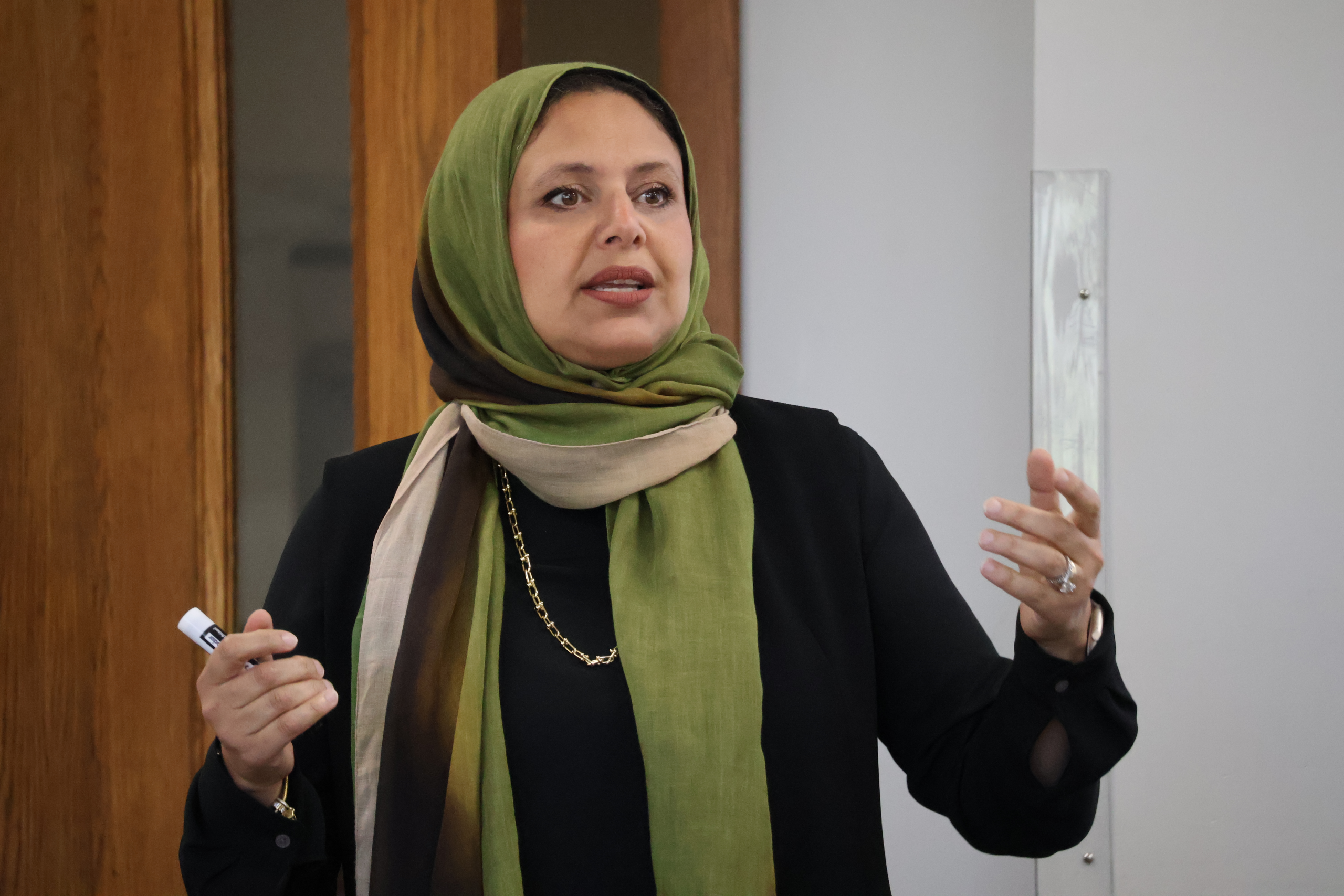
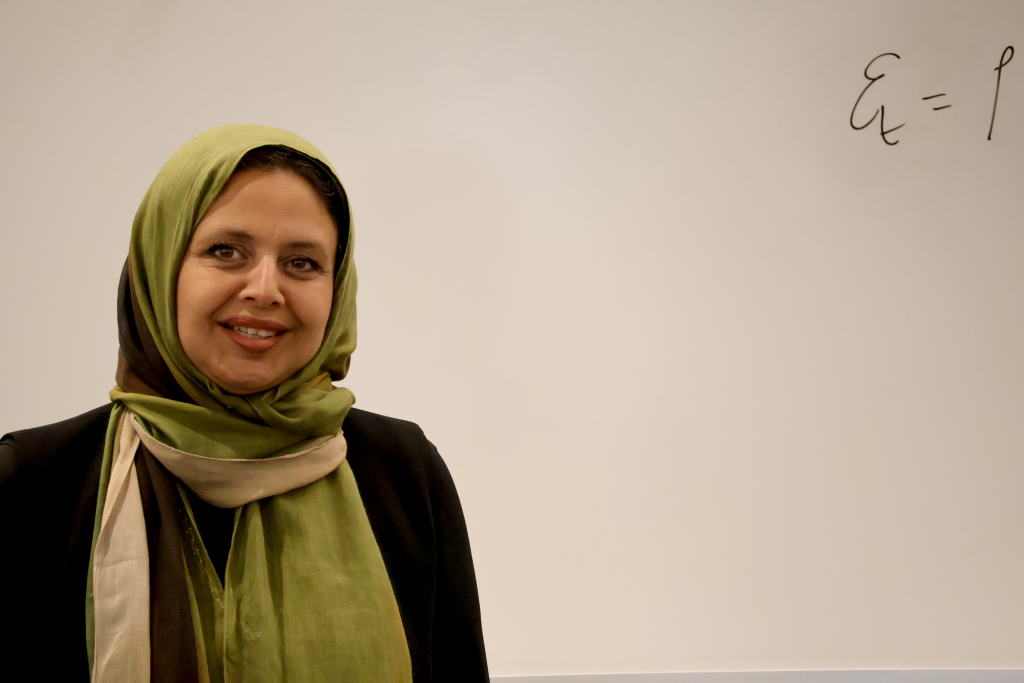
    Dr. Ronia Hawash’s understanding of economics didn’t begin in a classroom; it began in the everyday rhythms of life in Egypt.

    Growing up, she was surrounded by visible contrasts. Families worked tirelessly, doing everything they could to get ahead, yet many still struggled. Access to healthcare was inconsistent. Educational opportunities were uneven. The systems meant to support people didn’t always reach those who needed them most. For Dr. Hawash, those realities weren’t distant observations – they were impossible to ignore.

    They sparked a question that would shape her life’s work: why do systems work for some, but fail for others?

    That question led Dr. Hawash to economics.

    She began her academic journey at the Faculty of Economics and Political Science at Cairo University, where she earned her undergraduate degree in economics, before continuing to the American University in Cairo for her master’s. Later, she moved to the United States to pursue her Ph.D. in economics at Indiana University Indianapolis – an experience that would further expand both her academic lens and her worldview.

    By the time she arrived in the U.S., she was navigating both academic and cultural shifts, learning new norms around communication, privacy, and expression.

    “It was a gradual transition,” she reflects. “But what stood out to me most was how welcoming people were. They wanted to understand my background. There was warmth to that.”

    Living within two different economic systems also shaped how she understood inequality. Egypt’s more centralized structure and the United States’ capitalist model might suggest vastly different outcomes. But what surprised her most was how similar most challenges remained.

    “Inequality in the United States is very high,” she says. “As high as many developing countries. That was shocking to me.”

    For Dr. Hawash, it reinforced a deeper truth: economic outcomes aren’t determined by systems along, but by how societies choose to support their most vulnerable.

    Today, as an Associate Professor of Economics at the Lacy School of Business, where she has been teaching since 2017, and as Faculty Director of Diversity, Equity, and Inclusion, Dr. Hawash brings that perspective into both her research and her leadership – ensuring students don’t just learn economics, but understand its responsibility.

    Across topics like poverty, health, education, political conflict, refugees, and climate change, one thread connects her work: vulnerability. She is especially focused on populations that are often left behind, particularly women and children, whose experiences are frequently shaped by overlapping challenges and systemic gaps. This focus is reflected in her broader body of research, including “Voiceless and Stateless Rohingya Refugees: Competing Expectations Among NGOs in Cox’s Bazar, Bangladesh” (Voluntas: International Journal of Voluntary and Nonprofit Organizations), which highlights how humanitarian systems can unintentionally overlook the needs of women and individuals with disabilities – further compounding existing inequities.

    This commitment to understanding and addressing systemic gaps extends into her research: in “The Role of Women’s Empowerment on Environmental Sustainability: A Cross-Country Analysis,” published in the Journal of Strategic Innovation and Sustainability (January 2025), Dr. Hawash explores the connection between women’s political empowerment and environmental outcomes across 135 countries. The study finds that countries with higher levels of women’s political participation tend to have lower CO₂ emissions, especially in developing nations – highlighting that empowering women in political leadership is a proven pathway to stronger environmental policy and more sustainable futures.

    As an empirical economist, her work is grounded in data and rigorous analysis. But she is intentional about never losing sight of the human stories behind the numbers.

    “Every data point is a person,” she says. “A person with a story, a struggle, a family.”

    That perspective has changed how she approaches her work and what she expects from it. For Dr. Hawash, research must go beyond observation. It must be meaningful, actionable, and capable of driving change – something she actively models for students interested in policy, global development, and mission-driven careers.

    In the classroom, those insights come to life in a different way. Students often enter their first economics course expecting graphs, formulas, and conversations about money. Dr. Hawash meets them there but doesn’t let them stay there.

    “Economics isn’t about making money,” she tells them. “It’s about understanding how the world works and how to make better decisions.”

    She brings theory to life through stories – real examples from her own experiences and observations. For many students, it’s the first time they’ve encountered the realities of life in a developing country beyond a textbook. It shifts the conversation from abstract concepts to human impact, helping them see how their future careers can influence real people and communities.

    “You can see it,” she says. “Their eyes light up when it becomes real.”

    Her classroom is built on engagement, curiosity, and respect. When conversations turn to complex or emotionally charged topics, she emphasizes that no single perspective holds all the answers.

    “We all come from different backgrounds,” she says. “There’s no such thing as a perfect policy or a completely right or wrong viewpoint. What matters is understanding each other and respecting different points of view.”

    In her role as Faculty Director of Diversity, Equity, and Inclusion, she works to ensure that students, faculty, and staff from all backgrounds feel they belong and have a voice in shaping the community. From launching peer mentorship initiatives to creating spaces where people can share their cultures and experiences, her focus is on building connection and inclusion in meaningful ways.

    Her dedication to student impact and inclusion has been recognized with the 2024 Student Impact Award. Over the past 1.5 years, she has collaborated with students on Diversity Perspective Workshops, integrating her research and leadership to create spaces for meaningful dialogue and learning.

    Looking ahead, Dr. Hawash hopes students leave her classroom with more than knowledge. She wants them to carry curiosity, confidence, and a sense of responsibility – to understand that their decisions matter and that they have the ability to make a difference.

    Outside of her academic and leadership roles, Dr. Hawash is deeply connected to the things that bring her joy. She loves singing and once dreamed of becoming a radio presenter – a passion for voice and storytelling that still shows up in how she teaches. She hopes to one day start a podcast centered on personal reflections, a space to connect in a different way.

    She’s also someone who values connection in its simplest forms: gathering with friends, spending time with family, and exploring new places. And when it comes to food, she smiles before answering: Middle Eastern cuisine will always be her favorite, with Indian food a very close second.

    Through it all, the question that first drew her to economics still guides her work today. Not just understanding how systems function but how they can function better, more equitably, and more humanely.

    Because for Dr. Hawash, economics has never been just about numbers. It’s about people – and the possibility of building a world that works for all of them.

  • From Student to Strategist to Professor: Sara Omohundro ’16 Comes Full Circle at LSB

    From Student to Strategist to Professor: Sara Omohundro ’16 Comes Full Circle at LSB

    A decade after graduating from the Lacy School of Business, Sara Omohundro ’16 walks back into the same classrooms where she once sat as a student – only this time, she’s the one at the front of the room.

    An accomplished investor, nonprofit leader, and mentor, Sara has returned to Butler University as an adjunct professor to teach Alternative Investments. For her, it’s more than a professional milestone; it’s a full-circle moment rooted in gratitude, growth, and a desire to open doors for the next generation.

    A Chicago native, Sara chose LSB for the close-knit academic environment she couldn’t find at larger universities. She quickly discovered a place where curiosity was encouraged, professors knew her by name, and leadership wasn’t just possible – it was expected.

    “I wanted a smaller school where I could explore and really get to know the professors and my peers,” she said. “LSB checked all those boxes. I felt like I never had to leave the community here behind.”

    As an undergrad at LSB, Sara double-majored in Economics and Finance, paired with minors in Mathematics and Philosophy, and threw herself into leadership roles – from the Entrepreneurship Club to serving as President of the Equestrian Team. Those experiences didn’t just fill her resume; they taught her how to blend technical rigor with communication, problem-solving, and the confidence to take initiative.

    One of her most defining LSB experiences came through her honors thesis she completed under the guidance of Dr. William Rieber, an economics professor. Sara examined how fiscal policy shapes consumer confidence, and the project became a published undergraduate research article – an achievement that showed her not only what she was capable of, but what high-level inquiry looks like.

    “It was the first time I saw how much work goes into research and how rewarding it is to see your ideas out in the world,” she said. “LSB gave me the tools and the support to push myself.”

    After graduating in 2016, Sara stepped into the investment world through roles at the Indiana Public Retirement System and later a local venture capital firm. These experiences deepened her interest in the rapidly growing field of alternative investments – a space she now specializes in as an Investment Strategist at Goelzer Investment Management. Her work spans institutional allocations to private investments, but at its core, it relies on the blend of analytical skill and relationship-building she first honed at LSB.

    Throughout her career, Sara found ways to elevate others, especially women entering the investment field. She founded the Women Investors Network, a group dedicated to creating connection and mentorship in an industry where women remain underrepresented. She also chairs Take the Reins Youth Stable for Life, a nonprofit using equine programs to help underserved youth build life skills. These commitments reflect a philosophy shaped during her time at LSB: pair passion with purpose and use your opportunities to create more opportunities for others.

    That mindset is exactly what she brings with her back to Butler.

    In her Alternative Investments classroom, Sara focuses on real-world application, integrating her own professional experiences into assignments, case studies, and conversations. She wants students to understand not just how to analyze investments, but how to communicate insights, think strategically, and make informed decisions in dynamic environments.

    “I want students to understand that what we’re doing in class isn’t just theory. These are the conversations and decisions they might have to make in their careers,” she said. “It’s rewarding to be in the room with students as they discover what excites them, push themselves, and start to see the paths their careers might take. If they leave my class curious, confident, and ready to take initiative, then I’ve done my job.”

    Despite a demanding career and teaching schedule, Sara still finds time for the things that keep her grounded: riding and competing with her horses, Felix and Melvin, practicing Pilates, and laughing at the antics of her cat, Maggie, at home in Westfield.

    For students considering finance, Sara offers this advice:

    “Don’t be afraid to try new opportunities. Build your network. Seek mentors. And remember that your career will be shaped not just by what you know, but how you connect with others and the impact you create.”

    DISCLAIMER – This sponsored content is not an offer to buy or sell securities. Past performance is no guarantee of future returns. Investing involves risk and possible loss of principal capital. Goelzer is not a law firm or tax firm. Readers are encouraged to consult with qualified legal or tax professionals to address their individual circumstances. Goelzer works as a team with your professionals.

    Horse photos taken by Winslow Photography.

  • Finding Community in the Marketplace: Dr. Meredith Rhoads’ Journey into Marketing Research

    Finding Community in the Marketplace: Dr. Meredith Rhoads’ Journey into Marketing Research

    Marketing began long before Dr. Meredith Rhoads ever declared it as a major – it began in her father’s small furniture store in West Frankfort, Illinois. As a child, she watched her dad build relationships, serve his community, and make decisions that affected real families.

    “I had this front-row seat to what it means to run a business in a close-knit place,” the assistant professor of marketing recalled. “I didn’t know it then, but that shaped everything about how I view marketing.”

    Drawn to both creativity and strategy, she pursued an undergraduate marketing degree at Southern Illinois University Carbondale and quickly fell in love with it. But her understanding of the field expanded dramatically during her MBA program, when she began working with faculty on a research project examining older consumers and their interactions with service providers.

    “That project opened my eyes,” she said. “It showed me how marketing touches vulnerable populations and how the marketplace can either preserve or diminish dignity.”

    After graduation, Dr. Rhoads joined the new product development team at Anheuser-Busch, flexing her creative muscles while exploring new beverage concepts and emerging markets. Her work frequently took her into bars, restaurants, and community spaces to observe consumers in their own environments. “I kept finding myself in projects where I was collecting qualitative data,” she said. “I loved talking to people – getting to their motivations, emotions, and needs.”

    Those experiences revealed a clear pattern: she was most energized when she was doing research, working directly with consumers, and uncovering human-centered insights. Combined with her love of university environments, that realization led her to pursue a PhD at the University of Wisconsin.

    It was there that her research identity truly took shape. Dr. Rhoads gravitated toward questions about community – how people build it, how the marketplace affects it, and how systems can either include or exclude individuals. “I grew up in a town where people showed up for each other,” she said. “That has stayed with me. I’m drawn to understanding how community forms and how marketing can support or impede that.”

    Her work now spans several streams: how neighborhoods and city planning shape social bonds; how small local businesses act as community anchors; and how vulnerable consumers, including those with disabilities or resource constraints, navigate the marketplace. Across all her projects, she centers dignity, access, and inclusion.

    Her recent paper Service Design for Humanitarian Value, published in Journal of Service Research, captures that mission. Working with a longtime research team, she studied a diverse set of social service providers – from food banks to home meal programs to organizations serving formerly incarcerated individuals. The goal was to understand how these providers conceptualize the value they create. Rather than viewing them as a single category, Dr. Rhoads and her co-authors developed a framework outlining three layers of humanitarian value: triaging immediate needs, building long-term capacity, and empowering individuals toward independence.

    “What stood out is that poverty takes many forms: financial, social, emotional. These organizations are doing so much more than people realize,” she explained, “They’re meeting people where they are.”

    She hopes the framework helps policymakers and local leaders better allocate resources and understand shifting community needs. “Ultimately, I want my research to matter,” she said. “I want it to lead to real change.”

    That commitment to meaningful impact is also what brought her to the Lacy School of Business. After visiting dozens of universities nationwide, she knew her heart belonged back in the Midwest. Butler immediately felt different. “From the moment I stepped on campus, it felt like home,” she said. “People here care about people. They care about community.”

    In the classroom, Dr. Rhoads teaches consumer behavior, advertising, and introductory marketing. Her goal is to help students see the humanity within the discipline. “We live in a consumer society. Marketing touches everything,” she said. “I want students to understand the deep core needs that drive behavior and realize how enduring many of those needs are.”

    She weaves concepts from psychology, sociology, and anthropology into her courses, encouraging students to think critically about how markets shape lives and how businesses can create value responsibly. She also hopes to inspire the next generation of marketing researchers. “We have endless data now,” she said. “But what matters is asking good questions, questions that lead to insights that help people.”

    When she’s not teaching or conducting research, Dr. Rhoads can be found exploring Indianapolis with her four children, ages 19, 17, 13, and 10. She loves biking, yoga, and discovering local restaurants and neighborhood spots. “I’m drawn to places with heart,” she smiled. “Maybe that’s the small-town girl in me.”

    Now in her second year at LSB, she is energized by the collaborative spirit within the LSB community. “This is a place where ideas have no ceiling,” she said. She hopes her work will continue strengthening connections with local businesses, nonprofits, and policymakers. “I believe in backyard research – studying what’s right in front of us. There’s so much opportunity to make Indianapolis stronger.”

  • Inspiring Conversations: Lacy School of Business Introduces the Spring 2026 Research Speaker Series

    Inspiring Conversations: Lacy School of Business Introduces the Spring 2026 Research Speaker Series

    The Lacy School of Business is pleased to kick off the Spring 2026 Research Speaker Series – an ongoing celebration of the scholarship, curiosity, and intellectual leadership that drive our community forward.

    This spring lineup brings together faculty researchers who are exploring some of the most relevant questions in business today, offering students and colleagues a chance to engage with emerging insights that shape the way organizations and industries evolve.

    We invite you to join us throughout the semester to learn, connect, and be part of the ongoing exchange of ideas shaping the future.

    Friday, February 20 at 12:00 p.m.

    Speaker: Dr. Matthew Lanham, Assistant Professor of Business Technology and Analytics
    Location: Dugan Hall, Room 457
    Title: 
    Data4Good: A Ministry of Stewardship

    Abstract: This research reveals how a national, points-based analytics competition can transform traditional “case competitions” into a scalable, service-oriented learning ecosystem. Founded in 2022, Data4Good replaces winner-take-all formats with short, skill-building deliverables that accumulate toward regional champion status, so more participants earn portfolio-ready outcomes beyond a single final presentation.

    Each year, students apply analytics to mission-driven partners—captioning children’s Bible stories in low-resource languages (SIL Global), structuring clinical transcripts for healthcare (a Jesuit hospital system), supporting bereaved military families (TAPS.org), and improving the factuality of AI-generated educational content (Prediction Guard). Grounded in the biblical call to “use whatever gift you have received to serve others,” the talk frames analytic skill as stewardship and highlights how collaboration with experts, vendors, and professional societies accelerates both workforce readiness and real-world impact.

    To date, the competition has generated $141,000 in student prizes and enabled 2,253 Microsoft certifications, demonstrating how stewardship-minded design can scale high-quality outcomes. Looking ahead, Data4Good will expand participation to industry practitioners, strengthening a growing community of data stewards who serve others through analytics.

    Friday, March 27

    Speaker: Dr. Xixi Li, Assistant Professor of Marketing
    Location: Dugan Hall, Room 457
    Title: Subtler but Powerful: How Brand Prominence Influences Collaboration Intentions

    Abstract: Drawing on the stereotype content model, this research examines how and when brand prominence in luxury consumption shapes observers’ trait inferences, emotional responses, and collaboration intentions in task-oriented contexts. Results show that observers report greater collaboration intention with consumers displaying low (vs. high) brand prominence. This effect is driven by more favorable warmth and competence inferences, which in turn elicit higher benign envy.

    Importantly, general brand conspicuousness does not produce similar interpersonal effects. Moreover, the indirect effects on collaboration intentions disappear when the luxury item is perceived as undeserved.  

    Friday, April 17

    Speaker: Dr. Mario Marshall, Assistant Professor of Finance
    Location: Dugan Hall, Room 457
    Title: The Cost of Gambling Investors: Evidence from Reverse Stock Splits

    Abstract: Reverse stock splits are typically followed by sharp valuation declines, even though they leave firm fundamentals unchanged. This study provides evidence that these losses reflect the unwinding of a speculative premium embedded in prices by a class of investors who value lottery-like features, such as low nominal share prices and highly skewed payoffs. Motivated by Robert Shiller’s framework in which speculative value is capitalized into prices with varying intensity, the analysis examines how investor composition shapes the sensitivity of valuations to changes in nominal share prices.

    Using shareholder voting data from U.S. reverse stock splits, the study shows that firms with above-median opposition to reverse split proposals experience substantially larger post-split valuation losses, roughly ten percentage points more than firms with below-median opposition. These effects are significantly stronger in periods and locations associated with elevated gambling sentiment. 

    Overall, the findings suggest that reverse stock splits remove lottery-like attributes that had been capitalized into prices, and that valuation losses are larger when these attributes were priced with greater speculative intensity. The results contribute to ongoing debates over minimum price listing standards by showing that actions taken to meet these rules, such as reverse stock splits, can produce large valuation effects. At the same time, the findings suggest that investors should consider who else holds the stock, since valuation responses depend on investor composition rather than the corporate action alone.

  • Learning By Doing: Dr. Chi Zhang’s Approach to Marketing Education

    Learning By Doing: Dr. Chi Zhang’s Approach to Marketing Education

    Dr. Chi Zhang didn’t set out to become a marketing professor. In fact, when she started college in central China, she wasn’t even sure what business was. As a first-generation college student trying to make pragmatic choices, she picked computer science because it felt safe. “I knew it would get me a job, but I also knew pretty quickly that coding all day wasn’t where I wanted to stay.”

    So, she added an English major – another practical decision at the time, when English proficiency was rare and highly valued in East Asia. But it wasn’t until she joined an international consulting project led by a business faculty member that something clicked. “That experience opened my eyes,” Dr. Zhang said. “I realized I wanted to be in the business world. I wanted to understand how organizations worked – and I wanted to create impact.”

    There was just one problem: she’d never studied business.

    “I taught myself marketing,” she laughed. “Enough to pass the master’s admissions exam in China, which is very hard. You’re tested on everything – math, English, and your chosen field. I basically learned an entire major on my own.”

    That determination led her to the marketing graduate program at Huazhong University of Science and Technology – one of China’s top 10 universities – where she began conducting research in nonprofit organization (NPO) marketing. But even then, she wondered whether she could take the next step: moving across the world to study marketing in the United States.

    “I didn’t know if I could make it,” she admitted. “Marketing requires cultural knowledge, writing, and communicating. It was intimidating.” She eased into it with a master’s degree in information systems and operations management at the University of Florida – a bridge between her technical background and her growing interest in marketing. She excelled academically, but her heart wasn’t on the technical side anymore. “I knew I needed to stop hesitating,” she said. “So, I applied to Ph.D. programs in marketing and fully committed.”

    That choice eventually led her to the Lacy School of Business – and to a place that immediately felt right.

    “Honestly, it reminds me of my hometown in China,” she said. “Mid-sized, friendly, welcoming. People here take the time to get to know you. That matters.”

    At LSB, Dr. Zhang teaches some of the most data-driven courses in the curriculum. For undergraduate students, she teaches Marketing Analytics, Digital Marketing, and AI in Marketing. For graduate students, she teaches AI in Business for MBA students and Marketing Analytics in the Business Analytics program.

    While those course titles can intimidate students, she sees that as part of the opportunity. “Marketing is changing so fast,” she said. “It’s normal for students to feel nervous about data or analytics. My goal is to help them build confidence – because once you know you can learn something, you’re unstoppable.”

    Her classes combine data tools like Tableau with hands-on experiential work, often in partnership with local nonprofits. In her digital marketing course, students develop real campaigns for organizations that serve immigrant families, women seeking legal aid, and other community groups with limited resources.

    “The students do incredible work,” Dr. Zhang said. “And for the nonprofits, it’s marketing support they might not otherwise have. It’s a perfect example of how learning can make an immediate difference.”

    Dr. Zhang’s dedication to impactful teaching extends into her research as well. She recently published her first sole-authored paper in pedagogical research: “Enhancing Student Engagement and Class Performance in a Marketing Analytics Course: A Student-Empowered Flipped Classroom (SEFC) Approach” in the Journal of Advancement of Marketing Education. The study explores how giving students’ ownership over analytic topics – selecting, researching, and teaching them to peers – transforms apprehensive learners into confident practitioners. “Watching students go from nervous about data to empowered in decision-making is truly fulfilling,” she said. In addition to the scholarship of teaching and learning, her research focuses on nonprofit marketing – an area she has explored for many years – as well as AI in marketing and consumer well-being.

    That belief in constant learning is woven into both her teaching philosophy and her life philosophy. She jokes that becoming a mother to two young daughters made her a better professor.

    “When observing how my little kids learn new things, it gives me many ideas and examples to share with students. I show them how different machine learning models – like neural networks – identify patterns from data. I often use real-life examples to demonstrate that how we teach our children parallels, how machine learning experts train models, and how we should design AI prompts to effectively interact with large language models”.

    And at the end of the day, she hopes her students leave her classroom with something deeper than a set of skills.

    “Marketing is fun,” she said. “It’s dynamic, creative, analytical – all of it. But more than anything, I want students to walk away believing in themselves. Confidence grows with practice. Curiosity opens doors. That’s true in marketing, and it’s true in life.”

  • Dr. Matthew Lanham Elected to Leadership Role in INFORMS Analytics Society

    Dr. Matthew Lanham Elected to Leadership Role in INFORMS Analytics Society

    Dr. Matthew Lanham, Assistant Professor of Business Technology & Analytics in Butler University’s Lacy School of Business, has been elected Vice President / President-Elect of the INFORMS Analytics Society, the largest society within INFORMS and a premier global community for analytics and decision-science professionals.

    The INFORMS Analytics Society brings together leaders in analytics, operations research, optimization, data science, machine learning, and artificial intelligence to advance data-driven decision-making across industries. In his new role, Dr. Lanham will help shape strategic priorities for professional development, certification alignment, and industry partnerships that influence global standards for analytics practice, education, and professional development.

    “This role allows me to directly connect emerging industry needs with how we educate students and support analytics practitioners,” Dr. Lanham said. “My goal is to ensure that analytics education remains decision-centric, experiential, and aligned with the skills employers are actively seeking.”

    Dr. Lanham’s leadership in the Society directly strengthens Butler’s Business Technology and Analytics (BTA) curriculum and experiential learning ecosystem. Through this role, he brings early visibility into evolving analytics standards, certifications, and GenAI-enabled practices—often before they are widely adopted in academic programs—insights that are integrated into coursework, applied projects, and student competitions. These connections help ensure Butler students graduate with not only strong technical foundations, but also industry-validated credentials, portfolios, and professional networks that differentiate them in the job market.

    Dr. Lanham currently serves as an elected member of the INFORMS Analytics Certification Board (ACB) and previously served as President-Elect of the INFORMS Data Mining Society, where he helped lead its growth from a Section into a full Society. His continued involvement across INFORMS societies positions Butler as an active contributor to the national and global analytics community.

    Students interested in applied analytics, competitions, certification pathways, and professional engagement are encouraged to participate through Butler’s INFORMS Student Chapter.

  • From Courtroom to Classroom: Professor Hilary Buttrick’s Journey in Teaching Business Law

    From Courtroom to Classroom: Professor Hilary Buttrick’s Journey in Teaching Business Law

    For Professor Hilary Buttrick, the path to teaching business law wasn’t a straight line – it was a slow realization that the things she loved most had been pointing her toward the classroom all along.

    As an English major at DePauw University, she loved writing and worked as a peer tutor at the university’s writing center. But as graduation neared, she didn’t yet have a name for the career she was meant to pursue.

    “Someone suggested I look into law school,” the associate professor of business law recalled. “No one in my family had ever gone to law school, so I didn’t really know what it would be like. But it seemed like a way to leverage my strengths in writing and the skills I learned through studying at a liberal arts college.”

    Law did exactly that. It took her to Indiana University McKinney School of Law, then to a successful career in business litigation at Ice Miller. She loved the intellectual rigor, but she also felt pulled toward something more people centered. “Law is all about arguments, and it can be very contentious” she said. “But at its core, it’s about service. Clients come to you in vulnerable moments, and your job is to help them navigate uncertainty.”

    That understanding of service – meeting others where they are – became the thread that ultimately brought her to the Lacy School of Business.

    “When an opening came up to teach at Butler, right here in my backyard, I thought I was the luckiest girl in the world,” the New Harmony native said. “The energy of working with young professionals in the classroom is by far the best part of my workday.”

    Those early days weren’t without nerves, though. Moving from courtroom to the classroom required a new kind of advocacy – one that wasn’t about winning an argument but helping students learn how to build one. She quickly found her stride by leaning into what had drawn her to law in the first place: curiosity, creativity, and the willingness to see a problem from all angles.

    “Sometimes there isn’t one clear right answer,” she explained. “My goal is to help students craft the best possible argument, even for a side they don’t personally agree with. It’s about creativity, problem solving, and service.”

    Over the past decade, Professor Buttrick has watched LSB transform – growing in size, expanding its experiential learning opportunities, and pushing students to think in bigger, more interdisciplinary ways. That evolution is part of what pulled her back to LSB after a period away. “I missed my colleagues, the students, the quality of the work, and the intellectual engagement,” she said. “LSB is a special place where students are inquisitive, respectful, and motivated – and that energy is contagious.”

    As Associate Dean of Academics, Professor Buttrick’s work also includes helping students through some of their most overwhelming moments. It’s meaningful to her in a way that echoes her roots in litigation. “Sometimes students come to me with what seems like an insurmountable problem,” she said. “My role is to help them untangle it so they can thrive. Helping students develop strategies to succeed is deeply satisfying.”

    In the classroom, she brings real-world cases to life through hypotheticals, scenarios, and playful debates – inviting students to test ideas and learn by doing. The impact is real. Several students, who never considered law until taking her course, went on to apply to law school and attributed that decision to her guidance. Those moments stay with her.

    “I really believe in the potential of our students to do great things,” she said. “Preparing students to ask questions, think critically, and make well-reasoned decisions is why I teach. Watching their progress and growth over their time at Butler makes me really hopeful about the future.”

    Outside her work at LSB, Professor Buttrick stays grounded by spending time with her husband, two kids, two dogs, and two cats. She enjoys reading, hiking, traveling, and trying new recipes in search of the perfect chocolate chip cookie. “Being with my family and nurturing curiosity are what keep me energized,” she said.

    For students exploring the intersection of business and law, the professor offers simple but hard-won advice: “Ask questions. One of the greatest traps is thinking you have it all figured out and being entrenched in one perspective. Be willing to hear other ideas and change your mind – it’s how you grow.”