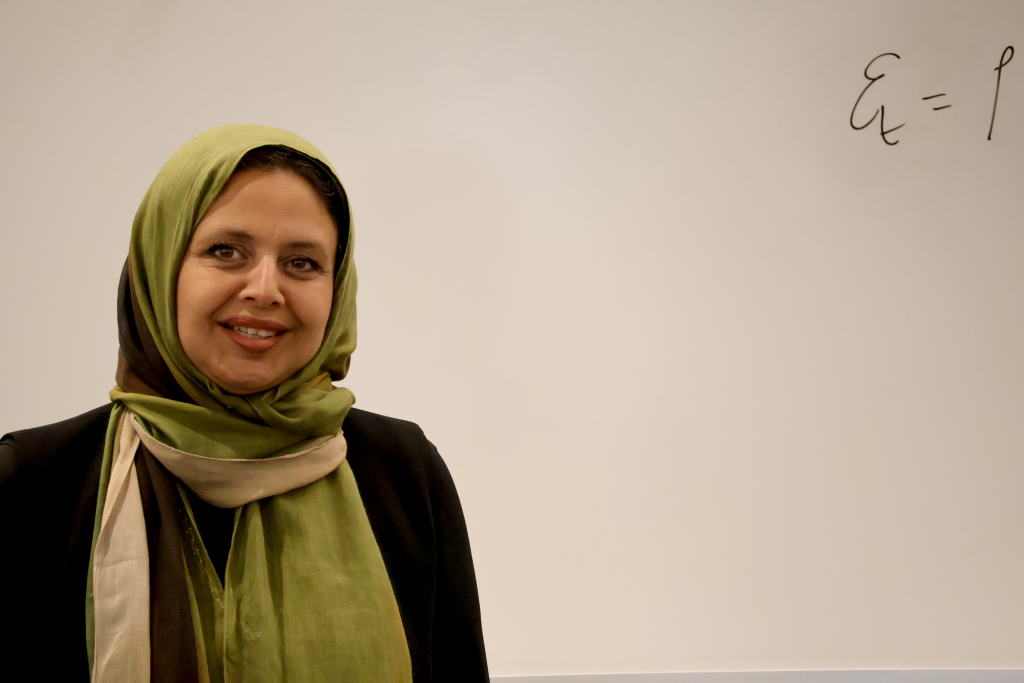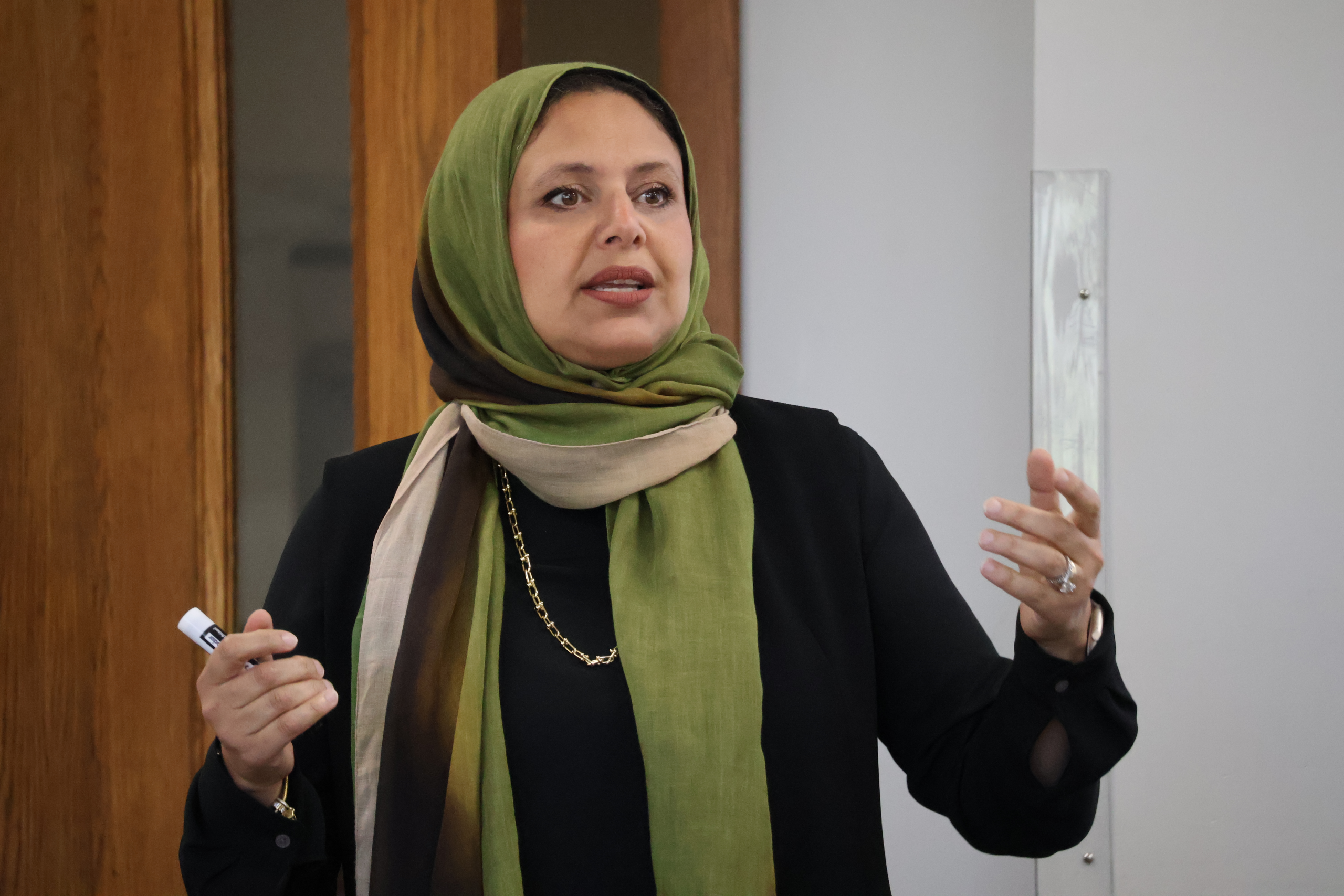
Dr. Ronia Hawash’s understanding of economics didn’t begin in a classroom; it began in the everyday rhythms of life in Egypt.
Growing up, she was surrounded by visible contrasts. Families worked tirelessly, doing everything they could to get ahead, yet many still struggled. Access to healthcare was inconsistent. Educational opportunities were uneven. The systems meant to support people didn’t always reach those who needed them most. For Dr. Hawash, those realities weren’t distant observations – they were impossible to ignore.
They sparked a question that would shape her life’s work: why do systems work for some, but fail for others?
That question led Dr. Hawash to economics.
She began her academic journey at the Faculty of Economics and Political Science at Cairo University, where she earned her undergraduate degree in economics, before continuing to the American University in Cairo for her master’s. Later, she moved to the United States to pursue her Ph.D. in economics at Indiana University Indianapolis – an experience that would further expand both her academic lens and her worldview.
By the time she arrived in the U.S., she was navigating both academic and cultural shifts, learning new norms around communication, privacy, and expression.
“It was a gradual transition,” she reflects. “But what stood out to me most was how welcoming people were. They wanted to understand my background. There was warmth to that.”
Living within two different economic systems also shaped how she understood inequality. Egypt’s more centralized structure and the United States’ capitalist model might suggest vastly different outcomes. But what surprised her most was how similar most challenges remained.
“Inequality in the United States is very high,” she says. “As high as many developing countries. That was shocking to me.”
For Dr. Hawash, it reinforced a deeper truth: economic outcomes aren’t determined by systems along, but by how societies choose to support their most vulnerable.
Today, as an Associate Professor of Economics at the Lacy School of Business, where she has been teaching since 2017, and as Faculty Director of Diversity, Equity, and Inclusion, Dr. Hawash brings that perspective into both her research and her leadership – ensuring students don’t just learn economics, but understand its responsibility.
Across topics like poverty, health, education, political conflict, refugees, and climate change, one thread connects her work: vulnerability. She is especially focused on populations that are often left behind, particularly women and children, whose experiences are frequently shaped by overlapping challenges and systemic gaps. This focus is reflected in her broader body of research, including “Voiceless and Stateless Rohingya Refugees: Competing Expectations Among NGOs in Cox’s Bazar, Bangladesh” (Voluntas: International Journal of Voluntary and Nonprofit Organizations), which highlights how humanitarian systems can unintentionally overlook the needs of women and individuals with disabilities – further compounding existing inequities.
This commitment to understanding and addressing systemic gaps extends into her research: in “The Role of Women’s Empowerment on Environmental Sustainability: A Cross-Country Analysis,” published in the Journal of Strategic Innovation and Sustainability (January 2025), Dr. Hawash explores the connection between women’s political empowerment and environmental outcomes across 135 countries. The study finds that countries with higher levels of women’s political participation tend to have lower CO₂ emissions, especially in developing nations – highlighting that empowering women in political leadership is a proven pathway to stronger environmental policy and more sustainable futures.
As an empirical economist, her work is grounded in data and rigorous analysis. But she is intentional about never losing sight of the human stories behind the numbers.
“Every data point is a person,” she says. “A person with a story, a struggle, a family.”
That perspective has changed how she approaches her work and what she expects from it. For Dr. Hawash, research must go beyond observation. It must be meaningful, actionable, and capable of driving change – something she actively models for students interested in policy, global development, and mission-driven careers.
In the classroom, those insights come to life in a different way. Students often enter their first economics course expecting graphs, formulas, and conversations about money. Dr. Hawash meets them there but doesn’t let them stay there.
“Economics isn’t about making money,” she tells them. “It’s about understanding how the world works and how to make better decisions.”
She brings theory to life through stories – real examples from her own experiences and observations. For many students, it’s the first time they’ve encountered the realities of life in a developing country beyond a textbook. It shifts the conversation from abstract concepts to human impact, helping them see how their future careers can influence real people and communities.
“You can see it,” she says. “Their eyes light up when it becomes real.”
Her classroom is built on engagement, curiosity, and respect. When conversations turn to complex or emotionally charged topics, she emphasizes that no single perspective holds all the answers.
“We all come from different backgrounds,” she says. “There’s no such thing as a perfect policy or a completely right or wrong viewpoint. What matters is understanding each other and respecting different points of view.”
In her role as Faculty Director of Diversity, Equity, and Inclusion, she works to ensure that students, faculty, and staff from all backgrounds feel they belong and have a voice in shaping the community. From launching peer mentorship initiatives to creating spaces where people can share their cultures and experiences, her focus is on building connection and inclusion in meaningful ways.
Her dedication to student impact and inclusion has been recognized with the 2024 Student Impact Award. Over the past 1.5 years, she has collaborated with students on Diversity Perspective Workshops, integrating her research and leadership to create spaces for meaningful dialogue and learning.
Looking ahead, Dr. Hawash hopes students leave her classroom with more than knowledge. She wants them to carry curiosity, confidence, and a sense of responsibility – to understand that their decisions matter and that they have the ability to make a difference.
Outside of her academic and leadership roles, Dr. Hawash is deeply connected to the things that bring her joy. She loves singing and once dreamed of becoming a radio presenter – a passion for voice and storytelling that still shows up in how she teaches. She hopes to one day start a podcast centered on personal reflections, a space to connect in a different way.
She’s also someone who values connection in its simplest forms: gathering with friends, spending time with family, and exploring new places. And when it comes to food, she smiles before answering: Middle Eastern cuisine will always be her favorite, with Indian food a very close second.
Through it all, the question that first drew her to economics still guides her work today. Not just understanding how systems function but how they can function better, more equitably, and more humanely.
Because for Dr. Hawash, economics has never been just about numbers. It’s about people – and the possibility of building a world that works for all of them.