
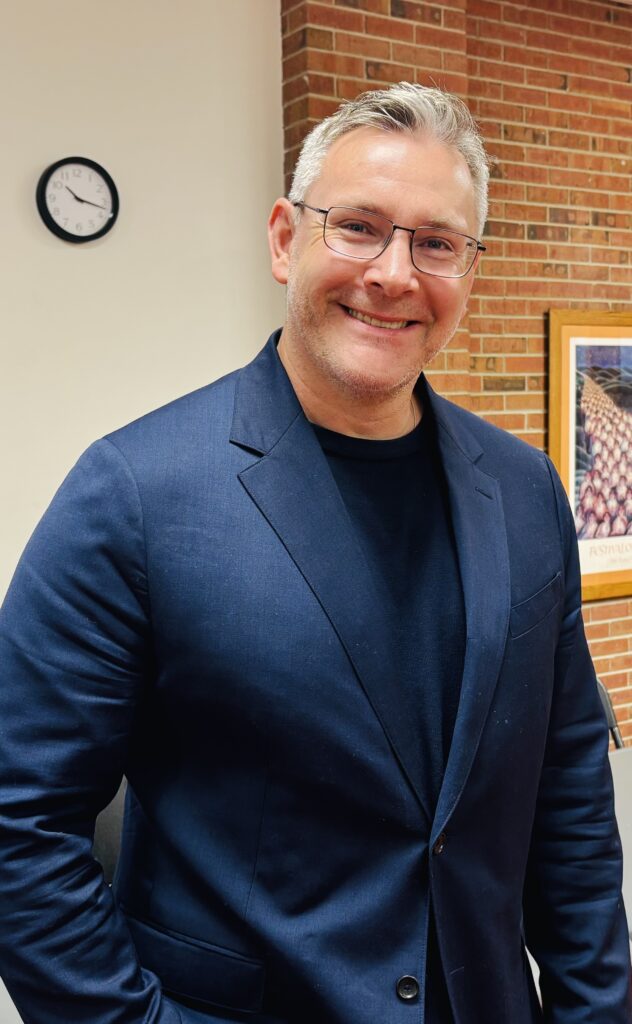
Marketing is about more than selling a product or coming up with a clever ad. It starts with understanding people, what they value, how they make decisions, and how they respond to the world around them. For Dr. Alexander Mitchell, assistant professor of marketing at Butler University’s Lacy School of Business, that curiosity is at the center of the industry. If you ask someone what marketing is and they might think of advertisements, social media posts, or convincing people to buy a product. But Dr. Mitchell sees the field as something much broader: understanding people.
In the classroom, Dr. Mitchell encourages students to question their assumptions and think critically about the decisions businesses make. For students exploring marketing, his approach offers a look at how the field combines creativity, business strategy, and a deeper understanding of people.
Why do consumers choose one brand over another? How do their experiences shape what they buy? And how do businesses keep up as people’s needs and expectations change? These are the kinds of questions that interest Dr. Mitchell as a researcher and inform the way he teaches.
His research looks at the relationships between consumers, brands, and the world around them. He draws on fields beyond business, including sociology and anthropology, to understand why people behave the way they do and how outside circumstances might influence their decisions.
His broader perspective is one reason marketing can lead in so many directions. Understanding consumers matters in every step of the business process. Dr. Mitchell wants students to look beyond what a business is selling and consider the people on the other side of the transaction.
“The core job of marketing is to understand people,” he explained. “And that’s like a lifetime exercise.”
Dr. Mitchell knows firsthand that finding the right career can take a few turns.
He began working at a software company in high school and continued there through college. When this no longer felt like the right fit, his employer’s suggestion pushed him to try marketing.
Over time, his interest grew in the ideas behind business decisions. He didn’t just want to put existing concepts into practice, instead he wanted to investigate questions and develop new knowledge of his own. That interest brought him back to school to pursue a Ph.D.
Now, he brings both his professional experience and academic perspective to Butler students.
His advice for students who are still figuring out their future is personal. Looking back, he wishes he had felt more confident pursuing what genuinely interested him instead of worrying so much about what he thought he should do.
“I would like to see more students follow their instincts and their passions because I wish I had done that more and not try to just follow the things that people told me I should be doing” he says.
One thing Dr. Mitchell hopes students take from his classes is the ability to question assumptions. In marketing, it’s easy to assume you know what customers want or to follow a new trend because other businesses are doing it. But, good decisions require looking at things more closely.
Dr. Mitchell encourages students to think beyond the excitement surrounding new technology. Does it solve a real problem? Does it provide something useful to consumers? Or is a company adopting it simply because it feels like everyone else is?
For him, learning to ask those questions is just as important as knowing how to use a particular tool.
He also wants students to connect what they learn in class to what happens outside of it. Through LSB’s internships and other working experiences, students can see how business concepts work in real settings. Dr. Mitchell has noticed that students often return from internships with new perspectives and a better understanding of how classroom lessons apply to real work.
He sees undergraduate research as another opportunity for students to explore their interests and develop ideas of their own. That experience can be valuable even for students who don’t plan to pursue research as a career. The goal is to help students become comfortable thinking through problems rather than looking for a single right answer.
Dr. Mitchell’s career shows how one opportunity can lead to another. A move away from computer programming introduced him to marketing. An interest in the ideas behind business led him to graduate school. And that path eventually brought him to the classroom.
“It’s so much more fulfilling when you get to do the things that you really are excited about” he says.
His experience shows that college is a time to explore your interests, learn from different perspectives, and discover opportunities you may not have considered before.
Dr. Mitchell hopes students leave his classroom better equipped to ask questions, think critically, and make decisions about what comes next. You don’t need to know your entire career path before you begin. Sometimes, you just need to be willing to try something different.
Leave a Reply