Author: Maddie Koss

  • New Faculty Join the Lacy School of Business for 2025-26

    New Faculty Join the Lacy School of Business for 2025-26

    The Lacy School of Business is excited to introduce a dynamic group of faculty members joining us for the 2025-26 academic year. Each brings a unique mix of industry experience, research expertise, and passion for teaching – further enriching the student experience at LSB. Their contributions will help us continue shaping future business leaders while tackling the challenges and opportunities of an ever-changing world.
    “Our new faculty members represent the future of the Lacy School of Business. These are the educators who will form the most meaningful connections with our students – shaping their experiences, their thinking, and ultimately, their futures,” Craig Caldwell, Dean of the Lacy School of Business, said. “One of LSB’s defining strengths is our faculty: research-active scholars who are deeply committed to student engagement. This new group brings extraordinary promise, continuing and even elevating our tradition of thoughtful, student-centered teaching and impactful scholarship.”
    Meet our new faculty members:

    Kanan Asif, Assistant Professor of Entrepreneurship & Innovation

    Kanan Asif’s own journey has been anything but ordinary – from growing up in a small town in Pakistan and riding a horse cart to school, to working as a tea boy in a jewelry shop, to launching startups and earning a Ph.D. in Entrepreneurship from the University of Massachusetts Lowell. That lived experience shapes how he teaches Real Business Experience (E201) at Butler: not just through lectures, but by helping students discover and develop their own unique strengths. “Learning, unlearning, and relearning every day is what keeps me inspired,” Asif says. Prior to joining academia, he worked across the nonprofit, corporate, and public sectors and began his academic career in Pakistan in 2017. His research explores entrepreneurial decision-making and the individual differences that shape how entrepreneurs think and act. When he’s not sparking entrepreneurial thinking in the classroom, he’s usually spending time with his wife and young daughter, exploring human behavior and personal growth – topics that fuel both his teaching and his life.

    Kanan Asif, Assistant Professor of Entrepreneurship & Innovation

    Tanya Carson, Lecturer in Accounting

    For Tanya Carson, teaching is all about connection. After years of leading large lecture halls with hundreds of students each semester, she knew she wanted something different – smaller classes where she could bring energy to the room and create a safe space for students to collaborate, ask questions, and experience those “light bulb” moments. At Butler, she’s found her dream fit. Carson teaches Principles of Accounting (AC203) and LSB Business Internship (LSB402), where she aims to make accounting approachable, interactive, and even fun. She earned her MBA from Ball State University and holds a graduate certificate in Accounting Analytics from the University of Connecticut. A longtime Carmel resident who has always admired Butler’s campus and community, Carson says joining the Lacy School of Business is everything she hoped it would be: engaged students, the right-sized classrooms, and an atmosphere that feels magical. Outside the classroom, she enjoys hiking, camping, and canoeing, as well as cooking and baking – her specialties include broccoli cheese soup and banana chocolate bread.

    Tanya Carson, Lecturer in Accounting

    Kerri Cissna, Lecturer of Entrepreneurship & Innovation

    Kerri Cissna loves learning and dreaming alongside her students, exploring ways to upgrade antiquated systems and use business as a force for good. At Butler, she teaches First Year Business Experience (E101), bringing her passion for innovation, leadership, and purpose-driven work into the classroom. Cissna earned her Ph.D. in Global Leadership and Change from Pepperdine University, completed a postdoctoral program at Wake Forest, and holds a master’s degree from Azusa Pacific and an undergraduate degree from Warner Pacific University. A certified yoga instructor and studio owner, she integrates mindfulness and movement into her life and teaching. When she’s not in the classroom, she enjoys spending time with her journal and a cappuccino, teaching fitness classes, and spending time with her husband Greg caring for their seven cats.

    Kerri Cissna, Lecturer of Entrepreneurship & Innovation

    Joe Cripe, Lecturer in Supply Chain Management

    Joe Cripe brings his love of developing talent – from his days leading operations at adidas to coaching grade school teams – into the classroom at Butler. He teaches Operations Management (MS350), LSB Business Internship (LSB402), and Strategy Capstone (MG490), helping students connect classroom theory to the real-world goods and services they encounter every day. A proud Indianapolis native, Cripe earned his B.S. at the University of Notre Dame and his MBA from the University of Chicago Booth School of Business. Butler has always held a special place in his life: his father is an alum, he’s been a Butler basketball season ticket holder for 25 years, and he has witnessed firsthand the University’s positive impact on the community. Now transitioning from adjunct to full-time faculty, he’s excited to deepen those connections with students. When he’s not teaching, you’ll likely find him running along the canal towpath or cheering on the Dawgs.

    Joe Cripe, Lecturer in Supply Chain Management

    Juan Manuel Gil, Assistant Professor of International Business

    For Juan Manuel Gil, international business is more than strategy and markets – it’s about people, purpose, and possibility. Gil has lived and studied across Colombia, England, France, Mexico and Spain, earning his Ph.D. cum laude in Business Administration and Management from Universitat Politècnica de València and a master’s degree in international relations from the University of Bristol. At Butler, he teaches International Business Environment (IB320), inviting students to connect global strategy with deeper meaning and confidence in their ability to shape the world. His own journey includes nearly three years in a unique international community with people from 14 nationalities, an experience that taught him the power of “unity in diversity” and sparked his lifelong belief in the strength of community. Guided by Butler’s purpose-driven mission, Gil begins each class with a moment of breathing and reflection, encouraging students to slow down, think intentionally, and approach business with imagination and heart. When he’s not teaching, he’s exploring entrepreneurial imagination through research and spending time with the global community he’s built around him.

    Juan Manuel Gil, Assistant Professor of International Business

    Matthew Lanham, Assistant Professor of Business Technology & Analytics

    Matthew Lanham is passionate about helping students become independent thinkers – so much so that his favorite part of teaching is watching them grow to the point where they no longer need him. At Butler, he teaches Business Analytics (MS365), guiding students to master data-driven decision-making and turn complex information into actionable insights. Lanham earned his Ph.D. in Business Information Technology from Virginia Tech, a master’s degree in Biostatistics-Decision Science from the University of Louisville, and his undergraduate degree from Indiana University. Before joining Butler, he spent nine years at Purdue University, leading analytics programs and research. Beyond the classroom, Lanham is a devoted dad to his seven-year-old daughter, Stella – his favorite Little House on the Prairie rewatch partner – and an active member of his church, where he teaches young children on Sundays.

    Matthew Lanham, Assistant Professor of Business Technology & Analytics

    John Shassberger, Lecturer in Finance

    After serving 40 years with the Department of the Navy – 21 on active duty as commander and nearly two decades as a civilian leader – John Shassberger knew exactly what he wanted to do next: teach. His journey from the Naval Academy – where he trained and mentored young sailors – to the classroom has been fueled by a passion for getting students to think critically, engage deeply, and launch confidently into life. At Butler, Shassberger is teaching Corporate Finance (FN340) and International Finance (FN451). He earned his Ed.D. in Leadership from Oakland City University, his M.S. in Financial Management from the Naval Postgraduate School in Monterey, Calif., and his B.S. in Political Science from the United States Naval Academy. Beyond the classroom, he runs a lively family farm that keeps him, in his words, “young in body and sharp in mind” – with seven kids, twelve dogs, two horses, two cows, two mini donkeys, and six goats to help with that mission.

    John Shassberger, Lecturer in Finance

    Shubhra Sharma, Lecturer in Entrepreneurship & Innovation

    For Shubhra Sharma, teaching is about presence – 50 minutes of full focus where “aha” moments spark and the classroom feels alive. She teaches First Year Business Experience (E101), drawing on a career that spans continents, from earning a doctorate in socio-cultural anthropology at the University of Texas at Austin to completing an Executive Master’s in Luxury Management and Design Innovation at ESSEC Business School in Paris. Along the way, she’s taught at Vanderbilt, lived in New York, and traveled to seven countries – each experience adding new perspective to how she approaches entrepreneurship. Sharma believes being an entrepreneur is “like drawing the map while you’re walking the terrain,” and she loves helping first-year students begin their journey. When she’s not teaching, you might find her on the golf course (handicap 12), strength training or running outdoors, listening to her favorite 80’s playlists, or working on creative projects like co-writing children’s books with her 10-year-old niece – who proudly claims the title of Creative Director.

    Shubhra Sharma, Lecturer in Entrepreneurship & Innovation
  • Advancing Ideas: Lacy School of Business Launches Fall 2025 Research Speaker Series

    Advancing Ideas: Lacy School of Business Launches Fall 2025 Research Speaker Series

    The Lacy School of Business is excited to announce the Fall 2025 Research Speaker Series. This series highlights the innovative research and thought leadership of our faculty and visiting scholars, providing opportunities for students, colleagues, and community members to engage with cutting-edge ideas in business and beyond.

    Each session offers a chance to hear directly from researchers about their latest work, ask questions, and connect theory with practice. Whether you’re curious about global business challenges, entrepreneurship, or emerging insights across disciplines, the series is designed to spark discussion and inspire new ways of thinking.

    We invite you to join us throughout the semester to learn, connect, and be part of the ongoing exchange of ideas shaping the future of business scholarship.

    Wednesday, October 8 at 11:45 PM

    Speaker: Ki-Hoon Lee, Senior Professor and Chair of Sustainability in Business at Edinburg Napier University
    Location:
    Dugan Hall, Room 347
    Title:
    “Sustainability Research Impact in Academia and Beyond”

    Abstract: Sustainability Research addresses global challenges and planetary boundaries by developing innovative solutions, influencing policy, and informing societal change towards sustainable development. In business and management research, public concern for environmental sustainability (e.g. climate change, water scarcity, air pollution) and social sustainability issues (e.g., poverty, hunger, income inequality, gender equity) over two decades have generated ‘social license to operate’ in corporate boardrooms that exceed regulatory compliance. However, scholars suggest that the sustainability research domain is not only narrowly-focused but also highly fragmented. Scholars suggest shifting the focus of research from “what” (sustainability definition) and “why” (reasons and motivations for engagement) to a greater concern for “how” firms can implement sustainable practices. Sustainability research across disciplines to tackle global challenges can generate research impacts in academia and society. This research talk seeks academic roles to generate sustainability research impact in our business and society.  

    Friday, October 17 at 12:00 PM

    Speaker: Hessam Sarooghi, Associate Professor of Entrepreneurship and Innovation
    Location: Dugan Hall, Room 347
    Title: “Configuring Success: Legitimation Pathways in Cryptocurrency Exchanges”

    Abstract: Legitimation is central to how new ventures secure resources and gain acceptance, yet it is rarely uniform. Ventures can establish credibility by being understandable and familiar to stakeholders (cognitive legitimacy), by signaling adherence to ethical norms and regulatory expectations (normative legitimacy), or by demonstrating tangible benefits and reliability (pragmatic legitimacy). These dimensions often operate together, sometimes in complementary fashion and sometimes as substitutes. The goal of this study is to examine how such patterns shape performance outcomes to provide a more complete understanding of the consequences of legitimation.

    To this end, this study develops a configurational perspective and applies fuzzy-set qualitative comparative analysis (fsQCA) to 111 cryptocurrency exchanges. The setting is institutionally fluid and high in volatility, making legitimacy particularly salient. The analysis reveals multiple equifinal pathways to high performance: some exchanges combine pragmatic utility with normative transparency, others substitute visible leadership for broad public recognition, and still others integrate all three dimensions into coherent constellations. 

    Friday, November 14 at 12:00 PM

    Speaker: Juan Manual Gil, Assistant Professor of International Business
    Location: Dugan Hall, Room 347
    Title: “Beyond Cognition: Integrating Embodied Imagination and Spiritual Capital in Entrepreneurial Value Creation”

    Abstract: This research project challenges the cognitive reductionism that dominates entrepreneurship scholarship by demonstrating how non-cognitive dimensions – specifically embodied entrepreneurial imagination and spiritual capital – fundamentally shape entrepreneurial value creation. Current theories treat entrepreneurial imagination as sophisticated information processing, yet this cognitive emphasis fails to explain the sudden insights, intuitive breakthroughs, and transformative visions that enable entrepreneurs to create genuinely novel value. Drawing on phenomenological philosophy, this work reconceptualizes entrepreneurial imagination as an embodied, affective process rooted in sensory experience and somatic intuition rather than mental computation alone. Similarly, it reframes spiritual capital as immanent, relational knowing embedded in everyday practice rather than external ethical norms or transcendent belief systems.

    The project currently focuses on conceptual development – clarifying constructs, establishing theoretical boundaries, and building nomological networks that connect these non-cognitive dimensions to existing entrepreneurship frameworks. This foundational work extends the effectuation decision-making model while developing an integrated framework for understanding how consciousness-based entrepreneurial imagination drives value creation, drawing on phenomenology, embodiment theory, and historical organizational analysis to establish conceptual coherence before empirical investigation.

    This conceptual foundation will enable subsequent qualitative research examining how contemporary entrepreneurs mobilize embodied imagination and spiritual resources to generate transformative value in practice, followed by quantitative studies measuring consciousness development practices and their relationship to venture outcomes across diverse contexts. By progressing systematically from philosophical grounding through interpretive inquiry to empirical validation, this research line aims to transform entrepreneurship scholarship from narrow cognitive models toward holistic frameworks that honor human consciousness in its full dimensionality for creating meaningful, regenerative entrepreneurial value.

    Friday, December 5 at 12:00 PM

    Speaker: Kuhelika De, Associate Professor of Economics
    Location: Dugan Hall, Room 347
    Title: “Remittances and Business Cycles: The Role of Financial Development”

    Abstract: This paper investigates whether financial development mitigates the impact of remittance shocks on the volatility of business cycles. Employing a two-stage empirical approach, we first estimate the dynamic response of consumption to remittance shocks using country-specific structural vector autoregression (VAR) models across 92 advanced and emerging market economies. In the second stage, we perform a cross-country analysis to assess the moderating role of financial development.

    The findings indicate that higher levels of financial development significantly reduce the volatility of consumption in response to remittance shocks, even after accounting for other macroeconomic and institutional factors. This study holds important policy implications. Since financial development dampens the impact of remittance shocks on consumption volatility, policies aimed at strengthening financial institutions, improving access to credit, and promoting financial inclusion can enhance economic resilience in remittance-receiving countries.

  • Experiential Learning Opportunities – Go Beyond the Classroom

    Experiential Learning Opportunities – Go Beyond the Classroom

    At the Lacy School of Business, the Supply Chain Department is excited to offer a lineup of experiential learning opportunities open to all Butler students, faculty, and staff. These hands-on experiences give you a chance to see supply chains, manufacturing, and logistics in action at some of Indiana’s leading organizations.

    All visits are optional and open to the Butler community. For students currently enrolled in courses with Professors Jane Siegler, Matthew Caito, or Joe Cripe, attending one or more visits and submitting a one-page reflection may allow you to replace a grade on a quiz or discussion board.

    Explore the opportunities below and see what’s happening beyond the classroom!

    Butler Experiential Logistics Lab (BELL) Tour
    RSVP below – spots are limited!

    About:
    Butler has partnered with the Vincennes University Logistics Training and Education Center (VULTEC), a modern Supply Chain Lab and functioning distribution center spanning ~30,000 sq. ft. in Plainfield. Students get hands-on experience with modern storage systems, racking, safety equipment, forklifts, power jacks (students can operate them), pick-to-light order fulfillment, truck loading docks, and industrial robotics.

    When: Dates and times vary.
    Where: 1610 Reeves Rd, Plainfield, IN 46168
    Drive time from Butler: ~40 minutes (carpooling may be available – indicate on RSVP)
    Cost: FREE – limited availability, first come first serve.
    In order for registration to be complete, you MUST also complete this required form.

    Allegion’s 2025 Manufacturing Day

    Thursday, October 2 from 9:00 AM – 12:30 PM
    Status: Full – registration closed

    About:
    Allegion is a global manufacturer of security products and solutions. Students will explore diverse career paths in engineering, IT, robotics, design, R&D, and production. This tour showcases how technology and innovation drive manufacturing growth and highlights opportunities for the next generation of professionals.

    Where: 2720 Tobey Drive, Indianapolis, IN 46219
    Drive time from Butler: ~20 minutes (carpooling may be available – indicate on RSVP)
    Cost: FREE – limited availability, first come first serve.
    Registration is now closed.

    Amazon Fulfillment Center Tour

    Monday, October 6 from 3:00 PM – 5:30 PM (arrive no later than 2:45 PM)

    About:
    Tour one of Amazon’s largest fulfillment centers in Indiana and witness the supply chain in action. Students will learn how Amazon uses robotics, automation, and real-time data to move products through storage, picking, packing, and shipping. This visit highlights the scale and speed of operations, as well as career paths that support Amazon’s global network.

    Where: 4255 Anson Boulevard, Whitestown, IN 46075
    Drive time from Butler: ~35 minutes (carpooling may be available – indicate on RSVP)
    Cost: FREE – limited availability, first come first serve.

    Adidas Indy Site Visit

    Tuesday, October 7 from 2:45 PM – 5:00 PM
    Status: Full – registration closed

    About:
    Meet directors overseeing Manufacturing and Distribution, as well as department heads at Adidas Indy. Students will see one of Indianapolis’ largest manufacturing employers in action with screen printing, embroidery, and heat transfer for garments and uniforms for U.S. professional and NCAA teams. This site uses a work center layout designed for speed to market, so many supply chain concepts from class will be visible in real time.

    Where: 8677 Impact Ct, Indianapolis, IN 46219
    Drive time from Butler: ~25 minutes (carpooling may be available – indicate on RSVP)
    Cost: FREE – limited availability, first come first serve.
    Registration is now closed.

    Heartland Foods Manufacturing Site Visit (Graduate Students Only)

    Friday, October 10 from 8:00 AM – 9:30 AM

    About:
    Heartland Foods is a major food manufacturer in Indianapolis. Students will tour the production floor and see high-speed manufacturing lines in action, gaining insight into the processes, technologies, and safety standards that keep food production efficient and reliable. Important: All attendees must wear closed-toe shoes; no jewelry is allowed for safety reasons.

    Where: 4929 W 86th Street, Indianapolis, IN 46268
    Drive time from Butler: ~20 minutes (carpooling may be available – indicate on RSVP)
    Cost: FREE – limited availability, first come first serve.

  • Finding Confidence and Community: Zaiah’s BU: BeReal Experience

    Finding Confidence and Community: Zaiah’s BU: BeReal Experience

    Stepping onto a college campus for the first time can feel intimidating – the unfamiliar buildings, the bustle of students, the sense of possibility all at once. But for high school students attending Butler University’s BU: BeReal camp, those initial nerves can quickly transform into curiosity, excitement, and a chance to imagine themselves thriving in a future they might never have considered.

    Zaiah Crites, a first-year Lacy School of Business (LSB) Finance major, remembers that feeling vividly.

    BU: BeReal was her first-ever camp experience. Encouraged by her great-grandmother, who had spotted the camp’s call-out on Facebook, Zaiah decided to take a leap into the unknown. “It was kind of like speed dating – but for friends,” she laughs. “By the end of the week, we had created a family out of complete strangers.”

    Supported by Lilly Endowment Inc. through its Indiana Youth Programs on Campus initiative, and developed in collaborations across the university, BU: BeReal included business- and leadership-focused programming shaped in part by LSB.

    It gently eased Zaiah into college life – helping her adjust to dorm routines and navigate daily schedules. But the real magic came from the hands-on business experiences led by LSB faculty,  she got a taste of real college classes and even earned a college credit through LSB, giving her a tangible step toward higher education while building confidence and practical skills.

    The first-generation college student got to see what it meant to build a business, explore marketing, and understand basic finance – all lessons that directly connected to what she’s learning now in her first-year business classes. “It was like a pre-prep for college coursework,” she says. The experience gave her both confidence and a sense of preparedness that few first-year students have, and it sparked a deeper curiosity about her potential in business.

    Beyond academics, BU: BeReal emphasizes leadership, collaboration, and personal growth. Zaiah discovered a newfound self confidence, and she learned to communicate, work with others, and step into leadership roles in ways she hadn’t before. “I realized I could be a leader in situations,” she says, reflecting on the week’s impact.

    Since its launch, BU: BeReal has more than tripled in size – growing from just over 60 students in 2023 to nearly 140 in 2025, with more than 325 participants so far.

    Part of what makes the camp so transformative is its commitment to accessibility. Scholarships are offered to students from low-income backgrounds or those who will be first-generation college students, giving every camper the chance to experience life on Butler’s campus. For a full week, they live on campus and immerse themselves in both academic and co-curricular opportunities – building the skills and confidence to not just attend college, but thrive there.

    For Jessica Stoltzfus, Director of Camps & Community Programs, the college immersion program is about more than just early exposure to business concepts – it’s about bringing those ideas to life. “High school students need to see what business and other industries look like in action,” she explains. “We want them to feel empowered to take risks, test ideas, and see themselves as capable leaders.”

    That vision is echoed by Emily Hawk, Assistant Dean of Innovation and Lecturer in Entrepreneurship, who sees the camp as a turning point for many. Students often arrive unsure; unsure of what business really is, unsure if college is for them. By the end of the week, she says, something shifts. “It’s about creating a safe place for students to explore, fail, pivot, and ultimately discover their strengths.”

    Zaiah is living proof of that shift. She describes the week as transformative – an experience that gave her not only practical skills but also a new sense of excitement for the journey ahead. “I’m starting from zero in my major, so I’m excited to grow, join clubs, network, and build a strong resume. The camp gave me a head start in understanding what it takes to succeed in business.”

    Her advice to future campers is simple but powerful: “Put yourself out there, try new things, and go into it with an open mind.”

    Registration for the 2026 summer session opens in December. The Lacy School of Business is committed to reaching students who may never have imagined college or a career in business, which is why BU: BeReal will expand to include a fully business-focused program in 2026. The pre-college program runs a full week, with intensive academic programming in the mornings and leadership, co-curricular, and extracurricular activities in the afternoons.

    “Whether or not they choose Butler or the Lacy School of Business after high school is not the goal,” Hawk says. “The goal is to touch students’ lives in meaningful ways, helping them grow into confident, independent, and innovative leaders.”

    To learn more about Bu: BeReal, click here.

  • Founders in the Making: LSB Launches First-Year Pitch Competition

    Founders in the Making: LSB Launches First-Year Pitch Competition

    Three and a half weeks into college, most first-years are still figuring out where their classes are or which dining hall is the safest bet. At the Lacy School of Business, though, 44 students were already stepping into the spotlight, pitching startup ideas as if millions were on the line.

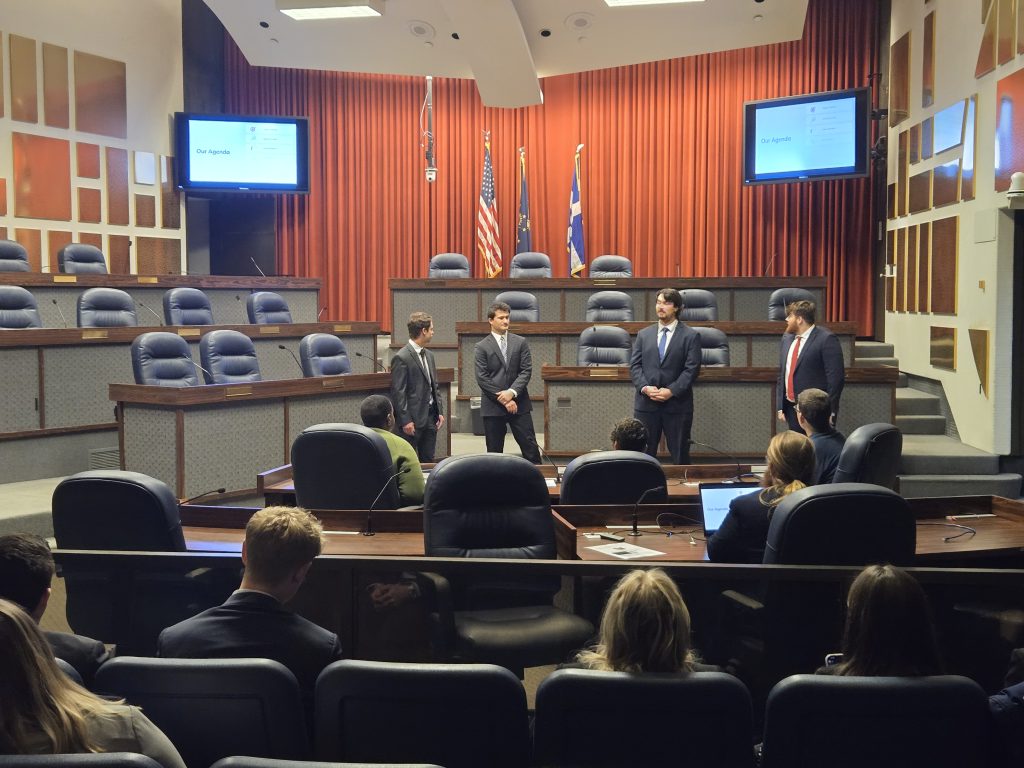
    That was the scene at the first First-Year Pitch Competition, sponsored by Roll Tack Ventures, on September 19. 22 teams, two students each, three minutes on the clock, and just three slides to make their case. A panel of six judges stood in as venture capitalists, pressing them with questions about customers, markets, and why their ideas deserved to exist right now.

    The case studies students worked from were inspired by real-world startups: HeartHalo, a wearable sensor that prevents heat stress in industrial workers; ReturnRaccoon, a B2B software that streamlines product returns; ShieldFox, a real-time risk monitoring tool; and TrueVibe, an employee sentiment platform mapping workplace “vibes” in real time. Each team wasn’t just pitching a product – they were stepping into the role of founder, showing why this company, why now, and why them.

    And they didn’t hold back. Some dressed in coordinated outfits, others designed their own logos, and one team triggered an alarm mid-pitch to demonstrate HeartHalo in action. It was Shark Tank energy; with all the guts and creativity you’d expect from entrepreneurs – only these “founders” had been on campus less than a month.

    Judges pushed hard, asking questions like: Who’s the decision-maker? Why hasn’t this problem been solved yet? What makes this the right time? But they also offered encouragement that left students buzzing. “Even if you don’t know the answers, come with confidence and give it your best shot,” Tyler Mantel, General Partner at Roll Tack Ventures, said.

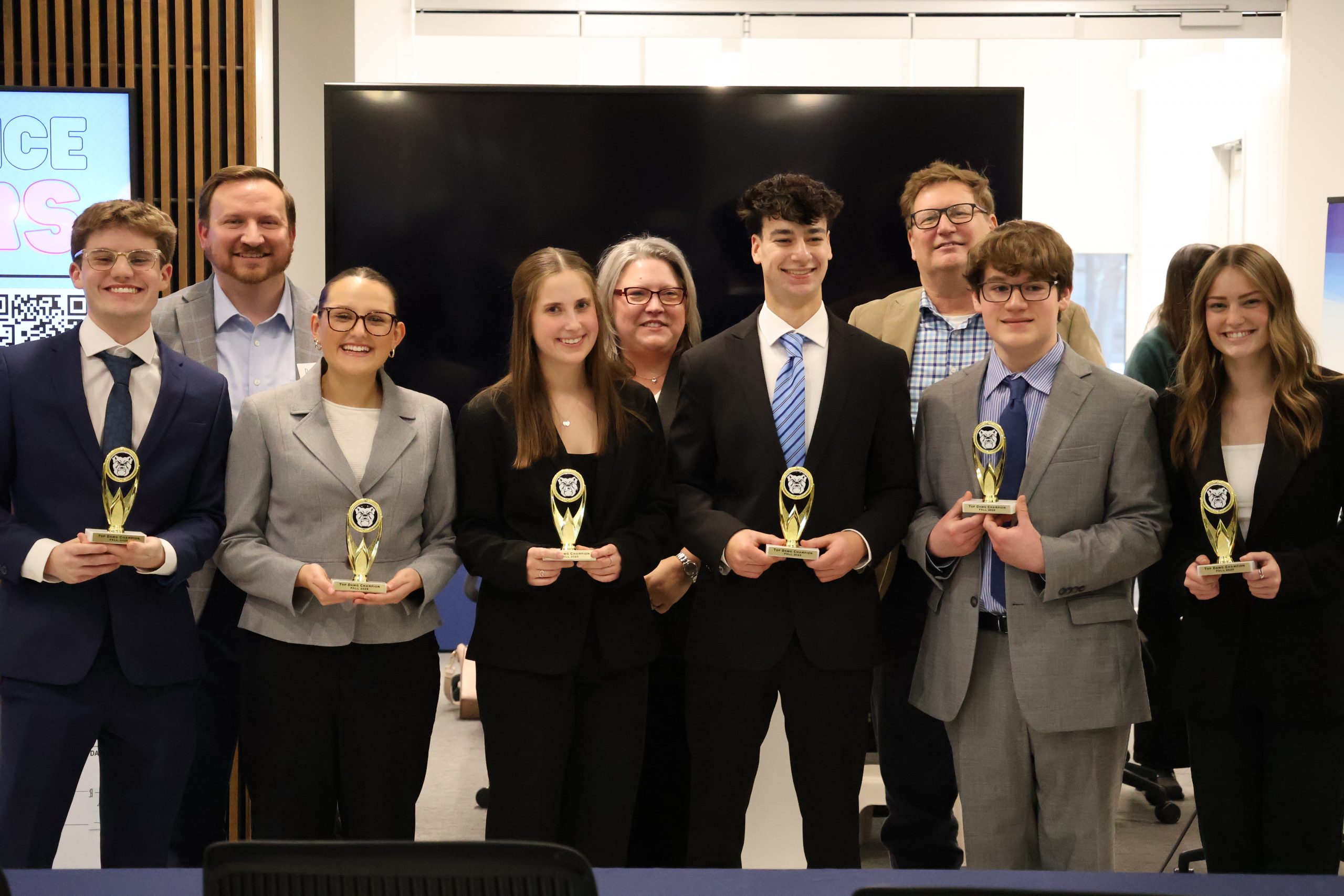
    At the end of the day, two teams stood out. Peri Mossman and Ava Mehling walked away with first place and a $1,000 prize for their compelling pitch of TrueVibe, showing how live “vibe maps” could transform employee engagement. Charlotte Potts and Kara Rady earned Best Presentation and a $500 prize for their polished and creative HeartHalo pitch, impressing judges with both style and substance.

    But the real story wasn’t about the big checks. It was about students pushing themselves out of their comfort zones and gaining skills that will serve them well beyond this competition.

    “Pitching allows students to practice nearly every skill they’ll need after graduation – working as a team, presenting ideas clearly, thinking through problems, leveraging research, balancing accuracy with creativity, and showing themselves well,” Nick Smarrelli, Lecturer in Entrepreneurship and Innovation said. “And the best part? It’s fun. Every team exceeded expectations. The students who said ‘yes’ to this competition have already set themselves apart just a few weeks into the school year.”

    As Roll Tack Ventures mentors reminded students, not every business is right for venture capital funding, and part of the process is learning to spot which ideas have the potential to scale. Just as importantly, students connected with peers and industry leaders, building networks that will fuel their growth throughout their academic and professional journeys.

    “To do something that doesn’t exist in the world, you have to have confidence – maybe even a little arrogance – to believe you can,” Mantel said. “Today, students showed they have a piece of that confidence. And that’s the start of something great.”

  • Fueling the Future: Entrepreneurship Takes Center Stage at LSB with Indy 500 Champion Alex Palou

    Fueling the Future: Entrepreneurship Takes Center Stage at LSB with Indy 500 Champion Alex Palou

    The buzz inside Fairview House was undeniable. More than 200 students, alumni, and community members gathered shoulder to shoulder on September 10 for the Entrepreneurship Kick-Off, hosted by the Lacy School of Business’s Private Venture Association (PVA) and Butler DECA. This wasn’t just another campus event – it was a celebration of bold ideas, resilience, and the drive to build something new, capped off with insights from Indy 500 champion Alex Palou.

    That spirit was reflected in the audience itself: more than 50 student founders were in the crowd, joined by peers from across Butler’s colleges, all eager to learn and connect.

    Nick Smarrelli, Lecturer in Entrepreneurship & Innovation, set the tone early. “About 70% of people in this generation want to start a business at some point. How can Butler help in that journey?” he asked the crowd. He pointed to the ways Butler already fuels that ambition, from Bulldog Enterprises – where students run real, functional businesses like Butler Brew and Chimba Bowls – to the PVA program, which helps students explore venture capital and angel investing. “We have a decade-plus of entrepreneurship at Butler and we’re continuing to take it to the next level,” Smarrelli said. “It’s about creating value, solving problems, making connections, and being inspired by creativity.”

    Dean Craig Caldwell echoed that sentiment, reminding the audience that Butler’s commitment to entrepreneurship goes far beyond the Lacy School of Business. “Everyone needs to know that the university, not just LSB, is leaning into entrepreneurship now more than ever. LSB is just leading the charge,” he said. He also highlighted the upcoming Butler Angel Network, set to launch in Spring 2026. The initiative will connect Butler with accredited investors to back early-stage firms, with the ultimate goal of seeing Butler-born startups thrive.

    From there, the focus turned to students and alumni who had already brought their ideas to life. John Dunn, a recent graduate and founder of EntryPoint SRM, spoke about his edtech company that helps K–12 schools streamline operations. His advice for aspiring entrepreneurs? “Have realistic expectations of what entrepreneurship looks like,” he said. “Talk to people as much as you can to get their feedback. Don’t try to do everything on your own.”

    Felipe Reyes, founder of Chimba Bowls, told the story of turning a class project into a restaurant that now employs more than 22 people. For him, the key lesson was that passion and persistence matter more than experience. “Butler gave me the yes and the opportunity,” Reyes said. “Know that you have the capacity to build cool things and make an impact. Don’t let the things you haven’t experienced hold you back.”

    For Sam Farber, founder of Zealot, the path was even more unexpected. He described selling his company for millions at just 24 and stressed the importance of taking risks rather than waiting for perfect timing. “Life is won by people who say yes – not those who wait,” Farber said. “You don’t learn to swim by reading about it, you learn by jumping in.”

    The energy in the room carried into the night’s headline moment: a fireside chat with IndyCar star Alex Palou. Though most know him as the 2025 Indy 500 champion, Palou spoke candidly about how his entrepreneurial spirit shaped his career. “Racing is not a straightforward process,” he told the audience. “I spent a lot of time making calls asking for money and support just so I’d have the opportunity to chase my dreams.” At just 20 years old, while in Japan, he even started a coffee shop as a backup plan. “I didn’t know anything in advance, but it was very successful,” he admitted with a grin.

    When asked what success means to him, Palou offered a simple but powerful definition. “When I was a kid, I just wanted to be a professional racer. To reach that dream was success. To be able to wake up every morning and work on what you love while trying to be better every day – that’s the goal.” And when it came to motivation after a big win, his words resonated with both racers and entrepreneurs alike: “Business is the same as championships. When you’re successful, it’s like a high for a few hours – then you want more. At the end of the day, you need to do it all over again.”

    As the crowd filtered out after an evening of insight, inspiration, and plenty of applause, one thing was clear: this event was more than a launch of the program. Thanks to the leadership of PVA and Butler DECA, it showcased the very heart of Butler entrepreneurship: students turning ideas into thriving businesses and alumni proving what’s possible after graduation.

  • The Butler Angel Network: Hands-On Learning for Tomorrow’s Leaders

    The Butler Angel Network: Hands-On Learning for Tomorrow’s Leaders

    Imagine being a college student and having the chance to evaluate real startups, connect with investors, and make funding decisions that could shape the next big idea – all before you graduate.

    That’s exactly what students at Butler University will be able to do through the upcoming launch of the Butler Angel Network in Spring 2026, a student-led initiative that bridges classroom learning with real-world venture capital experience.

    “This is more than an investment vehicle,” Craig, Caldwell, Dean of the Lacy School of Business, said. “It’s a living lab for our students, another example of student-run enterprises at Lacy, a bridge to our alumni, and a bold step toward making Bulter a hub for entrepreneurial leadership and economic development in the Midwest.”

    Developed and executed by LSB, the Butler Angel Network will give students the chance to actively participate in deal sourcing, due diligence, portfolio analysis, and communication with angel investors – gaining hands-on experience that will go far beyond the traditional classroom setting.

    The Butler Angel Network is the newest addition to a growing lineup of immersive, student-led ventures at the Lacy School of Business. These initiatives are designed to emphasize real-world experience over theory.

    Students have the opportunity to manage a captive insurance company, oversee a multimillion-dollar Student Managed Investment Fund, conduct company valuations through Bulldog Reports, and even launch their own businesses as sophomores.

    Additional enterprises, including the student-run coffee shop and thrift store, further expand these hands-on learning opportunities. Together, they position Butler among the nation’s top institutions for experiential business education.

    Through this model, graduates leave prepared to step confidently into their careers as leaders, problem solvers, and entrepreneurial changemakers.

    The network will also create new ways for alumni and accredited investors to get involved. Alumni will be able to mentor students, invest in startups, and directly contribute to Butler’s growing ecosystem.

    “By empowering students and connecting them with real-world investment opportunities, Butler is positioning itself as a critical partner in driving regional economic development,” Travis Stegemoller, General Counsel with gener8tor said.

    The initiative complements Butler University’s collaborations with organizations like gener8tor, TechPoint, and the Indiana Economic Development Corp, positioning the university as a leader in innovation and experiential business education. By deploying a part of its endowment as co-investment alongside accredited investors, Butler will help promising startups grow while giving students a truly hands-on learning experience. The network’s goal is to amass $10 million in investable capital and hold its first pitch event in Spring 2026.

    Returning to his alma mater as Executive Director, Dr. Paul Newsom will lead the initiative. “I’m thrilled to return to Butler University and contribute to student success by connecting them with practical, real-world business experiences,” he said. “After a decade of guiding early-stage startups toward growth and enhancing returns for accredited investors, I look forward to leveraging those insights at the Lacy School of Business to strengthen ties between students, accredited investors, and entrepreneurs.”

    The Butler Angel Network will redefine how students learn about entrepreneurship, giving them real responsibility, mentorship, and the opportunity to impact the regional startup ecosystem. For students, alumni, and investors alike, it’s an exciting step forward – and a reminder that innovation is a team sport.

    Accredited investors or alumni interested in joining the Butler Angel Network or learning more can contact butlerangels@butler.edu.

  • Economics in Action: Dr. Kuhelika De on Research, Teaching, and Mentorship

    Economics in Action: Dr. Kuhelika De on Research, Teaching, and Mentorship

    When Dr. Kuhelika De talks about economics, her energy is contagious.

    She leans in, eyes bright, as she unpacks complex ideas like causes of business cycles or the transmission of monetary policy.

    Her enthusiasm isn’t just for theory; it’s about understanding how these ideas can inform policy to create a better society.

    She loves showing students how curiosity and guidance can spark insight and opportunity. Teaching, she believes, has the power to open doors that might otherwise stay closed.

    “Your teachers make a lasting impression,” she reflects. “Back in high school, I had a great teacher who sparked my curiosity in economics. That’s what set me on this path.”

    That early spark eventually carried her from classrooms in India to the United Kingdom, and then to the United States, shaping the path of her impressive academic journey. Dr. De earned her Bachelor’s (B.A. Hons.) in Economics from the University of Delhi, a Master’s in Economics from the University of Manchester, and her Ph.D. in Economics from the University of Georgia in 2017, with a concentration in monetary economics.

    At the University of Georgia, her doctoral advisor, Dr. William D. Lastrapes, was a defining influence in her academic career, giving her both the technical training and the research mindset she now instills in her own students. “I owe my academic success to my doctoral advisor,” she said.

    Having studied in three countries, Dr. De brings a scholarly global perspective into her classroom. She describes her experiences abroad as transformative – not just academically, but personally – as she navigated cultural differences, independence, and new ways of thinking.

    As an Associate Professor of Economics, she joined Butler’s Lacy School of Business in August 2023 after five years at Seidman College of Business, Grand Valley State University in Michigan. She was particularly drawn to Butler, noting it’s number one ranking in the Midwest region for seven consecutive years.

    Drawn by LSB’s strong reputation, small class sizes, and highly prestigious business school environment, the faculty member says the move has exceeded expectations.

    “There’s such a positive externality here,” she laughs, borrowing an economics term. “The people around me – my colleagues, the Dean’s office, senior faculty – they’ve been incredibly supportive. They push me to innovate, to grow. You want to do more, give more, because you feel so inspired.”

    While her background is extensive, Dr. De’s enthusiasm truly shines when she talks about her students.

    “Interacting with students is the best part of my job,” she says with a smile. “Professors play a role that goes beyond teaching. We’re mentors and advisors. In some ways, we come next to parents in shaping a student’s future. I am where I am because of my professors. Now, I want to be that person for my students.”

    Recently, Dr. De celebrated major milestones in her research. In 2024, she published a paper in Health Economics titled “Business Cycles and Healthcare Employment,” exploring how recessions affect employment in the healthcare industry and highlighting the real-world impact of economic fluctuations on critical industries. From a broader perspective, the study provides new robust evidence that U.S. healthcare employment is not recession‐proof.

    In August, her paper, “Inequality, Household Credit Shocks, and House Price Dynamics,” was published in the International Monetary Fund Economic Review, one of the premier journals in the field of monetary economics published by the International Monetary Fund. Using data for 42 developed and emerging markets, the study shows how income and wealth inequality amplifies the impact of credit expansions on house price fluctuations, drawing lessons from the 2008 housing crisis. In simple terms, high inequality is associated with a larger proportion of credit-constrained households. These households tend to borrow more aggressively during periods of easy credit and then cut back spending more sharply when facing mounting debt. This creates a disproportionate distribution of debt, which can destabilize the housing market and contribute to a wider recession. Her conclusion is clear: “If we don’t address inequality, we risk making our economies less stable.”

    Her research contributions have been recognized with two notable awards: the “Distinguished Early Career Scholar Award” from Grand Valley State University in 2022, and the “Research with Impact Award” from the Lacy School of Business, Butler University in Spring 2025.

    For Dr. De, the motivation behind her research goes beyond analyzing economies – it’s about improving human well-being and creating a better society. Economics, as an interdisciplinary field, allows her to examine economic fluctuations and inform policies that can promote economic stability.

    At Butler, she is already incorporating these insights into her teaching in “Principles of Macroeconomics”, “Intermediate Macroeconomics” and “Money and Banking”. In the future, the associate professor will teach “Development Economics”, again connecting global issues such as inequality, infrastructure, economic growth, and access to fair and secure jobs – what economists call “decent work” – to the United Nations Sustainable Development Goals. Her aim, she says, is not only to teach students the tools of economics, but also to instill a sense of responsibility as global citizens.

    “I love my subject, but more than that, I love my students,” she says. For the educator, the joy of being a professor lies at the intersection of research, teaching, and mentorships. “They’re creative, curious, full of ideas. Every student is gifted in their own way. My job is to help them discover what’s meant for them – and give them the tools to pursue it.”