Author: Maddie Koss

  • Fueling the Future: Entrepreneurship Takes Center Stage at LSB with Indy 500 Champion Alex Palou

    Fueling the Future: Entrepreneurship Takes Center Stage at LSB with Indy 500 Champion Alex Palou

    The buzz inside Fairview House was undeniable. More than 200 students, alumni, and community members gathered shoulder to shoulder on September 10 for the Entrepreneurship Kick-Off, hosted by the Lacy School of Business’s Private Venture Association (PVA) and Butler DECA. This wasn’t just another campus event – it was a celebration of bold ideas, resilience, and the drive to build something new, capped off with insights from Indy 500 champion Alex Palou.

    That spirit was reflected in the audience itself: more than 50 student founders were in the crowd, joined by peers from across Butler’s colleges, all eager to learn and connect.

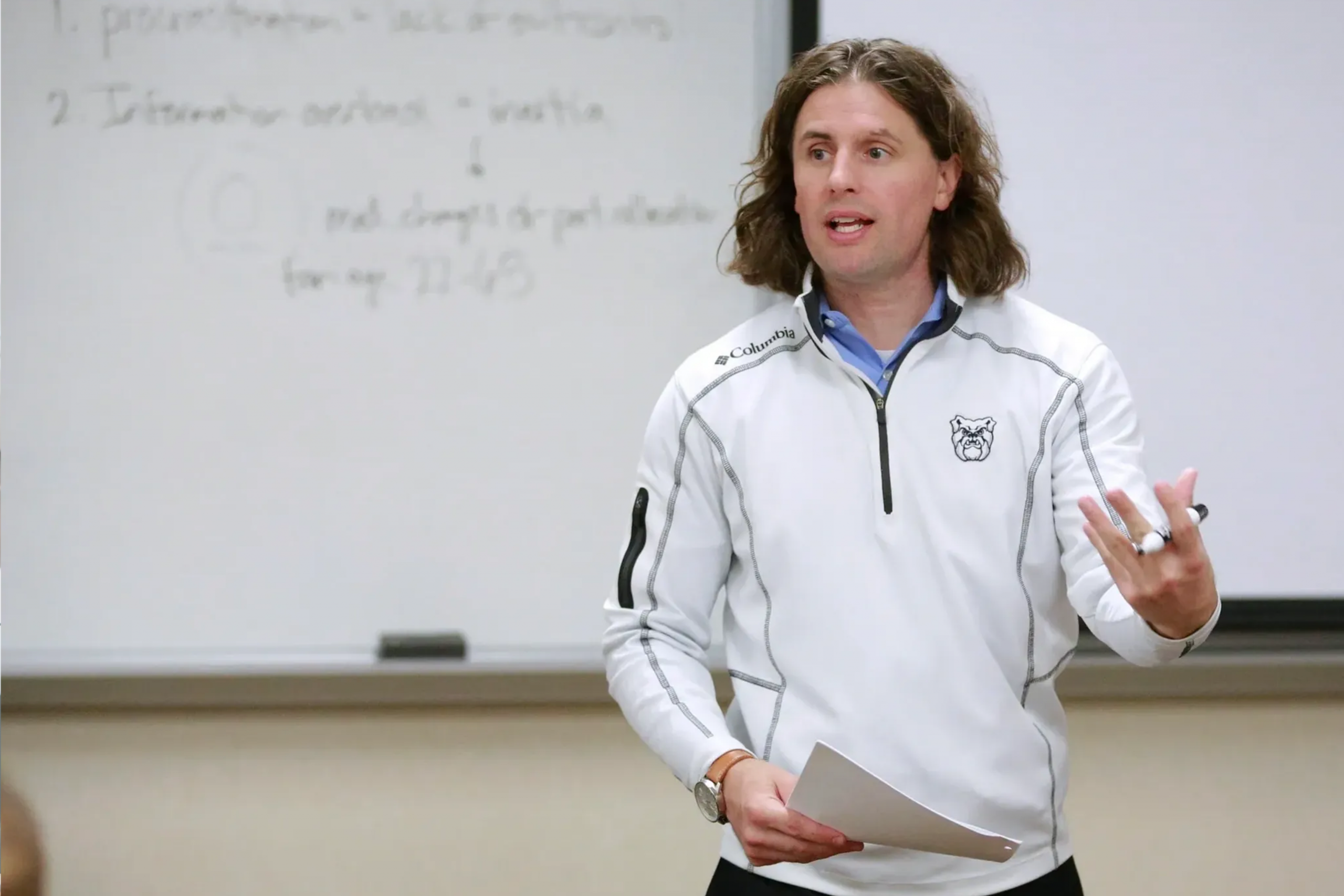
    Nick Smarrelli, Lecturer in Entrepreneurship & Innovation, set the tone early. “About 70% of people in this generation want to start a business at some point. How can Butler help in that journey?” he asked the crowd. He pointed to the ways Butler already fuels that ambition, from Bulldog Enterprises – where students run real, functional businesses like Butler Brew and Chimba Bowls – to the PVA program, which helps students explore venture capital and angel investing. “We have a decade-plus of entrepreneurship at Butler and we’re continuing to take it to the next level,” Smarrelli said. “It’s about creating value, solving problems, making connections, and being inspired by creativity.”

    Dean Craig Caldwell echoed that sentiment, reminding the audience that Butler’s commitment to entrepreneurship goes far beyond the Lacy School of Business. “Everyone needs to know that the university, not just LSB, is leaning into entrepreneurship now more than ever. LSB is just leading the charge,” he said. He also highlighted the upcoming Butler Angel Network, set to launch in Spring 2026. The initiative will connect Butler with accredited investors to back early-stage firms, with the ultimate goal of seeing Butler-born startups thrive.

    From there, the focus turned to students and alumni who had already brought their ideas to life. John Dunn, a recent graduate and founder of EntryPoint SRM, spoke about his edtech company that helps K–12 schools streamline operations. His advice for aspiring entrepreneurs? “Have realistic expectations of what entrepreneurship looks like,” he said. “Talk to people as much as you can to get their feedback. Don’t try to do everything on your own.”

    Felipe Reyes, founder of Chimba Bowls, told the story of turning a class project into a restaurant that now employs more than 22 people. For him, the key lesson was that passion and persistence matter more than experience. “Butler gave me the yes and the opportunity,” Reyes said. “Know that you have the capacity to build cool things and make an impact. Don’t let the things you haven’t experienced hold you back.”

    For Sam Farber, founder of Zealot, the path was even more unexpected. He described selling his company for millions at just 24 and stressed the importance of taking risks rather than waiting for perfect timing. “Life is won by people who say yes – not those who wait,” Farber said. “You don’t learn to swim by reading about it, you learn by jumping in.”

    The energy in the room carried into the night’s headline moment: a fireside chat with IndyCar star Alex Palou. Though most know him as the 2025 Indy 500 champion, Palou spoke candidly about how his entrepreneurial spirit shaped his career. “Racing is not a straightforward process,” he told the audience. “I spent a lot of time making calls asking for money and support just so I’d have the opportunity to chase my dreams.” At just 20 years old, while in Japan, he even started a coffee shop as a backup plan. “I didn’t know anything in advance, but it was very successful,” he admitted with a grin.

    When asked what success means to him, Palou offered a simple but powerful definition. “When I was a kid, I just wanted to be a professional racer. To reach that dream was success. To be able to wake up every morning and work on what you love while trying to be better every day – that’s the goal.” And when it came to motivation after a big win, his words resonated with both racers and entrepreneurs alike: “Business is the same as championships. When you’re successful, it’s like a high for a few hours – then you want more. At the end of the day, you need to do it all over again.”

    As the crowd filtered out after an evening of insight, inspiration, and plenty of applause, one thing was clear: this event was more than a launch of the program. Thanks to the leadership of PVA and Butler DECA, it showcased the very heart of Butler entrepreneurship: students turning ideas into thriving businesses and alumni proving what’s possible after graduation.

  • The Butler Angel Network: Hands-On Learning for Tomorrow’s Leaders

    The Butler Angel Network: Hands-On Learning for Tomorrow’s Leaders

    Imagine being a college student and having the chance to evaluate real startups, connect with investors, and make funding decisions that could shape the next big idea – all before you graduate.

    That’s exactly what students at Butler University will be able to do through the upcoming launch of the Butler Angel Network in Spring 2026, a student-led initiative that bridges classroom learning with real-world venture capital experience.

    “This is more than an investment vehicle,” Craig, Caldwell, Dean of the Lacy School of Business, said. “It’s a living lab for our students, another example of student-run enterprises at Lacy, a bridge to our alumni, and a bold step toward making Bulter a hub for entrepreneurial leadership and economic development in the Midwest.”

    Developed and executed by LSB, the Butler Angel Network will give students the chance to actively participate in deal sourcing, due diligence, portfolio analysis, and communication with angel investors – gaining hands-on experience that will go far beyond the traditional classroom setting.

    The Butler Angel Network is the newest addition to a growing lineup of immersive, student-led ventures at the Lacy School of Business. These initiatives are designed to emphasize real-world experience over theory.

    Students have the opportunity to manage a captive insurance company, oversee a multimillion-dollar Student Managed Investment Fund, conduct company valuations through Bulldog Reports, and even launch their own businesses as sophomores.

    Additional enterprises, including the student-run coffee shop and thrift store, further expand these hands-on learning opportunities. Together, they position Butler among the nation’s top institutions for experiential business education.

    Through this model, graduates leave prepared to step confidently into their careers as leaders, problem solvers, and entrepreneurial changemakers.

    The network will also create new ways for alumni and accredited investors to get involved. Alumni will be able to mentor students, invest in startups, and directly contribute to Butler’s growing ecosystem.

    “By empowering students and connecting them with real-world investment opportunities, Butler is positioning itself as a critical partner in driving regional economic development,” Travis Stegemoller, General Counsel with gener8tor said.

    The initiative complements Butler University’s collaborations with organizations like gener8tor, TechPoint, and the Indiana Economic Development Corp, positioning the university as a leader in innovation and experiential business education. By deploying a part of its endowment as co-investment alongside accredited investors, Butler will help promising startups grow while giving students a truly hands-on learning experience. The network’s goal is to amass $10 million in investable capital and hold its first pitch event in Spring 2026.

    Returning to his alma mater as Executive Director, Dr. Paul Newsom will lead the initiative. “I’m thrilled to return to Butler University and contribute to student success by connecting them with practical, real-world business experiences,” he said. “After a decade of guiding early-stage startups toward growth and enhancing returns for accredited investors, I look forward to leveraging those insights at the Lacy School of Business to strengthen ties between students, accredited investors, and entrepreneurs.”

    The Butler Angel Network will redefine how students learn about entrepreneurship, giving them real responsibility, mentorship, and the opportunity to impact the regional startup ecosystem. For students, alumni, and investors alike, it’s an exciting step forward – and a reminder that innovation is a team sport.

    Accredited investors or alumni interested in joining the Butler Angel Network or learning more can contact butlerangels@butler.edu.

  • Economics in Action: Dr. Kuhelika De on Research, Teaching, and Mentorship

    Economics in Action: Dr. Kuhelika De on Research, Teaching, and Mentorship

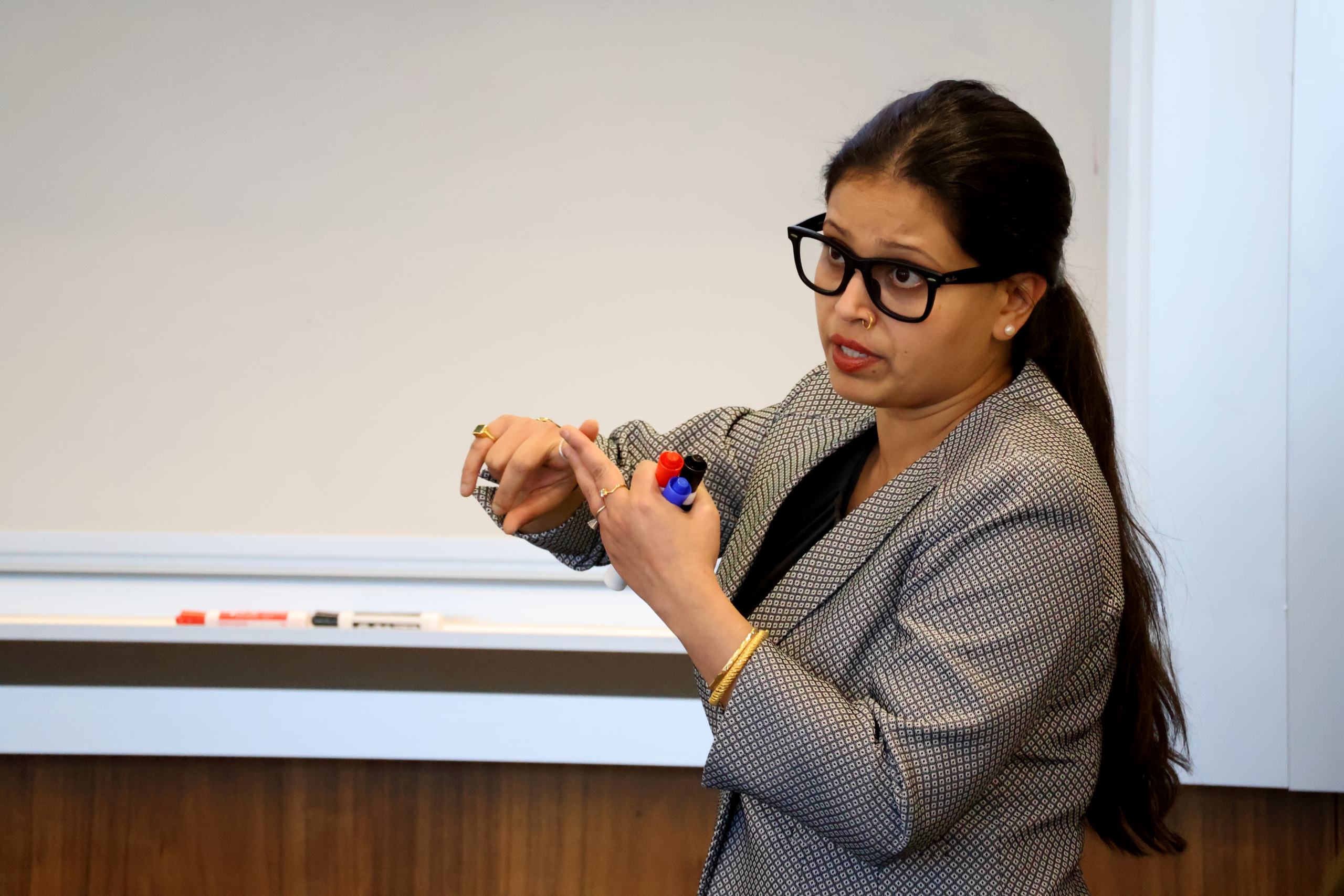
    When Dr. Kuhelika De talks about economics, her energy is contagious.

    She leans in, eyes bright, as she unpacks complex ideas like causes of business cycles or the transmission of monetary policy.

    Her enthusiasm isn’t just for theory; it’s about understanding how these ideas can inform policy to create a better society.

    She loves showing students how curiosity and guidance can spark insight and opportunity. Teaching, she believes, has the power to open doors that might otherwise stay closed.

    “Your teachers make a lasting impression,” she reflects. “Back in high school, I had a great teacher who sparked my curiosity in economics. That’s what set me on this path.”

    That early spark eventually carried her from classrooms in India to the United Kingdom, and then to the United States, shaping the path of her impressive academic journey. Dr. De earned her Bachelor’s (B.A. Hons.) in Economics from the University of Delhi, a Master’s in Economics from the University of Manchester, and her Ph.D. in Economics from the University of Georgia in 2017, with a concentration in monetary economics.

    At the University of Georgia, her doctoral advisor, Dr. William D. Lastrapes, was a defining influence in her academic career, giving her both the technical training and the research mindset she now instills in her own students. “I owe my academic success to my doctoral advisor,” she said.

    Having studied in three countries, Dr. De brings a scholarly global perspective into her classroom. She describes her experiences abroad as transformative – not just academically, but personally – as she navigated cultural differences, independence, and new ways of thinking.

    As an Associate Professor of Economics, she joined Butler’s Lacy School of Business in August 2023 after five years at Seidman College of Business, Grand Valley State University in Michigan. She was particularly drawn to Butler, noting it’s number one ranking in the Midwest region for seven consecutive years.

    Drawn by LSB’s strong reputation, small class sizes, and highly prestigious business school environment, the faculty member says the move has exceeded expectations.

    “There’s such a positive externality here,” she laughs, borrowing an economics term. “The people around me – my colleagues, the Dean’s office, senior faculty – they’ve been incredibly supportive. They push me to innovate, to grow. You want to do more, give more, because you feel so inspired.”

    While her background is extensive, Dr. De’s enthusiasm truly shines when she talks about her students.

    “Interacting with students is the best part of my job,” she says with a smile. “Professors play a role that goes beyond teaching. We’re mentors and advisors. In some ways, we come next to parents in shaping a student’s future. I am where I am because of my professors. Now, I want to be that person for my students.”

    Recently, Dr. De celebrated major milestones in her research. In 2024, she published a paper in Health Economics titled “Business Cycles and Healthcare Employment,” exploring how recessions affect employment in the healthcare industry and highlighting the real-world impact of economic fluctuations on critical industries. From a broader perspective, the study provides new robust evidence that U.S. healthcare employment is not recession‐proof.

    In August, her paper, “Inequality, Household Credit Shocks, and House Price Dynamics,” was published in the International Monetary Fund Economic Review, one of the premier journals in the field of monetary economics published by the International Monetary Fund. Using data for 42 developed and emerging markets, the study shows how income and wealth inequality amplifies the impact of credit expansions on house price fluctuations, drawing lessons from the 2008 housing crisis. In simple terms, high inequality is associated with a larger proportion of credit-constrained households. These households tend to borrow more aggressively during periods of easy credit and then cut back spending more sharply when facing mounting debt. This creates a disproportionate distribution of debt, which can destabilize the housing market and contribute to a wider recession. Her conclusion is clear: “If we don’t address inequality, we risk making our economies less stable.”

    Her research contributions have been recognized with two notable awards: the “Distinguished Early Career Scholar Award” from Grand Valley State University in 2022, and the “Research with Impact Award” from the Lacy School of Business, Butler University in Spring 2025.

    For Dr. De, the motivation behind her research goes beyond analyzing economies – it’s about improving human well-being and creating a better society. Economics, as an interdisciplinary field, allows her to examine economic fluctuations and inform policies that can promote economic stability.

    At Butler, she is already incorporating these insights into her teaching in “Principles of Macroeconomics”, “Intermediate Macroeconomics” and “Money and Banking”. In the future, the associate professor will teach “Development Economics”, again connecting global issues such as inequality, infrastructure, economic growth, and access to fair and secure jobs – what economists call “decent work” – to the United Nations Sustainable Development Goals. Her aim, she says, is not only to teach students the tools of economics, but also to instill a sense of responsibility as global citizens.

    “I love my subject, but more than that, I love my students,” she says. For the educator, the joy of being a professor lies at the intersection of research, teaching, and mentorships. “They’re creative, curious, full of ideas. Every student is gifted in their own way. My job is to help them discover what’s meant for them – and give them the tools to pursue it.”