

Housework Motivators for Kids

Our days are hectic and busy, filled with all sorts of events and chores making it difficult to find time to be physically active on some days. Here are some suggestions on how to be physically active in your home, doing things you would have to do anyway!
- Get your kids active while doing housework. Place a sticky note on all of the items that need cleaning or tidying (like the kitchen table, the sofa, the bed). Your child will collect each sticky note after they clean the item. Make it a friendly competition to see who collects the most stickies. You could even offer a prize (like a Frisbee or jump rope from the dollar store) for the winner with the most stickies. Your kids will be physically active, helping with household chores and having fun!
- Increase the intensity of household chores by using time limits. Put on a favorite CD and allot a certain number of songs to complete each chore. For example, allow two songs to vacuum the living room, three songs to wash the dishes, and one song to pick up toys in the playroom. You and your kids will be moving faster and working harder to beat the clock, causing your hearts to pump harder and get stronger.
- Get the entire family involved. After dinner, assign everyone a task in the clean up. Everything from clearing the dishes, loading the dishwasher, and putting away leftovers can get the family up and moving. Finish off the evening by going for a family walk or doing group physical activities like stretching. Not only will everyone be out of their chair, but this will also be fun bonding time for you and your family.
With a little creativity, you will be surprised by all the ways you and your family can be physically active in your very own home!
Work Together Standing Up?

A study from Olin Business School at Washington University (St. Louis) found that standing up during group work makes people more creative, enthusiastic and willing to work together than when they are sitting down. Plus, standing or walking during group work is a great way to counteract all that bad-for-your-health sitting.
http://www.personalbest.com/TopPerformanceOnline/ViewIssue.aspx?issue=878#4748
Salting Suggestions
Eat Less Sodium: Quick tips 
Nine out of 10 Americans eat more sodium (salt) than they need. Too much sodium increases your risk for health problems like high blood pressure. Use these tips to help lower the amount of sodium in your diet.
Know your sodium limit.
Ask your doctor how much sodium is okay for you. The general guidance is:
- Healthy adults and teens age 14 and older need to limit their sodium intake to no more than 2,300 mg a day (about 1 teaspoon of salt).
- Some adults, including people with high blood pressure, need to limit their sodium intake to 1,500 mg a day.
- Children need no more than 1,500 to 2,200 mg a day of sodium, depending on how old they are.
To eat less sodium, you don’t have to make lots of changes at once. If you cut back on sodium little by little, your taste for salt will change with time.

Check the label.
- Use the Nutrition Facts label to check the amount of sodium in foods. Try to choose products with 5% Daily Value (DV) or less. A sodium content of 20% DV or more is high.
- Look for foods labeled “low sodium,” “reduced sodium,” or “no salt added.”
Shop for low sodium foods.
- Load up on vegetables, fruits, beans, and peas, which are naturally low in sodium. Fresh, frozen, and dried options are all good choices.
- When you buy canned foods (like vegetables, beans, or fish), choose ones with labels that say “low sodium,” “reduced sodium,” or “no salt added.”
- Compare the sodium in prepared foods like bread, soup, and frozen meals. Choose the ones with less sodium.
- Limit processed meats – especially ones that are salted, smoked, or cured, like hot dogs, bacon, and deli meats.
Prepare your meals with less sodium.
- If you use canned foods that aren’t low in sodium, rinse them before eating or cooking with them. This will wash away some of the salt.
- Use unsalted margarine or spreads with no trans fats.
- Don’t add salt to the water when you cook pasta or rice.
- Try different herbs and spices to flavor your food, like ginger or garlic.
- Take the salt shaker off your table.
Get less salt when you eat out.
- When you order at a restaurant, ask that salt not be added to your food.
- Choose low-sodium options when you can – like dishes that are steamed, broiled, or grilled.
Add more potassium to your diet.
Eating foods with potassium can help lower your blood pressure. Good sources of potassium include potatoes, cantaloupe, bananas, beans, milk, and yogurt.
How to Eat a Rainbow
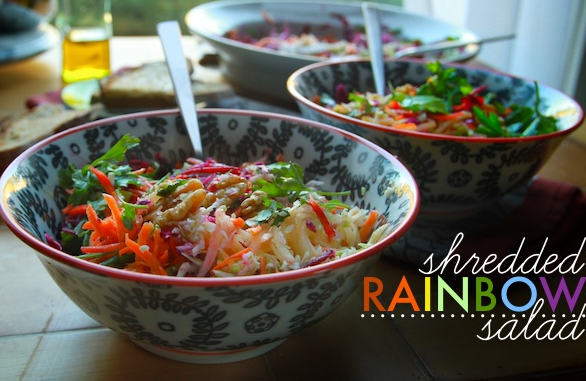
serves 8
recipe adapted from Jamie Oliver via Everyday Food Magazine
- 2 raw medium beets (any color) trimmed, scrubbed & quartered
- 1/4 red cabbage, quartered
- 2 large carrots, scrubbed & trimmed
- 1/4 white cabbage, quartered
- 1 apple, quartered
- 1 cup walnuts, roughly bashed
- 2 handfuls Italian parsley and mint, chopped
for the dressing:
- 1 tablespoon Greek yogurt
- 1 teaspoon Dijon mustard
- 3 tablespoons apple cider vinegar
- 6 tablespoons extra-virgin olive oil
- sea salt & ground pepper
- Worcestershire sauce
- hot sauce
Put a coarse grater attachment into a food processor and push ingredients through in the following order (to stop the beets from staining everything): beets, red cabbage, carrots, white cabbage and apple. (If your food processor is small, do this in batches.) Turn vegetables out onto a platter so get a pile of rainbow colors. Mix the yogurt, mustard, vinegar, and oil, then season with salt, pepper, Worcestershire, and hot sauce. Add walnuts and herbs and toss everything together until you get a big, beautiful plate of dressed vegetables.
http://www.shutterbean.com/2012/shredded-rainbow-salad/
Picnic Caviar

There’s nothing fishy about this combination of beans, corn, and peppers. The easy-to-make gem gets better as it marinates in its sweet-‘n’-spicy dressing.
- ¼ cup rice vinegar
- ¼ cup vegetable oil
- 1 Tbs. sugar
- 2 cloves garlic, minced (2 tsp.)
- ½ tsp. dried oregano
- ½ tsp. dried basil
- 1 15-oz. can black beans, rinsed and drained
- 1 15-oz. can pinto beans or black-eyed peas, rinsed and drained
- 1 ½ cups fresh corn kernels
- 1 red, yellow, or orange bell pepper, finely chopped (1 cup)
- ½ small red onion, finely chopped (½ cup)
- 1 2-oz. can diced green chiles with liquid
- ¼ cup chopped cilantro
1. Whisk together vinegar, oil, sugar, garlic, oregano, and basil in large bowl.
2. Stir in black and pinto beans, corn, bell pepper, onion, chiles, and cilantro. Season with salt and pepper. Refrigerate 1 hour before serving.
Balance Exercises
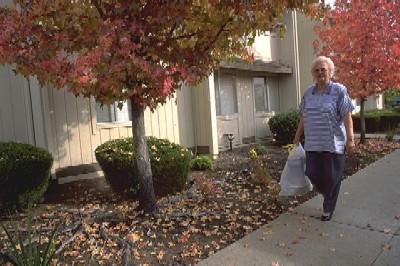
To get all of the benefits of physical activity, try all four types of exercise — endurance, strength, balance, and flexibility. This page addresses balance exercises.
Important for Fall Prevention
Each year, more than one-third of people age 65 or older fall. Falls and fall-related injuries, such as hip fracture, can have a serious impact on an older person’s life. If you fall, it could limit your activities or make it impossible to live independently. Balance exercises, along with certain strength exercises, can help prevent falls by improving your ability to control and maintain your body’s position, whether you are moving or still.
Balance Exercises to Try
These 5 exercises that are shown below are aimed at improving your balance and your lower body strength. They include
- standing on one foot
- walking heel to toe
- balance walk
- back leg raises
- side leg raises
Anywhere, Anytime
You can do balance exercises almost anytime, anywhere, and as often as you like, as long as you have something sturdy nearby to hold on to if you become unsteady. In the beginning, using a chair or the wall for support will help you work on your balance safely.
Balance exercises overlap with the lower body strength exercises, which also can improve your balance. Do the strength exercises — back leg raises, side leg raises, and hip extensions — two or more days per week, but not on any two days in a row.
Safety Tips
- Have a sturdy chair or a person nearby to hold on to if you feel unsteady.
- Talk with your doctor if you are unsure about doing a particular exercise.
Modify as You Progress

The exercises which follow can improve your balance even more if you modify them as you progress. Start by holding on to a sturdy chair for support. To challenge yourself, try holding on to the chair with only one hand; then with time, you can try holding on with only one finger, then no hands. If you are steady on your feet, try doing the exercise with your eyes closed.
Balance Exercise – Standing on One Foot

Improve your balance by standing on one foot.
- Stand on one foot behind a sturdy chair, holding on for balance.
- Hold position for up to 10 seconds.
- Repeat 10 to 15 times.
- Repeat 10 to 15 times with other leg.
- Repeat 10 to 15 more times with each leg.
Balance Exercise – Walking Heel to Toe

Improve your balance by walking heel to toe.
- Position the heel of one foot just in front of the toes of the other foot. Your heel and toes should touch or almost touch.
- Choose a spot ahead of you and focus on it to keep you steady as you walk.
- Take a step. Put your heel just in front of the toe of your other foot.
- Repeat for 20 steps.
Balance Exercise – Balance Walk
Improve your balance with the balance walk.
- Raise arms to sides, shoulder height.
- Choose a spot ahead of you and focus on it to keep you steady as you walk.
- Walk in a straight line with one foot in front of the other.
- As you walk, lift your back leg. Pause for 1 second before stepping forward.
- Repeat for 20 steps, alternating legs.
Strength Exercise – Back Leg Raises

Strengthen your buttocks and lower back with back leg raises.
- Stand behind a sturdy chair, holding on for balance. Breathe in slowly.
- Breathe out and slowly lift one leg straight back without bending your knee or pointing your toes. Try not to lean forward. The leg you are standing on should be slightly bent.
- Hold position for 1 second.
- Breathe in as you slowly lower your leg.
- Repeat 10 to 15 times.
- Repeat 10 to 15 times with other leg.
- Repeat 10 to 15 more times with each leg.
Strength Exercise – Side Leg Raises

Strengthen your hips, thighs, and buttocks with side leg raises.
- Stand behind a sturdy chair with feet slightly apart, holding on for balance. Breathe in slowly.
- Breathe out and slowly lift one leg out to the side. Keep your back straight and your toes facing forward. The leg you are standing on should be slightly bent.
- Hold position for 1 second.
- Breathe in as you slowly lower your leg.
- Repeat 10 to 15 times.
- Repeat 10 to 15 times with other leg.
- Repeat 10 to 15 more times with each leg.
For videos of the above and other helpful links go to:
http://nihseniorhealth.gov/exerciseandphysicalactivityexercisestotry/balanceexercises/01.html
Indiana Trail Finder
![IN-Dunes-Trail-05-11[1]](http://blogs.butler.edu/healthyhorizons/files/2016/05/IN-Dunes-Trail-05-111.jpg)
Whether you are looking for hiking, biking, horseback or motorized trails in Indiana, the link below will provide you much needed information regarding public access to many trails. For the link to all kinds of hiking, check below the fun kid’s video offering you a little giggle today.
http://indnr.maps.arcgis.com/apps/webappviewer/index.html?id=332ed3e954974914b26284525ecb1068
The Practice of Patience
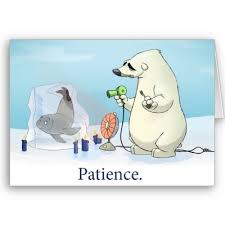 Some people seem born patient. Others feel impatient several times a day. You may sense it building before you express it. Once spoken, it can have negative consequences for those around you.
Learn to recognize your personal signs of escalating impatience: frustration, muscle tension, clenching teeth, anxiety, irritability, rushing and shallow breathing. They signal it’s time to step back and change your reaction.
Stop the cycle. Reacting to situations with anger and frustration may provide emotional instant gratification that is ultimately self-defeating. Accept those feelings for what they are, but practice responding in more positive ways.
Tune up self-talk. Impatience often results from the negative loop playing inside your head, which tells you “I don’t like this,” or “This isn’t going my way.” Slow down and tune into your inner voice during moments when you’re impatient; then find a way to manage that discomfort more successfully.
Take a break. When you’re feeling agitated, try to move away, mentally or physically. Take a walk, do relaxation stretches, call a friend, or spend time in quiet reflection. Once you are calm, return to the situation with a fresh outlook.
You can improve your emotional outlook by building good health: regular exercise, good nutrition and adequate sleep. You will have more patience when you are well rested and feeling your best.
“Patience is bitter, but its fruit is sweet.” — Aristotle
http://www.personalbest.com/TopPerformanceOnline/ViewIssue.aspx?issue=878
Here comes the sun!
![sun-exposure-benefits[1]](http://blogs.butler.edu/healthyhorizons/files/2016/05/sun-exposure-benefits1.jpg)
Outdoor activities planned for the holiday weekend?
New sunscreen recommendations:
http://www.cbsnews.com/news/consumer-reports-which-sunscreens-live-up-to-product-claims-keep-skin-safe/
http://www.cbsnews.com/news/consumer-reports-which-sunscreens-live-up-to-product-claims-keep-skin-safe/