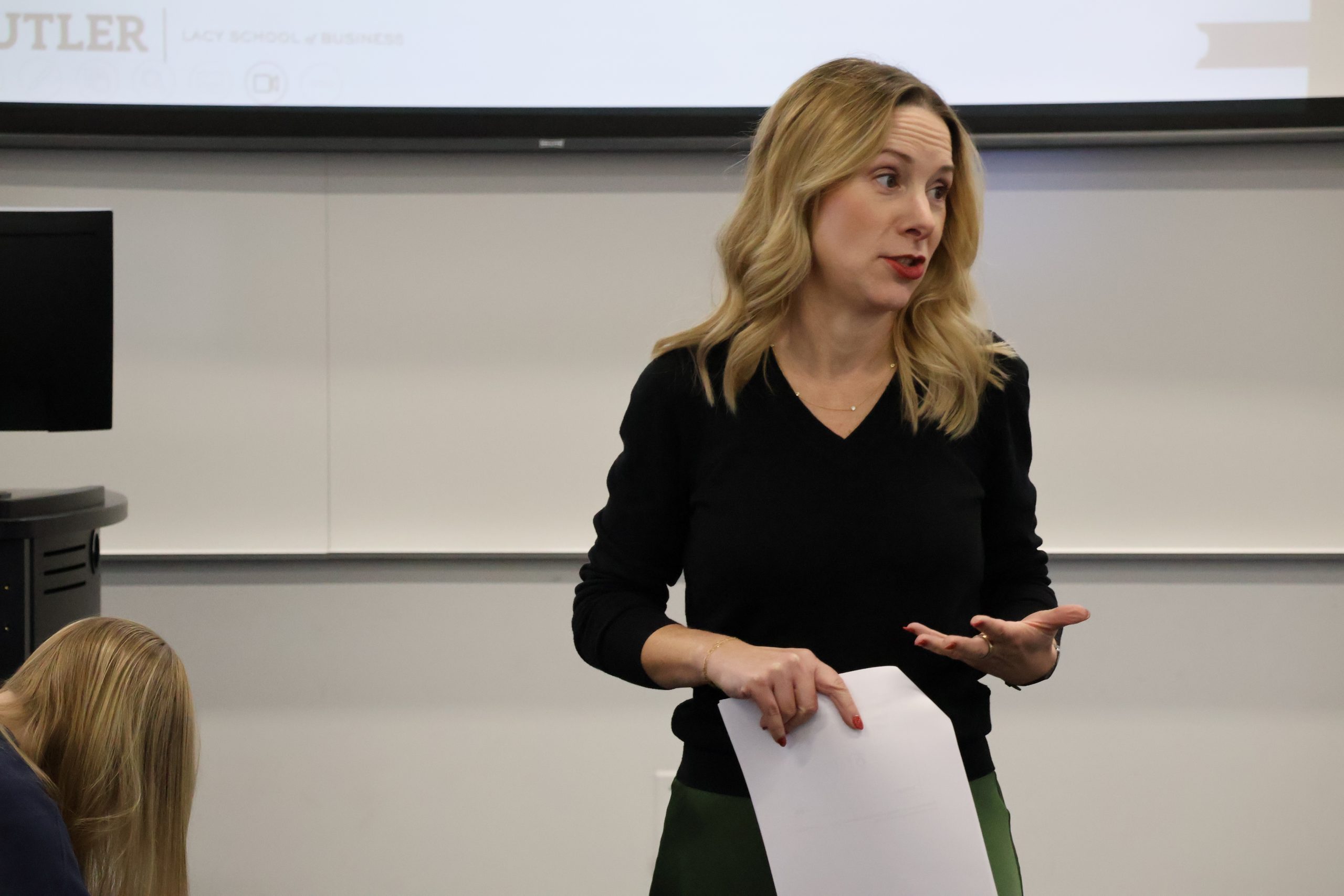
For Professor Hilary Buttrick, the path to teaching business law wasn’t a straight line – it was a slow realization that the things she loved most had been pointing her toward the classroom all along.
As an English major at DePauw University, she loved writing and worked as a peer tutor at the university’s writing center. But as graduation neared, she didn’t yet have a name for the career she was meant to pursue.
“Someone suggested I look into law school,” the associate professor of business law recalled. “No one in my family had ever gone to law school, so I didn’t really know what it would be like. But it seemed like a way to leverage my strengths in writing and the skills I learned through studying at a liberal arts college.”
Law did exactly that. It took her to Indiana University McKinney School of Law, then to a successful career in business litigation at Ice Miller. She loved the intellectual rigor, but she also felt pulled toward something more people centered. “Law is all about arguments, and it can be very contentious” she said. “But at its core, it’s about service. Clients come to you in vulnerable moments, and your job is to help them navigate uncertainty.”
That understanding of service – meeting others where they are – became the thread that ultimately brought her to the Lacy School of Business.
“When an opening came up to teach at Butler, right here in my backyard, I thought I was the luckiest girl in the world,” the New Harmony native said. “The energy of working with young professionals in the classroom is by far the best part of my workday.”
Those early days weren’t without nerves, though. Moving from courtroom to the classroom required a new kind of advocacy – one that wasn’t about winning an argument but helping students learn how to build one. She quickly found her stride by leaning into what had drawn her to law in the first place: curiosity, creativity, and the willingness to see a problem from all angles.
“Sometimes there isn’t one clear right answer,” she explained. “My goal is to help students craft the best possible argument, even for a side they don’t personally agree with. It’s about creativity, problem solving, and service.”
Over the past decade, Professor Buttrick has watched LSB transform – growing in size, expanding its experiential learning opportunities, and pushing students to think in bigger, more interdisciplinary ways. That evolution is part of what pulled her back to LSB after a period away. “I missed my colleagues, the students, the quality of the work, and the intellectual engagement,” she said. “LSB is a special place where students are inquisitive, respectful, and motivated – and that energy is contagious.”
As Associate Dean of Academics, Professor Buttrick’s work also includes helping students through some of their most overwhelming moments. It’s meaningful to her in a way that echoes her roots in litigation. “Sometimes students come to me with what seems like an insurmountable problem,” she said. “My role is to help them untangle it so they can thrive. Helping students develop strategies to succeed is deeply satisfying.”
In the classroom, she brings real-world cases to life through hypotheticals, scenarios, and playful debates – inviting students to test ideas and learn by doing. The impact is real. Several students, who never considered law until taking her course, went on to apply to law school and attributed that decision to her guidance. Those moments stay with her.
“I really believe in the potential of our students to do great things,” she said. “Preparing students to ask questions, think critically, and make well-reasoned decisions is why I teach. Watching their progress and growth over their time at Butler makes me really hopeful about the future.”
Outside her work at LSB, Professor Buttrick stays grounded by spending time with her husband, two kids, two dogs, and two cats. She enjoys reading, hiking, traveling, and trying new recipes in search of the perfect chocolate chip cookie. “Being with my family and nurturing curiosity are what keep me energized,” she said.
For students exploring the intersection of business and law, the professor offers simple but hard-won advice: “Ask questions. One of the greatest traps is thinking you have it all figured out and being entrenched in one perspective. Be willing to hear other ideas and change your mind – it’s how you grow.”