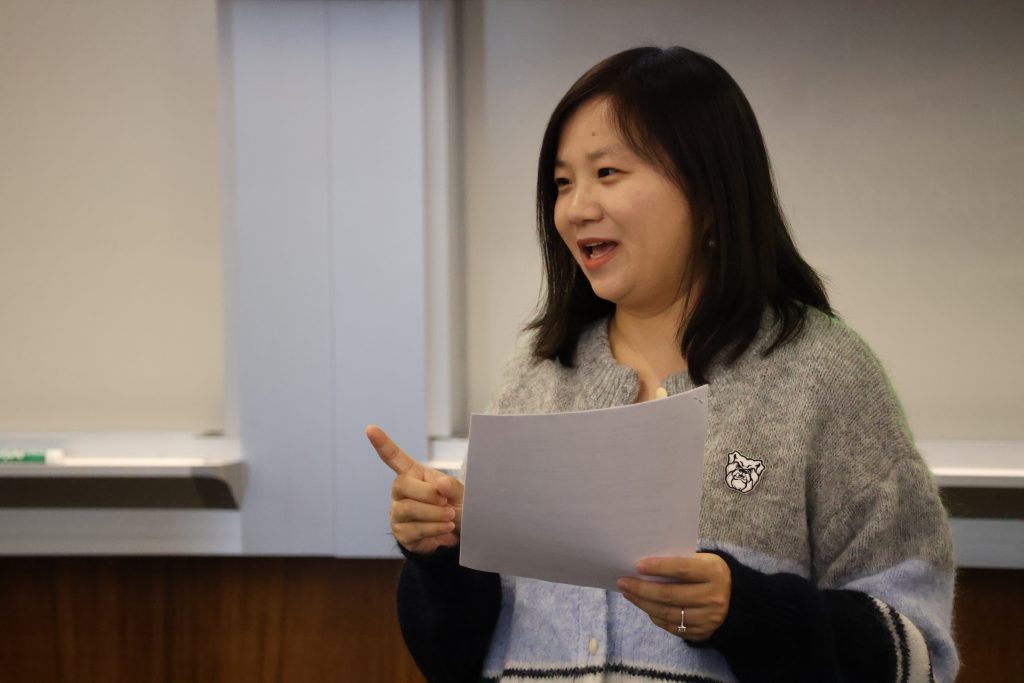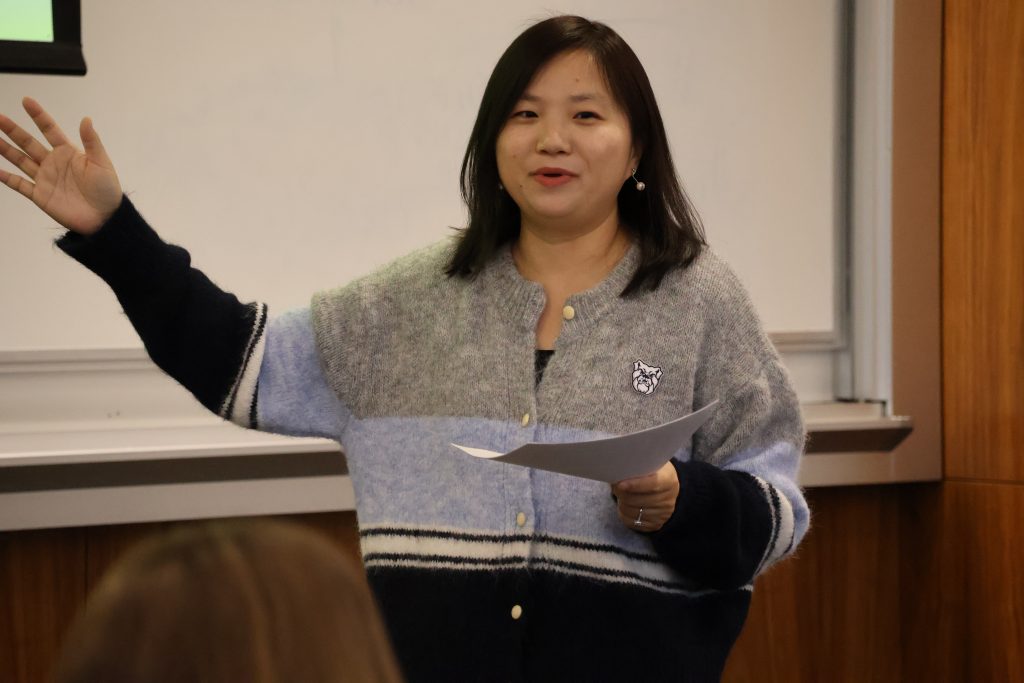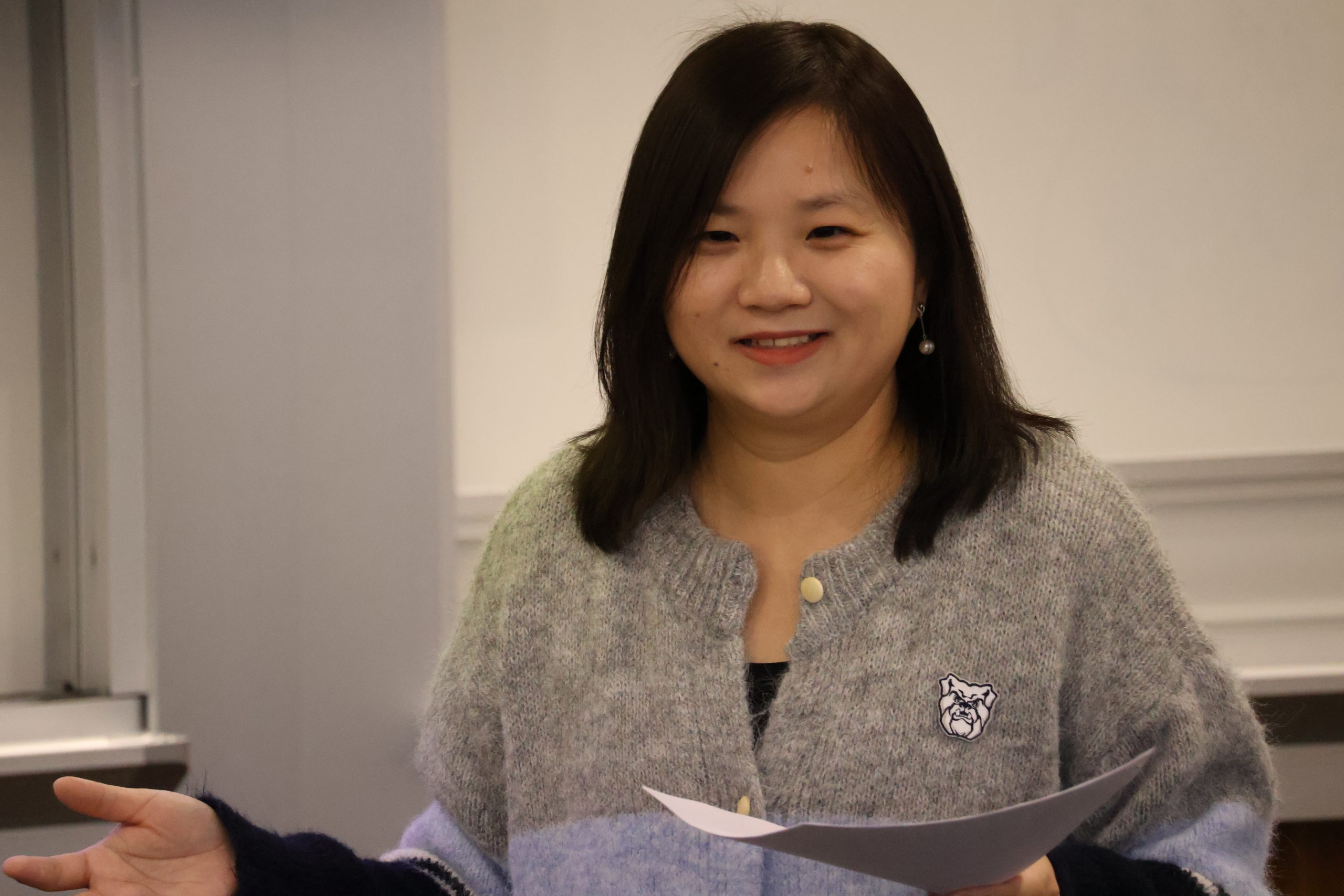
Dr. Chi Zhang didn’t set out to become a marketing professor. In fact, when she started college in central China, she wasn’t even sure what business was. As a first-generation college student trying to make pragmatic choices, she picked computer science because it felt safe. “I knew it would get me a job, but I also knew pretty quickly that coding all day wasn’t where I wanted to stay.”
So, she added an English major – another practical decision at the time, when English proficiency was rare and highly valued in East Asia. But it wasn’t until she joined an international consulting project led by a business faculty member that something clicked. “That experience opened my eyes,” Dr. Zhang said. “I realized I wanted to be in the business world. I wanted to understand how organizations worked – and I wanted to create impact.”
There was just one problem: she’d never studied business.
“I taught myself marketing,” she laughed. “Enough to pass the master’s admissions exam in China, which is very hard. You’re tested on everything – math, English, and your chosen field. I basically learned an entire major on my own.”
That determination led her to the marketing graduate program at Huazhong University of Science and Technology – one of China’s top 10 universities – where she began conducting research in nonprofit organization (NPO) marketing. But even then, she wondered whether she could take the next step: moving across the world to study marketing in the United States.
“I didn’t know if I could make it,” she admitted. “Marketing requires cultural knowledge, writing, and communicating. It was intimidating.” She eased into it with a master’s degree in information systems and operations management at the University of Florida – a bridge between her technical background and her growing interest in marketing. She excelled academically, but her heart wasn’t on the technical side anymore. “I knew I needed to stop hesitating,” she said. “So, I applied to Ph.D. programs in marketing and fully committed.”
That choice eventually led her to the Lacy School of Business – and to a place that immediately felt right.
“Honestly, it reminds me of my hometown in China,” she said. “Mid-sized, friendly, welcoming. People here take the time to get to know you. That matters.”
At LSB, Dr. Zhang teaches some of the most data-driven courses in the curriculum. For undergraduate students, she teaches Marketing Analytics, Digital Marketing, and AI in Marketing. For graduate students, she teaches AI in Business for MBA students and Marketing Analytics in the Business Analytics program.
While those course titles can intimidate students, she sees that as part of the opportunity. “Marketing is changing so fast,” she said. “It’s normal for students to feel nervous about data or analytics. My goal is to help them build confidence – because once you know you can learn something, you’re unstoppable.”
Her classes combine data tools like Tableau with hands-on experiential work, often in partnership with local nonprofits. In her digital marketing course, students develop real campaigns for organizations that serve immigrant families, women seeking legal aid, and other community groups with limited resources.
“The students do incredible work,” Dr. Zhang said. “And for the nonprofits, it’s marketing support they might not otherwise have. It’s a perfect example of how learning can make an immediate difference.”
Dr. Zhang’s dedication to impactful teaching extends into her research as well. She recently published her first sole-authored paper in pedagogical research: “Enhancing Student Engagement and Class Performance in a Marketing Analytics Course: A Student-Empowered Flipped Classroom (SEFC) Approach” in the Journal of Advancement of Marketing Education. The study explores how giving students’ ownership over analytic topics – selecting, researching, and teaching them to peers – transforms apprehensive learners into confident practitioners. “Watching students go from nervous about data to empowered in decision-making is truly fulfilling,” she said. In addition to the scholarship of teaching and learning, her research focuses on nonprofit marketing – an area she has explored for many years – as well as AI in marketing and consumer well-being.
That belief in constant learning is woven into both her teaching philosophy and her life philosophy. She jokes that becoming a mother to two young daughters made her a better professor.
“When observing how my little kids learn new things, it gives me many ideas and examples to share with students. I show them how different machine learning models – like neural networks – identify patterns from data. I often use real-life examples to demonstrate that how we teach our children parallels, how machine learning experts train models, and how we should design AI prompts to effectively interact with large language models”.
And at the end of the day, she hopes her students leave her classroom with something deeper than a set of skills.
“Marketing is fun,” she said. “It’s dynamic, creative, analytical – all of it. But more than anything, I want students to walk away believing in themselves. Confidence grows with practice. Curiosity opens doors. That’s true in marketing, and it’s true in life.”