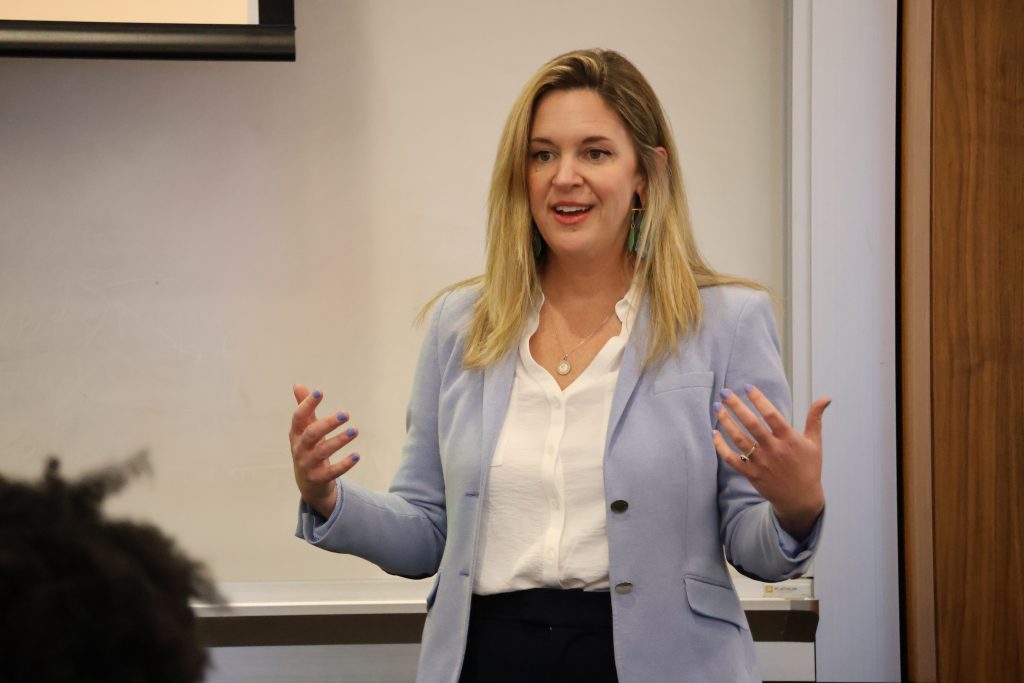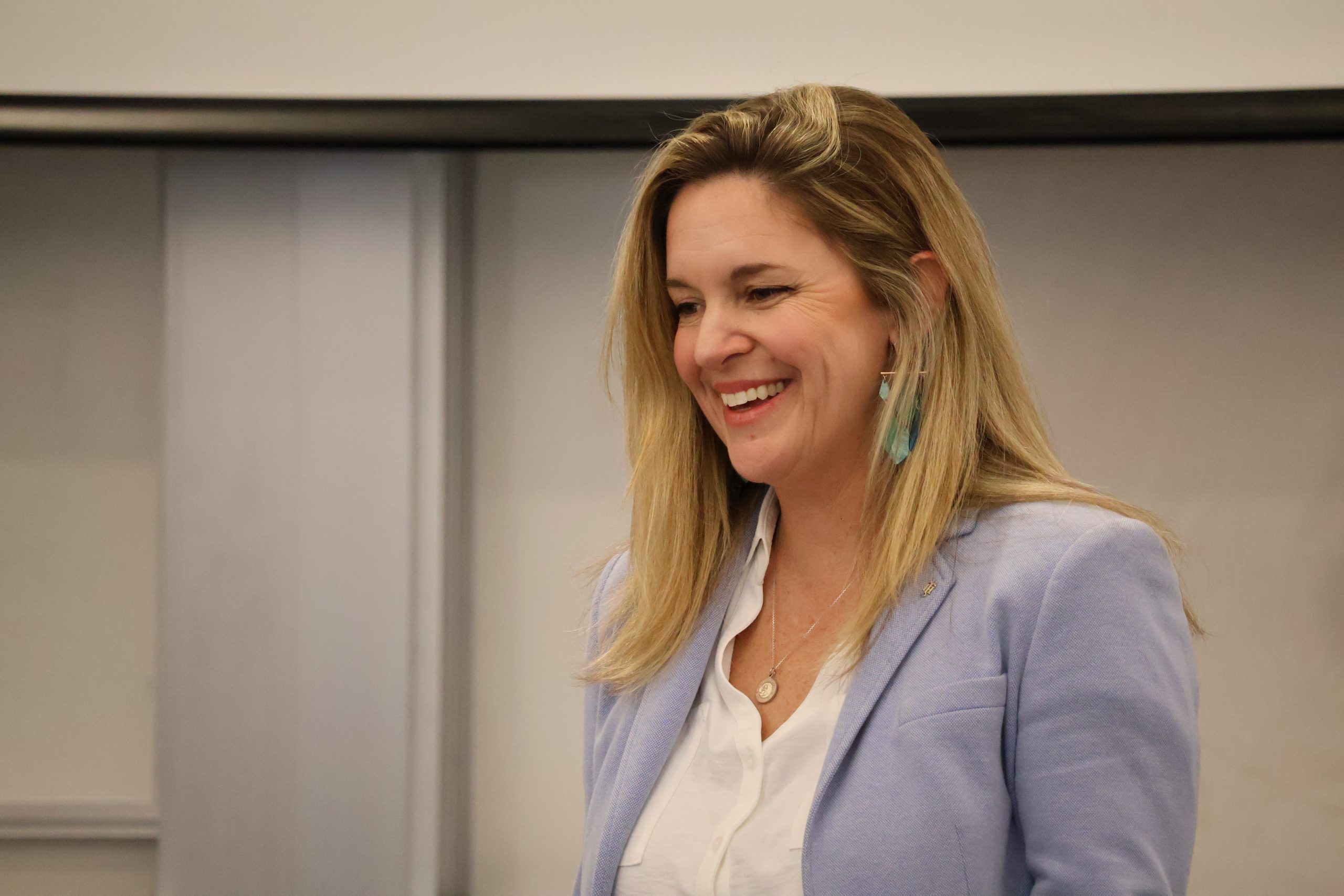
Marketing began long before Dr. Meredith Rhoads ever declared it as a major – it began in her father’s small furniture store in West Frankfort, Illinois. As a child, she watched her dad build relationships, serve his community, and make decisions that affected real families.
“I had this front-row seat to what it means to run a business in a close-knit place,” the assistant professor of marketing recalled. “I didn’t know it then, but that shaped everything about how I view marketing.”
Drawn to both creativity and strategy, she pursued an undergraduate marketing degree at Southern Illinois University Carbondale and quickly fell in love with it. But her understanding of the field expanded dramatically during her MBA program, when she began working with faculty on a research project examining older consumers and their interactions with service providers.
“That project opened my eyes,” she said. “It showed me how marketing touches vulnerable populations and how the marketplace can either preserve or diminish dignity.”
After graduation, Dr. Rhoads joined the new product development team at Anheuser-Busch, flexing her creative muscles while exploring new beverage concepts and emerging markets. Her work frequently took her into bars, restaurants, and community spaces to observe consumers in their own environments. “I kept finding myself in projects where I was collecting qualitative data,” she said. “I loved talking to people – getting to their motivations, emotions, and needs.”
Those experiences revealed a clear pattern: she was most energized when she was doing research, working directly with consumers, and uncovering human-centered insights. Combined with her love of university environments, that realization led her to pursue a PhD at the University of Wisconsin.
It was there that her research identity truly took shape. Dr. Rhoads gravitated toward questions about community – how people build it, how the marketplace affects it, and how systems can either include or exclude individuals. “I grew up in a town where people showed up for each other,” she said. “That has stayed with me. I’m drawn to understanding how community forms and how marketing can support or impede that.”
Her work now spans several streams: how neighborhoods and city planning shape social bonds; how small local businesses act as community anchors; and how vulnerable consumers, including those with disabilities or resource constraints, navigate the marketplace. Across all her projects, she centers dignity, access, and inclusion.
Her recent paper Service Design for Humanitarian Value, published in Journal of Service Research, captures that mission. Working with a longtime research team, she studied a diverse set of social service providers – from food banks to home meal programs to organizations serving formerly incarcerated individuals. The goal was to understand how these providers conceptualize the value they create. Rather than viewing them as a single category, Dr. Rhoads and her co-authors developed a framework outlining three layers of humanitarian value: triaging immediate needs, building long-term capacity, and empowering individuals toward independence.
“What stood out is that poverty takes many forms: financial, social, emotional. These organizations are doing so much more than people realize,” she explained, “They’re meeting people where they are.”
She hopes the framework helps policymakers and local leaders better allocate resources and understand shifting community needs. “Ultimately, I want my research to matter,” she said. “I want it to lead to real change.”
That commitment to meaningful impact is also what brought her to the Lacy School of Business. After visiting dozens of universities nationwide, she knew her heart belonged back in the Midwest. Butler immediately felt different. “From the moment I stepped on campus, it felt like home,” she said. “People here care about people. They care about community.”
In the classroom, Dr. Rhoads teaches consumer behavior, advertising, and introductory marketing. Her goal is to help students see the humanity within the discipline. “We live in a consumer society. Marketing touches everything,” she said. “I want students to understand the deep core needs that drive behavior and realize how enduring many of those needs are.”
She weaves concepts from psychology, sociology, and anthropology into her courses, encouraging students to think critically about how markets shape lives and how businesses can create value responsibly. She also hopes to inspire the next generation of marketing researchers. “We have endless data now,” she said. “But what matters is asking good questions, questions that lead to insights that help people.”
When she’s not teaching or conducting research, Dr. Rhoads can be found exploring Indianapolis with her four children, ages 19, 17, 13, and 10. She loves biking, yoga, and discovering local restaurants and neighborhood spots. “I’m drawn to places with heart,” she smiled. “Maybe that’s the small-town girl in me.”
Now in her second year at LSB, she is energized by the collaborative spirit within the LSB community. “This is a place where ideas have no ceiling,” she said. She hopes her work will continue strengthening connections with local businesses, nonprofits, and policymakers. “I believe in backyard research – studying what’s right in front of us. There’s so much opportunity to make Indianapolis stronger.”