
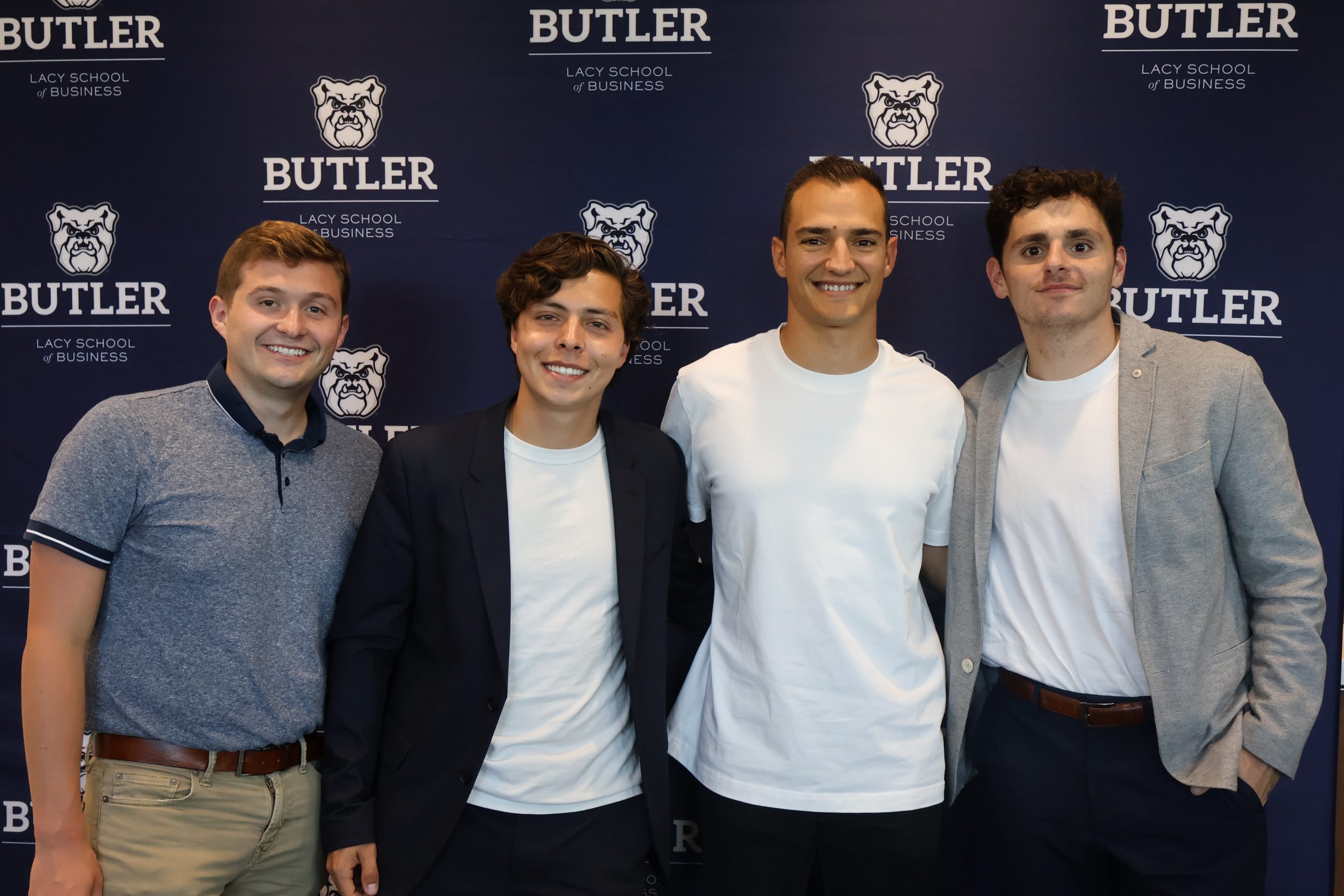
The buzz inside Fairview House was undeniable. More than 200 students, alumni, and community members gathered shoulder to shoulder on September 10 for the Entrepreneurship Kick-Off, hosted by the Lacy School of Business’s Private Venture Association (PVA) and Butler DECA. This wasn’t just another campus event – it was a celebration of bold ideas, resilience, and the drive to build something new, capped off with insights from Indy 500 champion Alex Palou.
That spirit was reflected in the audience itself: more than 50 student founders were in the crowd, joined by peers from across Butler’s colleges, all eager to learn and connect.
Nick Smarrelli, Lecturer in Entrepreneurship & Innovation, set the tone early. “About 70% of people in this generation want to start a business at some point. How can Butler help in that journey?” he asked the crowd. He pointed to the ways Butler already fuels that ambition, from Bulldog Enterprises – where students run real, functional businesses like Butler Brew and Chimba Bowls – to the PVA program, which helps students explore venture capital and angel investing. “We have a decade-plus of entrepreneurship at Butler and we’re continuing to take it to the next level,” Smarrelli said. “It’s about creating value, solving problems, making connections, and being inspired by creativity.”
Dean Craig Caldwell echoed that sentiment, reminding the audience that Butler’s commitment to entrepreneurship goes far beyond the Lacy School of Business. “Everyone needs to know that the university, not just LSB, is leaning into entrepreneurship now more than ever. LSB is just leading the charge,” he said. He also highlighted the upcoming Butler Angel Network, set to launch in Spring 2026. The initiative will connect Butler with accredited investors to back early-stage firms, with the ultimate goal of seeing Butler-born startups thrive.
From there, the focus turned to students and alumni who had already brought their ideas to life. John Dunn, a recent graduate and founder of EntryPoint SRM, spoke about his edtech company that helps K–12 schools streamline operations. His advice for aspiring entrepreneurs? “Have realistic expectations of what entrepreneurship looks like,” he said. “Talk to people as much as you can to get their feedback. Don’t try to do everything on your own.”
Felipe Reyes, founder of Chimba Bowls, told the story of turning a class project into a restaurant that now employs more than 22 people. For him, the key lesson was that passion and persistence matter more than experience. “Butler gave me the yes and the opportunity,” Reyes said. “Know that you have the capacity to build cool things and make an impact. Don’t let the things you haven’t experienced hold you back.”
For Sam Farber, founder of Zealot, the path was even more unexpected. He described selling his company for millions at just 24 and stressed the importance of taking risks rather than waiting for perfect timing. “Life is won by people who say yes – not those who wait,” Farber said. “You don’t learn to swim by reading about it, you learn by jumping in.”
The energy in the room carried into the night’s headline moment: a fireside chat with IndyCar star Alex Palou. Though most know him as the 2025 Indy 500 champion, Palou spoke candidly about how his entrepreneurial spirit shaped his career. “Racing is not a straightforward process,” he told the audience. “I spent a lot of time making calls asking for money and support just so I’d have the opportunity to chase my dreams.” At just 20 years old, while in Japan, he even started a coffee shop as a backup plan. “I didn’t know anything in advance, but it was very successful,” he admitted with a grin.
When asked what success means to him, Palou offered a simple but powerful definition. “When I was a kid, I just wanted to be a professional racer. To reach that dream was success. To be able to wake up every morning and work on what you love while trying to be better every day – that’s the goal.” And when it came to motivation after a big win, his words resonated with both racers and entrepreneurs alike: “Business is the same as championships. When you’re successful, it’s like a high for a few hours – then you want more. At the end of the day, you need to do it all over again.”
As the crowd filtered out after an evening of insight, inspiration, and plenty of applause, one thing was clear: this event was more than a launch of the program. Thanks to the leadership of PVA and Butler DECA, it showcased the very heart of Butler entrepreneurship: students turning ideas into thriving businesses and alumni proving what’s possible after graduation.