
It doesn’t start with a lecture or a textbook.
It starts with a question – one without a clear answer – and a dataset big enough to feel intimidating. Students aren’t told exactly what to do or how to get there. Instead, they’re asked to figure it out, together, under real deadlines and real expectations.
That’s the premise of the NCAA Final Four Analytics Challenge, where analytics move beyond the classroom and into a professional arena. Using real NCAA data, students step into the role of analysts, strategists, and storytellers – applying technical skills while learning how to communicate insights that matter.
Originally launched as a regional analytics competition, the challenge has grown into a statewide experience that mirrors Indianapolis’s role as both a basketball capital and an innovation hub. Now co-hosted by Butler University and the NCAA, the Final Four Analytics Challenge invites students from across Indiana to step into the kind of analytical work happening behind the scenes of major sporting events – and far beyond them.
Students compete in teams of two to five, working through multiple rounds that require predictive modeling, visualization, and clear business communication. They’re asked not only to analyze data, but to explain it – translating complex findings into insights decision-makers can actually use.
For many students, the draw is simple: it’s real.

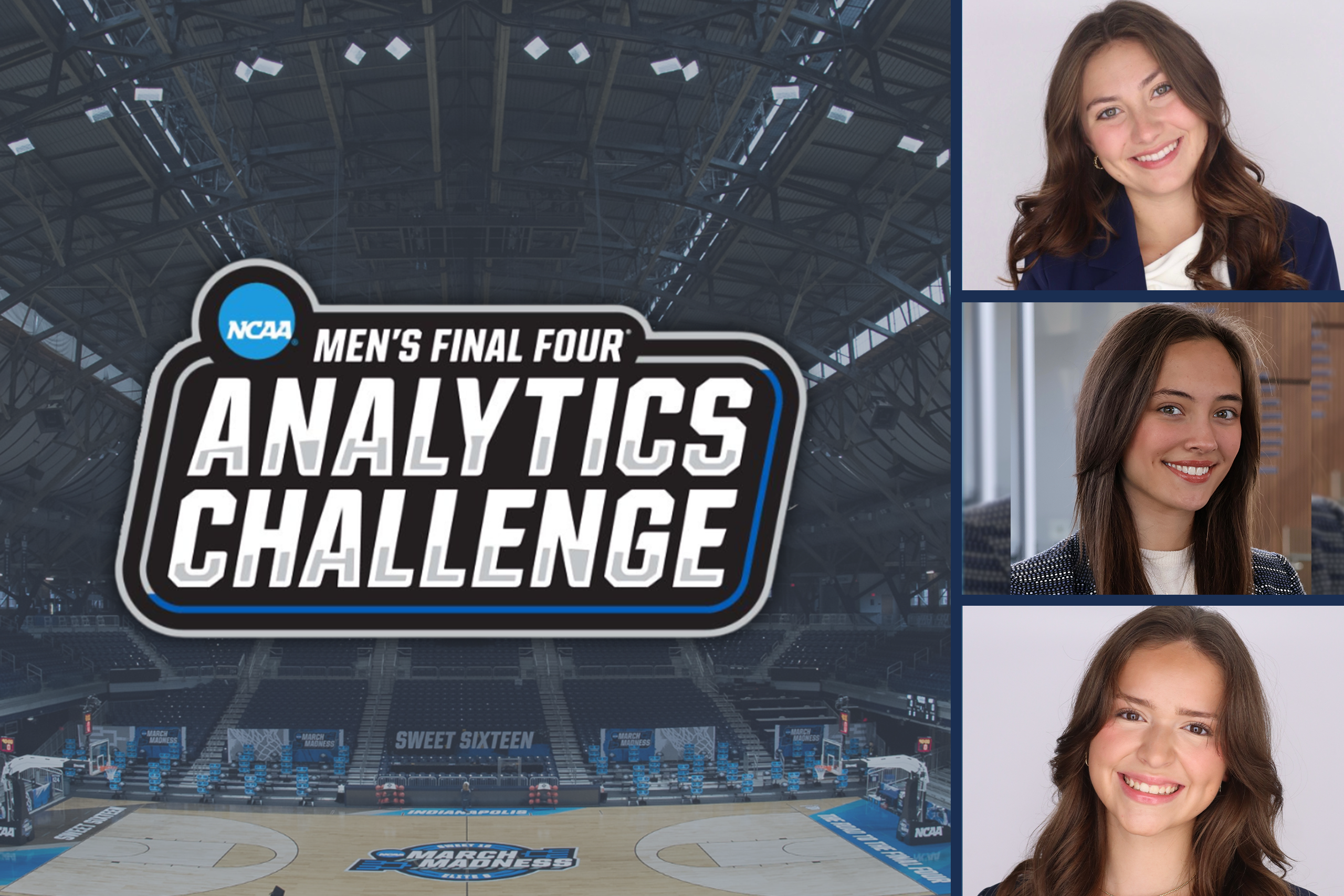
“As a Finance and Business Technology Analytics dual major, I wanted hands-on experience in data analysis, exploration, and modeling,” senior Jentry Gottfried said. “Knowing I could potentially present to the NCAA challenged me in a completely new way and opened my eyes to what a career in analytics can look like.”
That challenge often pushes students well beyond what a traditional classroom can offer. Past participants describe learning new tools, navigating ambiguity, and working at a pace that mirrors professional environments.
“This competition gave me hands-on experience with advanced Tableau modeling, Google Collaboratory, and data classification,” Gottfried said. “Those are skills you don’t just learn conceptually – you learn them by doing, at the scale real projects require.”
The analytics challenge is intentionally designed to welcome students from a wide range of academic backgrounds. Analytics experience helps, but curiosity, collaboration, and problem-solving matter just as much.
Senior Marianna Green, an international business and Spanish double major, didn’t initially see herself as an analytics student at all.

“I had little to no interest in data analytics until I was encouraged to enroll,” Green said. “I doubted my skills, but the experience pushed me to think innovately, overcome challenges, and rely on the strengths of my team. It was fast-paced, and an incredible experience. I’m so grateful for the way it pushed me.”
For many students, the impact extends well beyond the competition itself. Participants consistently point to the competition as a turning point – academically, professionally, or both.
“The challenge broadened my perspective on the opportunities that exist in analytics,” Gottfried said. “It showed me how the skills we’re learning right now can make us changemakers in a rapidly evolving industry.”
Juanita Rojas, a junior finance and economics double major, echoed that sentiment.

“The challenge allowed me to apply analytical foundations from the classroom to a real-world problem,” Rojas said. “I learned how to balance technical analysis with clear, actionable insights – how to tell a data story that actually matters to stakeholders.”
That ability to communicate insights is a core focus of the competition, and one that students say has followed them into internships and professional settings.
“After the competition, my confidence with data visualization and advocating for recommendations grew significantly,” Rojas said. “It reinforced my interest in using analytics in real decision-making environments.”
The experience begins with a Tip-Off Event on Feb. 2 at the NCAA Hall of Champions, where teams receive their case and connect with peers and professionals. Finalists advance to present in person on April 6 at the Indiana Convention Center just ahead of the Men’s National Championship game – a national stage that underscores just how real the work has become.
For students considering whether to register, past participants offer simple advice.
“Register to broaden your perspective, get hands-on experience, and work with a team that will push you to be better,” Gottfried said.
“If you’re looking to expand your skill set in a competitive environment, this is it,” Green added. “The skills you take away will serve you long after the competition ends.”
As Indianapolis prepares to welcome the Final Four, LSB students won’t just be watching the action – they’ll be contributing to the kind of analytical thinking that drives it. And by the end of the competition, they’ll walk away with more than experience.
They’ll walk away knowing they can do the work.