Author: Stuart Glennan

  • Seasons Greetings and welcome to our new STS director

    Dear friends of STS —

    With the close of this semester I will be ending my short stint as interim director.  I will be replaced by the new permanent director, Dr. Carmen Salsbury.  Dr. Salsbury, who for the past six years has served as chair of the department of biological sciences, brings a lot of energy, a focus on student learning, a wealth of administrative experience, and a passion for studying the behavior of squirrels (In her honor that’s a sciurus carolinensis in the Santa hat).

    Dr. Salsbury will take over January 2, but she and I will be working together over the coming months on the transition and on the search for the new full-time STS instructor.  That search is, by the way, going well.  We have received many quality applications, and expect to be bringing finalists to campus in February or March.

    I have enjoyed working with so many of you over the last semester, and I look forward to continuing to work with STS as an instructor, advisor and a member of the steering committee.  Have a good holiday, and make sure to come to our STS party on Friday January 17 so the we can welcome our new director.

    Stuart Glennan


  • Announcing our affiliate faculty!

    Who are the STS faculty?  Since STS is a program that draws on the expertise of faculty across the university, this can be a bit hard to figure out — until now.  Starting this semester we are beginning to officially designate faculty whose research, teaching and service supports STS as affiliate faculty.  These are the faculty members who will teach most of your classes, be your advisors, supervise your internships, and show up at STS events.  Most of these faculty members have been helping STS for years, but now we want to acknowledge them, and make them more identifiable to our students.  You can check out our list on the STS website:

    http://www.butler.edu/science-technology/faculty-and-staff/

    And if you’ve had a professor teach an STS class and they aren’t on this list, they probably forgot their application.  You can remind them 🙂


  • Literature and the Environment: Another STS elective

    I just realized that we had failed to share with you another course for spring  2014 that can serve as an STS elective.  This looks very interesting — especially for those of you interested in environmental studies.

    EN393: Into the Wild – Literature and the Environment

    This class will explore wilderness and its relationship to human culture. Our concern throughout will be on a concept, the idea of wilderness, as it evolves in the nature writing tradition. We tend to think of wilderness spatially, as “an area where the earth and its community of life are untrammeled by man, where man is a visitor who does not remain” (Wilderness Act of 1964). And we will examine wilderness in terms of specific locales: John Muir’s Sierra, Edward Abbey’s red-rimmed deserts, the old-growth forests of Gary Snyder’s far west, Barry Lopez’s arctic, the archipelagic outposts of Robert MacFarlane’s Britain. For these and other writers from H. D. Thoreau to Aldo Leopold, wilderness offered in turns scenery, solitude, spiritual communion, recreation, and scientific study, and their experiences encourage us to think wilderness in different terms. Might we not consider wilderness temporally: does a familiar place become wild in the deep pitch of night? Or in terms of climate: is a snow-clad peak more wild than that same height greened by wildflowers? To what extent is wilderness a state of mind?

    We will also take up recent responses to the received notion of wilderness. Kathleen Jamie provides a feminist critique of a strain of wilderness writing by what she calls the “lone enraptured male,” while Evelyn White reminds us that how we think about the wild is shaped by gender and race. The very idea of wilderness as a place where “man is a visitor who does not remain” is challenged by Luther Standing Bear and Leslie Marmon Silko, who attest to a long native American inhabitance of these lands. Moreover, recent work by ecologists and cultural geographers has suggested that the primeval wilderness we associate with the European settlement of North America is a historical aberration. Today, as wilderness continues to bleed from the world, we will ask ourselves how nature writing might re-wild our own imaginations.

  • Check your audit

    A common and important question for STS majors is: what counts towards my STS degree?  In theory, the best way to answer this and other questions about graduation requirements is by reviewing your academic requirements (what everyone calls your degree audit)  in the Student Center of My.Butler.  I say, “in theory” because in order the audits to work, the audit must be correctly programmed by the registrar to know what courses count as STS electives in any given semester — and that has not been the case for STS.

    This semester I have been working with the STS steering committee and the registrar’s office to bring course information up to date, and at this point we are close to an audit that you and your adviser can trust.  Now I need your help.  I would be grateful if all of you (especially those who are juniors and seniors) would check your audit.  It should tell you all courses that you have completed or are presently enrolled in that can count toward the STS major.  If you have taken a course that you thought would count, and it is not on your audit, you need to let me know. 

    You can find your audit on My.Butler.  Here are the instructions:

    Login and click  Self Service > Student Center. In the Academics area, under the Other Academics dropdown, select Academic Requirements and click on the button. Your advising audit appears onscreen. Requirement areas that haven’t been completely fulfilled yet will automatically be expanded. Sections of the audit that are minimized have already been satisfied.

    When you get there, you may find it helpful to click the button that allows you to see the report in PDF format.  I personally like this, because it lists all the courses you have taken towards the STS elective requirement in a single table, so you don’t have to scroll through 100+ options.

  • Paid internship in DC for minority students in STEM fields

    Below is an e-mail snippet about a paid internship opportunity in Science Policy this summer in Washington D.C.  To qualify you must be a member of a group “underrepresented in (science, technology engineering and mathematics (STEM) disciplines” and you must be a STEM major.  STS itself is not obviously a STEM major, but if you have a second major in something like engineering, biology or chemistry, you would be perfect to apply, and it may be that an STS major with appropriate STEM background would be considered.  If you are interested in this opportunity, we can try to confirm whether you meet the requirements to send in an application.  Here’s the e-mail:

    ———————————————-

    From Shirley McBay, President of QEM Network

    This is an early alert regarding a Science Policy-focused Summer Internship Program (SSIP) conducted by the Quality Education for Minorities (QEM) Network with support from the National Science Foundation (NSF).  Attached you will find an application packet we would like you to share with your graduate and undergraduate students from groups underrepresented in science, technology, engineering, and mathematics (STEM), particularly, but not limited to, students interested in pursuing careers in science policy or science education. Also, you will find attached a flyer describing this summer internship opportunity. We ask that you download and post the flyer on your departmental bulletin board to further ensure that students are aware of these opportunities.

    The ten-week, Washington, DC-based internship (May 27–August 1, 2014) is made possible through a grant to the QEM  Network from NSF. Students who successfully complete the internship will receive a taxable stipend, $3,000 for undergraduates and $4,000 for graduate students, paid in three installments over the course of the summer. The students also will receive housing at George Washington University with other QEM interns as well as round-trip airfare and ground travel reimbursement.

    During the internship, students will have an opportunity to: (1) increase their understanding of how science policy is made; (2) further develop their potential for becoming leaders and proponents of increased participation in science and engineering by students from underrepresented minority groups; (3) become knowledgeable about potential/actual barriers preventing minority students from receiving a high quality mathematics/science education; and (4) become familiar with policies, programs, and strategies being implemented to address such issues. The students also will strengthen their research, communications, and other professional skills, and develop a peer network that includes QEM summer interns from across the country.

    A student who wishes to participate in the internship must currently be a STEM major at an accredited institution and have successfully completed at least the sophomore year before the start of the internship program. An applicant also must be returning to a degree-granting institution the following academic year, either at the undergraduate or graduate level. Graduating seniors must be already admitted to and planning to enter graduate school in Fall 2014 to be eligible.

    Please distribute the application packet to eligible students and feel free to duplicate as needed. The application deadline is Friday, February 14, 2014; however, applications can be submitted prior to the deadline. On-line copies of the application are available for download at http://www.qem.org/internship.htm#NSF <http://www.qem.org/internship.htm#NSF> .

    The internship is a wonderful educational opportunity and we would greatly appreciate your encouraging students to apply who could benefit from this experience.

    QEM NSF Internship Flyer

  • Course Search can now be trusted!

    You can now look up STS courses on Course Search.  When you get there:

    • Select the browse tab
    • Select “College of Liberal Arts and Sciences” or “Interdisciplinary Studies” in the first drop-down
    • Select “Science, Technology and Society” in the second drop-down
    • Select Spring 2014

    This should match the information on the one page handout I posted earlier, but it will give you up-to-date information on enrollments, so you can see if a class is filling up.

    You still can’t trust your degree audit, but we’ll get that fixed soon.


  • The Indianapolis Community Requirement (ICR)

    Butler’s new core includes the Indianapolis Community Requirement, which requires you to take a course that meets certain requirements for active engagement in the community.  You may well have already taken one.  Please check your degree requirements to see where you stand.  If you haven’t, you need this to graduate, so juniors (and especially seniors!!!) should look to take an ICR course.  Click here for Courses offered Spring 2014 that satisfy the Indianapolis Community Requirement


  • Geographic Information Systems (GIS) course

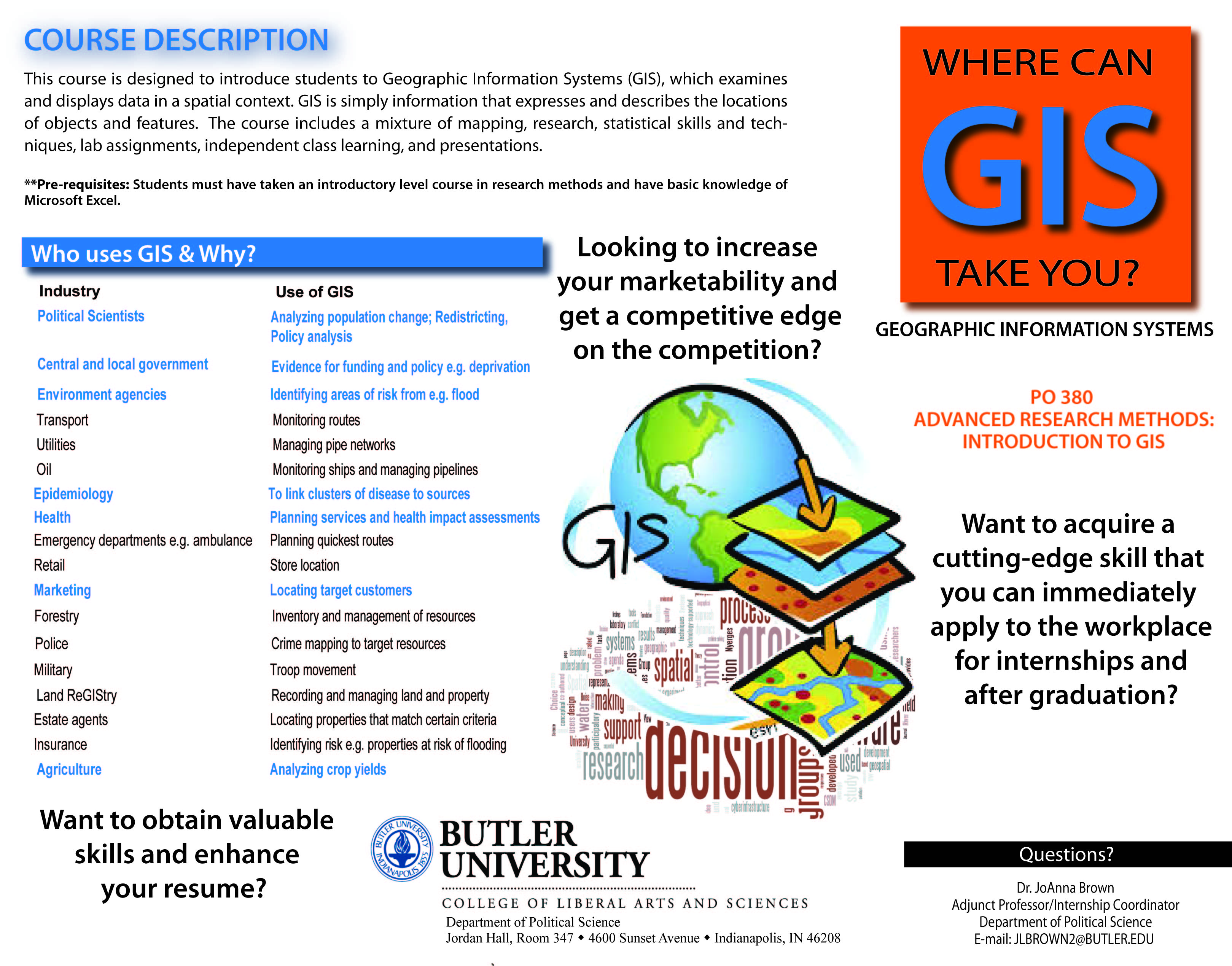
    PageLines- Butler-Logo.pngPageLines- ButlerLogo.jpg The following course taught this spring in the political science is an interesting opportunity for STS majorsPO 380 Advanced Research Methods Course Flier_print

  • And here are the STS courses for Spring 2014

    At this link you will find STS courses Spring 2014, both core course and electives.   You should use this list for your planning.  (Course search currently lists some STS courses incorrectly; I will let you know when I’ve got that fixed.)

    As you plan your schedule, here are some things to keep in mind:

    • If you haven’t taken ST200, take it.
    • If you have taken ST200, consider taking ST320, which satisfies the STS core, and also can count as an elective if you have already taken ST330.  If you are a junior or senior, you can take both concurrently.
    • Natural world courses: We have slightly changed our rules regarding NW courses in STS.  You may count one course toward your 15 hours of the STS science requirement.  Additionally, you may take selected NW courses to count as STS electives (though you cannot count a single course to both requirements).  The courses that can be used as NW electives are on the course list, and only a single NW course can count towards your elective requirement.
    • Prerequisites: Please note that a good number of our electives have pre-requisites in the disciplines where they are taught.  If you don’t have the pre-requisites and you are interested in the course, you can contact the instructor to see if they will waive the requirement.  If you see a set of courses that you are interested in that you might take in a future semester (say if you are interested in economics courses on health care or energy), you should consider taking the pre-requisites now so you can enroll in a later term.

    Please try to make one of the STS advising meetings.  We’ll have lots to talk about.

  • STS to add a new faculty member next Fall

    unknownWe are very pleased to announce that we will, for the first time, be hiring a full-time faculty member with a primary appointment in Science, Technology and Society.  A full-time faculty member will allow us to increase the regularity and variety of course offerings.

    The search for a new person is already underway.  We expect to bring candidates to campus in the spring, with our new hire teaching next fall.

    Thanks to all of our students, whose commitment to the STS program has made this possible! We will be asking you to participate in our search in the spring.