Voices

MFA Alums Print LitMag


Screen Shot 2015-11-11 at 9.26.01 PM

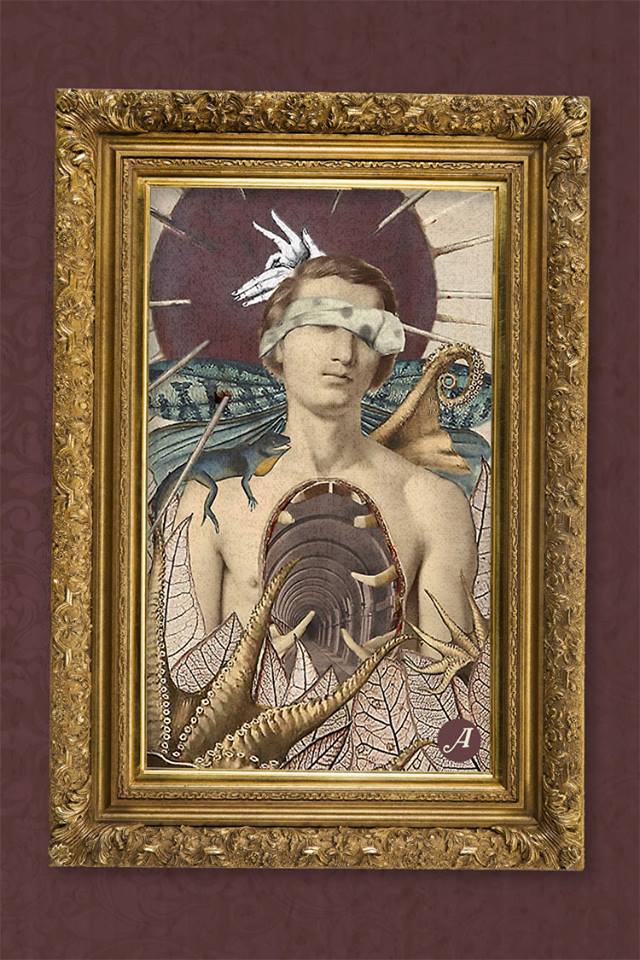
Two Butler MFA alums, Zach Roth and Luke Wortley, began Axolotl with the dream of creating “a beautiful, completely bilingual magazine to publish both established and emerging writers that share their love for magical realism and its various iterations.” Butler MFA students who worked with Zach and Luke at Butler’s lit mag, Booth, (both were fiction editors during their time in the program) are not surprised to see these big dreaming, hard working, creative minds realize that dream.

After just one year, the two list these accomplishments on their website:

  1. We published six (6) online issues
  2. We compiled and successfully printed a beautiful print issue
  3. We nominated several pieces for various awards and anthologies
  4. We took on a third staff member
  5. Most importantly, we have returned for a second year

Their website and blog are written as well as the most entertaining story and gives the details of their journey. If that’s not enough, they answered questions for their alma mater’s blog, too.

What makes Axolotl different than the stacks of lit mags out there?

Zach: We’re fully bilingual and love to read translations, which allows us to reach unique markets. We don’t keep a blacklist and invite everyone to submit more work. Our website background is Cosmic Latte, the average color of the universe.

Luke: We try so hard to be transparent about the process and we actively look for ways to change and evolve.

Are you surprised by Axolotl’s steady growth and success or did you always know you had a winner?

Zach: I knew we were firmly differentiated and would have a niche, but I would never have anticipated this. I was expecting that after a few months it would die an obscure whisper.

Your website says you are seeking “previously unpublished translations and original works of fiction, drama, poetry, and art—in both English and Spanish—in and about and around the genres of magical realism and slipstream. We want pieces that infinitely absorb us like black holes.” What else makes a great story for Axolotl?

Zach: A good first line, a better first page, and exceptional follow-through.

Luke: I’d add that a good poem to us is one that forces me to reconsider something fundamentally, whether that be the poem itself or the poem’s subject matter. I want stuff that takes risks.

Hey Zach, what gets Luke so excited that his Kentucky accent comes out?

Zach: A hoedown at the hootenanny.

Luke, did you believe in Zach’s idea from the beginning or have there been moments of doubt?
Luke: Honestly, I launched myself into this idea from the beginning. Full-throated support from the drop, really.

What does Luke bring to the mag?

Zach: I am a hermit crab of a man. Luke brings the charisma, personality, and social media prowess. He also brings a more finely-attuned eye and ear for poetry because he reads all sorts of nonsense about birds and ice cream emperors.

How much do you disagree? Who gets the final say?

Zach: As often as you would expect of two people with different aesthetics and values–a healthy amount. But that’s the fun part. I would argue that Luke technically gets final say because he’s the tougher negotiator.

Luke: I’d say we’re usually pretty in-sync. Part of what makes our process so unique is that we’re a team of editors and readers. So when there’s a disagreement, we’re having it out over whether or not that piece gets published, not whether or not an editor even gets to take a look. So, of course, I voice my opinion in one direction or the other. Then the intellectual beatdown begins. Thankfully, though, I don’t have to worry about Zach’s powerful calves (seriously, though, his calves are those of Adonis) because most of our sparring takes place online.

What are you most proud of in Axolotl?

Zach: Personally, the edits to the story, “Ten Days in the Submerged City.” I didn’t mean for such a comprehensive edit to happen. I gave the author about 40 suggestions, and he took them ALL. And then gave me two new drafts. I also think the story’s design in the print volume is probably the most ambitious and successful.

Luke: For me it’s our longevity. The shelf-life of most literary magazines, especially ones not connected to a university or other writing center, is pretty short and many do not make it to a second cycle of publication (many don’t even finish their first). I’m also proud to have added a third staff member, the hilariously talented Tana Oshima.

Why did you decide to create a print issue?

Zach: Half of it is because digital publishing is liberating but transient. The journal that accepted my first-ever publication no longer exists and thus my first-ever publication credit no longer exists. The print issue serves as a beautiful, permanent record for us and our contributors. The other half of it is that my real passion is design. I firmly believe that a story or poem that hums can be made to sing with the right design. The greatest modern tragedy is an ugly book.

Luke: I knew that Zach would kill it.

How did your work with Booth help with this project?

Zach: Working on Booth gave me a lot of insight into the administrative side of running a lit mag and choosing pieces, but it’s also my personal standard I hope to surpass. For both design and content, it’s a good combination of vision and execution. Looks slick, reads slick. I want someone to feel about Axolotl the way I felt holding Booth 4 for the first time.

Luke: Being both a reader (poetry) and editor (fiction) at Booth gave me relevant experience to navigate the ever-changing literary market, especially as a young magazine. Attending AWP as a Booth representative was also extremely helpful because I made a lot of contacts in the literary world — experiences that have helped us mold our nebulous literary idea into a concrete aggregate of the some of the most beautiful and strange stuff on the web (and in print).

Where are you going from here?

Zach: I hear that hootenanny is still going on.

Luke: To the hoedown.

coverTo get in this hootenanny, check out Axolotl online, consider submitting, or purchase the first issue.
MFA Alums Print LitMag


Screen Shot 2015-11-11 at 9.26.01 PM

Two Butler MFA alums, Zach Roth and Luke Wortley, began Axolotl with the dream of creating “a beautiful, completely bilingual magazine to publish both established and emerging writers that share their love for magical realism and its various iterations.” Butler MFA students who worked with Zach and Luke at Butler’s lit mag, Booth, (both were fiction editors during their time in the program) are not surprised to see these big dreaming, hard working, creative minds realize that dream.

After just one year, the two list these accomplishments on their website:

  1. We published six (6) online issues
  2. We compiled and successfully printed a beautiful print issue
  3. We nominated several pieces for various awards and anthologies
  4. We took on a third staff member
  5. Most importantly, we have returned for a second year

Their website and blog are written as well as the most entertaining story and gives the details of their journey. If that’s not enough, they answered questions for their alma mater’s blog, too.

What makes Axolotl different than the stacks of lit mags out there?

Zach: We’re fully bilingual and love to read translations, which allows us to reach unique markets. We don’t keep a blacklist and invite everyone to submit more work. Our website background is Cosmic Latte, the average color of the universe.

Luke: We try so hard to be transparent about the process and we actively look for ways to change and evolve.

Are you surprised by Axolotl’s steady growth and success or did you always know you had a winner?

Zach: I knew we were firmly differentiated and would have a niche, but I would never have anticipated this. I was expecting that after a few months it would die an obscure whisper.

Your website says you are seeking “previously unpublished translations and original works of fiction, drama, poetry, and art—in both English and Spanish—in and about and around the genres of magical realism and slipstream. We want pieces that infinitely absorb us like black holes.” What else makes a great story for Axolotl?

Zach: A good first line, a better first page, and exceptional follow-through.

Luke: I’d add that a good poem to us is one that forces me to reconsider something fundamentally, whether that be the poem itself or the poem’s subject matter. I want stuff that takes risks.

Hey Zach, what gets Luke so excited that his Kentucky accent comes out?

Zach: A hoedown at the hootenanny.

Luke, did you believe in Zach’s idea from the beginning or have there been moments of doubt?
Luke: Honestly, I launched myself into this idea from the beginning. Full-throated support from the drop, really.

What does Luke bring to the mag?

Zach: I am a hermit crab of a man. Luke brings the charisma, personality, and social media prowess. He also brings a more finely-attuned eye and ear for poetry because he reads all sorts of nonsense about birds and ice cream emperors.

How much do you disagree? Who gets the final say?

Zach: As often as you would expect of two people with different aesthetics and values–a healthy amount. But that’s the fun part. I would argue that Luke technically gets final say because he’s the tougher negotiator.

Luke: I’d say we’re usually pretty in-sync. Part of what makes our process so unique is that we’re a team of editors and readers. So when there’s a disagreement, we’re having it out over whether or not that piece gets published, not whether or not an editor even gets to take a look. So, of course, I voice my opinion in one direction or the other. Then the intellectual beatdown begins. Thankfully, though, I don’t have to worry about Zach’s powerful calves (seriously, though, his calves are those of Adonis) because most of our sparring takes place online.

What are you most proud of in Axolotl?

Zach: Personally, the edits to the story, “Ten Days in the Submerged City.” I didn’t mean for such a comprehensive edit to happen. I gave the author about 40 suggestions, and he took them ALL. And then gave me two new drafts. I also think the story’s design in the print volume is probably the most ambitious and successful.

Luke: For me it’s our longevity. The shelf-life of most literary magazines, especially ones not connected to a university or other writing center, is pretty short and many do not make it to a second cycle of publication (many don’t even finish their first). I’m also proud to have added a third staff member, the hilariously talented Tana Oshima.

Why did you decide to create a print issue?

Zach: Half of it is because digital publishing is liberating but transient. The journal that accepted my first-ever publication no longer exists and thus my first-ever publication credit no longer exists. The print issue serves as a beautiful, permanent record for us and our contributors. The other half of it is that my real passion is design. I firmly believe that a story or poem that hums can be made to sing with the right design. The greatest modern tragedy is an ugly book.

Luke: I knew that Zach would kill it.

How did your work with Booth help with this project?

Zach: Working on Booth gave me a lot of insight into the administrative side of running a lit mag and choosing pieces, but it’s also my personal standard I hope to surpass. For both design and content, it’s a good combination of vision and execution. Looks slick, reads slick. I want someone to feel about Axolotl the way I felt holding Booth 4 for the first time.

Luke: Being both a reader (poetry) and editor (fiction) at Booth gave me relevant experience to navigate the ever-changing literary market, especially as a young magazine. Attending AWP as a Booth representative was also extremely helpful because I made a lot of contacts in the literary world — experiences that have helped us mold our nebulous literary idea into a concrete aggregate of the some of the most beautiful and strange stuff on the web (and in print).

Where are you going from here?

Zach: I hear that hootenanny is still going on.

Luke: To the hoedown.

coverTo get in this hootenanny, check out Axolotl online, consider submitting, or purchase the first issue.

MFA Student Shares Publishing Secrets

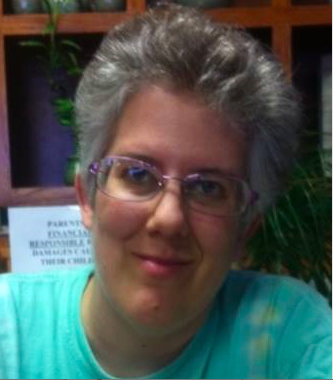
Screen Shot 2015-10-26 at 12.45.14 PMTracy Mishkin is a Poetry MFA student with a long list list of publications. “My goal when I entered the MFA program was to write more, write better, and send out my work more often with the hope of publishing a book,” Tracy said.

She’s published 39 poems and has 10 more forthcoming. She’s also published a chapbook, I Almost Didn’t Make It to McDonald’s, in 2014 and is currently sending out manuscripts for another. She is an active member of InterUrban, an inclusive writing group of Indianapolis poets, including many Butler MFA students and alumni. Tracy agreed to share her experience with publishing and writing.

  • With all the acceptances, there must be some rejections? How do you handle them?

I have sent out 417 poems since August 2014. I have also sent out 73 chapbook and full-length manuscripts. It doesn’t bother me to get a rejection, especially now that I get a decent number of acceptances. Once I started getting some rejections that were not form letters and that encouraged me to submit again, I knew I was headed in the right direction.

  • Do you have a routine or regular habit for publishing? Do you set aside time for submitting like you do for writing?

I am very organized about my submissions. I check my CRWROPPS email folders regularly, and I track my submissions on a spreadsheet. I try to write and submit on weekends and a couple nights a week. I try to balance between writing, revising, and submitting and not get stuck on one of these activities for too long.

  • How has the Butler MFA been helpful to your writing?

The poetry faculty have supported me in developing a poetics that pushes beyond the surface and faces challenging themes without detouring into comedy or drowning in the literal. Consider the advice I received from Alessandra Lynch in 2013: “Channel your frustration in other directions. . . . Lift off a bit from the literal situation by stepping outside the room, linking this scene with others in your life or the world or nature.”

Something else the Butler MFA has helped me with: being able to articulate my aesthetic. The poetry faculty encourages us to prepare for thesis writing by asking us to write about our work, to be able to see it from the outside and articulate what it does. The first time Chris Forhan asked me to write about what my work does, I felt terrified and overwhelmed, but I am much more comfortable with that process now.

  • What advice do you have for hopefuls who have not been published?

Use CRWROPPS (or a similar resource) and don’t give up. I avoid sending more than 3 poems to any one journal, and each poem will only be sent to 3 journals at the same time. That helps me cope with rejections, too. A rejection means that now I can send that poem to 3 more places–and hopefully it has been revised in the interim and is stronger.

Want to read some of Tracy’s poems? Here’s a list of her most recent publications and a link to her chapbook.

The Akbar Reading

Dan

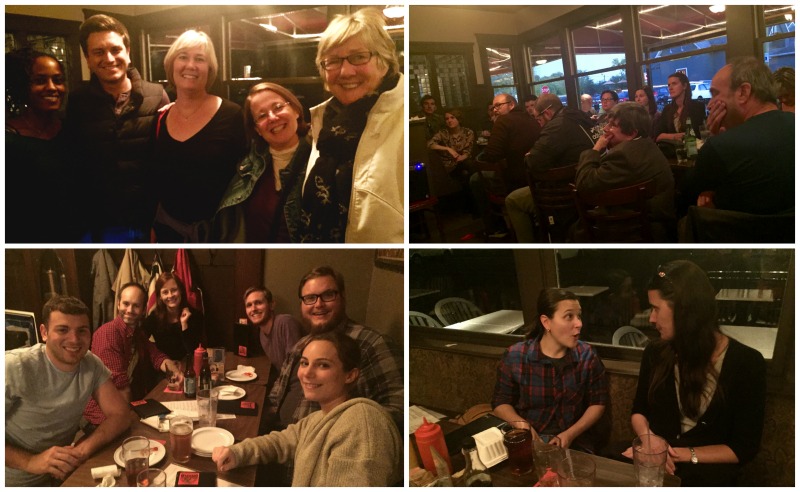
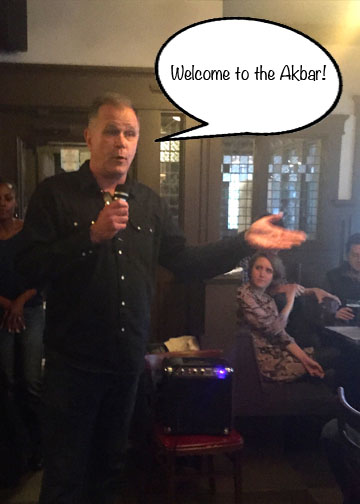
Over fifty people packed the Broad Ripple Brewpub for the first Akbar reading. The new reading series promised short, entertaining readings, free beer trivia, and the chance to engage with other writers in the Butler community. The Akbar delivered on all points. In the spirit of keeping the boring stuff short, the reading series formally known as The Kaveh Akbar (ahem!) Endowed Reading Series, is now called simply  “The Akbar.”


akbarreading

The reading began with a series of poems by Allyson Horton. Her reading experience was evident as she captivated the large, rowdy crowd with her womanly, jazzy poems and haikus. The unmarried poet jokingly gave marriage advice after reading “Husband number 4.”

Fiction candidate Logan Spackman’s reading was punctuated with hardy laughter and dramatic page tossing. He read an excerpt of his thesis project, a novel involving a small town mystery, twins in the basement, and boozing parents. Are there better ingredients for a novel?

Andy Levy, Butler English Department Chair and MFA nonfiction professor, provided an incredibly personal essay on grief and closure. “Spoiler: you’ll never find it,” Levy read. The essay centered around the loss of his friend who died in Pan Am flight 103 before he made it as the literary superstar many thought he’d be.

The winners of the free beer trivia contest were Claire Leo, Erin Harris, and Tracy Mishkin. They sure know their drunk writers.

akbar1

The readers wowed, but the best part of the night was the eclectic group assembled in the pub. It was standing room only as members of the first Butler MFA graduating class mingled with first year students, professors, and everyone in between. Old and new friends encouraged each other in our common mission on being a better writer.

Save the date for the next Akbar reading Wednesday, December 16th, 7:00pm at the Brewpub. The lineup includes Butler MFA director and nonfiction professor Hilene Flanzbaum, fiction candidate Greg O’Neill, and poetry candidate Rachel Sahaidachny. Plus, inappropriate trivia presented by John Eckerd. See you at the Akbar!

Butler MFA in Print

Congratulations to our talented MFA students and alumni who published stories, poems, and essays this summer and early fall. Here at the Butler MFA, we celebrate hard work and enjoy seeing the result in print. Enjoy reading from this extensive list of deserving work.

Bailey Merlin’s poem “A Great Greco Roman Romance” was awarded Honorable Mention in the 84th Annual Writer’s Digest Writing Competition.

Maria Cook published an essay, “My Maddening Quest to Get My Tubes Tied at Age 20,” this September in Marie Clare.

Laura Kendall published an essay in Vela titled “The People This Body has Housed.”

John Eckerd has two poems in the fall issue of  2River Review, “Bloomington” and “Lauraunder his pen name, John Leo.

Luke Wortley’s story “A Pathetic Little Sound” is featured in Limestone: Art. Prose. Poetry.

Chris Speckman has two poems, “Preshrunk” and “Bathwater” in the Autumn 2015 edition of Rust + Moth.

Kaveh Akbar has poems published in Philadelphia Review of Books and decomP. He recently attended Bread Loaf and also received an invitation to the BOAAT Writer’s Retreat with Eduardo Corral.

Alex Mattingly has a story in the print issue of Midwestern Gothic and another in Crimespree Magazine. He was also a storyteller at Indy Tale‘s August show.

Zach Roth and Luke Wortley published their first print issue of their growing literary magazine, Axolotl.

Don’t foget about these upcoming events!

10/13: Laila Lalami reading, 7:30, Atherton Union

10/14: Laila Lalama Q & A, 12:00, ECCW

10/14: Writing Club, 10-12, ECCW

10/14: Kaveh Akbar *ahem!* endowed reading, 7:00, Broad Ripple Brewpub


Butler MFA in Print

Congratulations to our talented MFA students and alumni who published stories, poems, and essays this summer and early fall. Here at the Butler MFA, we celebrate hard work and enjoy seeing the result in print. Enjoy reading from this extensive list of deserving work.

Bailey Merlin’s poem “A Great Greco Roman Romance” was awarded Honorable Mention in the 84th Annual Writer’s Digest Writing Competition.

Maria Cook published an essay, “My Maddening Quest to Get My Tubes Tied at Age 20,” this September in Marie Clare.

Laura Kendall published an essay in Vela titled “The People This Body has Housed.”

John Eckerd has two poems in the fall issue of  2River Review, “Bloomington” and “Lauraunder his pen name, John Leo.

Luke Wortley’s story “A Pathetic Little Sound” is featured in Limestone: Art. Prose. Poetry.

Chris Speckman has two poems, “Preshrunk” and “Bathwater” in the Autumn 2015 edition of Rust + Moth.

Kaveh Akbar has poems published in Philadelphia Review of Books and decomP. He recently attended Bread Loaf and also received an invitation to the BOAAT Writer’s Retreat with Eduardo Corral.

Alex Mattingly has a story in the print issue of Midwestern Gothic and another in Crimespree Magazine. He was also a storyteller at Indy Tale‘s August show.

Zach Roth and Luke Wortley published their first print issue of their growing literary magazine, Axolotl.

Don’t foget about these upcoming events!

10/13: Laila Lalami reading, 7:30, Atherton Union

10/14: Laila Lalama Q & A, 12:00, ECCW

10/14: Writing Club, 10-12, ECCW

10/14: Kaveh Akbar *ahem!* endowed reading, 7:00, Broad Ripple Brewpub