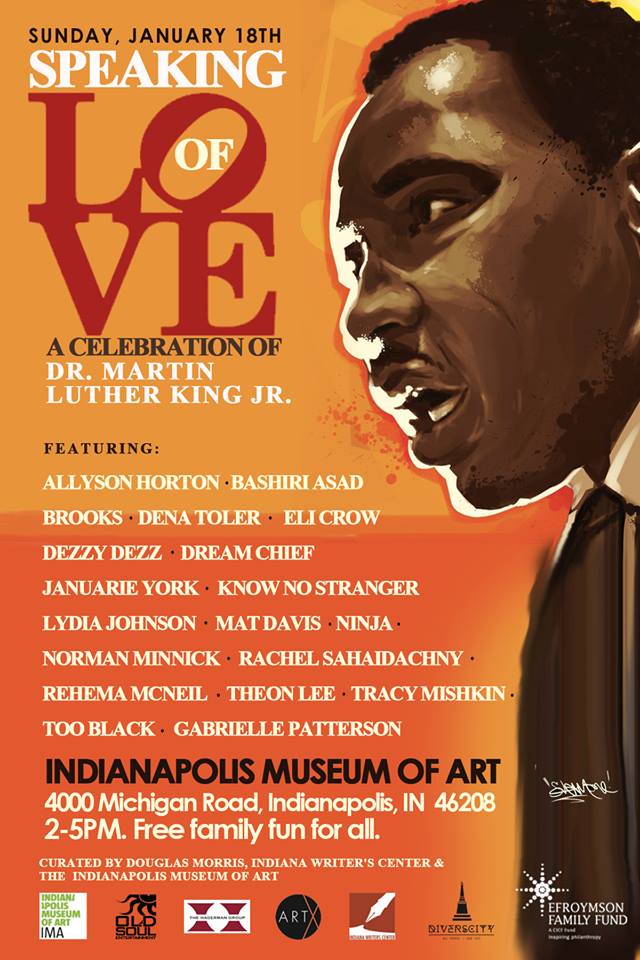
At divedapper.com Butler MFA Kaveh Akbar has created a space for his passion: talking about poetry. The beautiful website features conversations with some of the poetry world’s brightest stars. The interviews cover a wide range of topics in Kaveh’s personal tone. Kaveh recently discussed the project with me. Like his interviews suggest, Kaveh proved truly easy to talk to and passionate about poetry.
What is Divedapper?
It’s a website designed to house conversations with poets I admire. Really, it’s a not-too-subtle ploy to get poets I admire to be interested in talking to me. These are people whose words have dominated huge chunks of my consciousness for years, or people whose words might currently be dominating my consciousness. Divedapper is a place for me to get to know the people behind those words.
One of the first things I ever heard you say was, “I love to talk about poetry. I want to talk to everyone about poetry.” How does Divedapper fit into this passion?
Oh, God. It’s an excuse to talk to my heroes, these titans of my own personal canon who have no business talking with an anonymous weirdo in the middle of Indiana. There’s no way to relay how much joy it brings me without sounding hyperbolic. I literally get dizzy sometimes when I think about it. It’s overwhelming, the gratitude I feel for the opportunities Divedapper’s given me, for the conversations I’ve had. That people are reading the interviews, that some seem to enjoy them, that’s gravy. Sweet sweet life-affirming gravy.
I am so impressed by the people you get to talk to in your blog interviews. How easy is it to get a response from these writers?
It’s nuts to me too! I write a lot of letters. I make a lot of cold calls. Poets are still people, however I might mythologize them. Most don’t have agents, most have to do their own promotion. One poet on the site answered an email solicitation within five minutes of my sending it. There’s a poet (who hasn’t yet appeared on the site) with whom I’ve been exchanging postal letters for months. For another poet with an interview currently on the site, I sent biweekly emails, cold, for six months, a couple paragraphs every other week for six months before I even got a phone number.
It’s different for every interview, but it all boils down to me explaining who I am, how Divedapper works, and what interests me about the poet’s work. Now that the site’s been live for a few months, I’ve actually received a couple responses to solicitations from poets who were already readers of the site. Those made me want to cartwheel around the block and kiss everyone along the way.
I recently read the article at The Awl about the weekly postcards you have received for years from poet David J. Thompson. I’m not sure I’ve heard of a cooler relationship. You seem to easily make friends and meaningful connections with other writers. When I read the conversations on Divedapper, they seem like a discussion between two friends rather than a formal interview. Is this just part of your personality or is there a trick? How does this ability help you with Divedapper?
Hah! I don’t know. I don’t think there’s any trick. James Dickey said, “What you have to realize when you write poetry, or if you love poetry, is that poetry is just naturally the greatest god damn thing that ever was in the whole universe.” I think any person for whom that is true is naturally inclined to feel comfortable with another. I will say that I’m not interested in tempering my enthusiasm, and I think (or hope!) this sometimes might inspire confidence in the sincerity of my interest. It maybe helps some people drop their guard a little.
I’ve noticed some of the interviews do not focus on poetry as much as a person’s thoughts on a subject. Like in the Claudia Rankine interview you discussed the Darren Wilson verdict. What do poets add to discussions of current events/politics, etc.
A lot. Rankine’s Citizen was the most insightful discussion of contemporary American racial politics I encountered last year, in any medium. Translated works from contemporary Arab poets like Dunya Mikhail and Ghassan Zaqtan offer us glimpses into the lives of people living in parts of the world where such narratives are often actively suppressed from American readers. That poets like Nazim Hikmet, Joseph Brodsky, Liu Xiaobo, and countless others wrote and continue to write poetry in spite of the abuse and incarceration and indignities levied upon them for it says everything you need to know about why it matters, about what their contribution to the discussion has been.
When I told someone about your sports fanatic side, he was like, “A poet sports fan!?!” isn’t that an oxymoron? Do you feel stereotyped as a poet, and how do the people you interview break those stereotypes?
Ha! I contain multitudes! I grew up in Wisconsin, and the first poem I ever published was called “A Packer Poem.” I was in second grade and my teacher sent it to our local newspaper, which printed it alongside a goofy gap-toothed photo of me. It was cemented then and there—these two things (poetry and football) would be my twin obsessions. Between reading and writing and keeping up with the world of sports, I don’t really do a whole lot else. It’s a charmed life.
I’m certainly not unique in these obsessions. J. Ryan Stradal’s “Fantasy Football For Poets” column at The Rumpus is one of my favorite things on the internet. Gabrielle Calvocoressi (interview forthcoming on the site) is a huge Steelers enthusiast. Stephen Burt, one of the most important poetry critics in America, is a great fan of the WNBA (he wrote a chapbook about it).
I’ve been surprised in other, non-sports ways, too. Don Share, editor of the world’s most important poetry journal, almost did his doctoral dissertation on Lester Bangs. Frank Bidart (also forthcoming on Divedapper) spoke with me at length about how much he loved Pineapple Express. Dorothea Lasky has a wonderful poem in her new collection about Diet Mountain Dew. I think there’s this notion that poets always walk around reminding themselves to act poet-y, sniffing at leaves and weeping at robins and the like. I love when poets subvert those expectations.
I have to confess, hearing your passion in the plea to talk about poetry made me want to talk about poetry. However, I’m a prose reader/writer. What kind of advice can you give people who want to begin to talk about poetry but are intimidated? Is there value to reading poetry that you don’t immediately understand?
Sure—read it! Read as much as you can and don’t be intimidated if you don’t immediately love everything you read. A lot of new readers assume that not being compelled by a poem or poet indicates an inability to understand or enjoy poetry. That’s like thinking your tongue is broken because you hate cantaloupe. I think anyone would be hard-pressed to read a hundred poems by a hundred different publishing poets and not feel moved by any of them.
As you read and begin to think critically about what you’re reading, what’s filling you with wonder and what’s leaving you cold, consider this bit by Auden: “For an adult reader, the possible verdicts are five; I can see this is good and I like it; I can see this is good but I don’t like it; I can see this is good and, though at present I don’t like it, I believe that with perseverance I shall come to like it; I can see this is trash but I like it; I can see this is trash and I don’t like it.” If you can start to think about what you’re reading in terms of those categories, you’re set.
As for the last part of your question, I think there’s tremendous value in poetry you can’t immediately decode. I can listen to Paul Celan read “Todesfugue” (“Death Fugue”) in German, a language I don’t speak at all, and still feel intensely emotional. I ordered a pizza yesterday and when the delivery guy, maybe fifty years old, asked me what I did, I told him I was a poet. He immediately gave me a dramatic, extemporaneous recitation of Yeats’ “When You Are Old,” from memory. (This, by the way, is an excellent way to earn a good tip.) The joy I felt at his recitation had nothing to do with any biographical information about Yeats or technical understanding of the poem’s mechanics. Ultimately, I go to poetry for pleasure. I go to it to understand how others have lived in pleasure, and how they’ve battled those forces that conspired against their pleasure. The best teachers of poetry I’ve had have been those who have found ways to deepen my pleasure in reading. My (and, I’d contend, most people’s) natural state is one of receptiveness to poetry, to its rhythms and cadences and psychic resonances.
Do you have reading suggestions for “beginner” poetry readers?
Sure. I’d say anyone interested in developing a relationship with poetry should read more widely than deeply, at first. I think subscribing to some poetry magazines is a great first step. Recommendations: just POETRY and Rattle would cover a lot of ground. I fell in love with poet interviews as a teenager reading old issues of the New York Quarterly, their craft talks. For more general lit-mags that feature poetry, Boston Review and Lana Turner Journal are two of my favorites. And BOOTH, of course. The two books of poetry I’ve given away as gifts to non-poets most often in the past few years have been Eduardo Corral’s Slow Lightning and Heather Christle’s The Difficult Farm. It depends very much on the reader, of course, but those are some places to start.
What are some things, or the best thing, you’ve gotten from your Divedapper interviews?
The conversations! The opportunity to go under the hoods of some of my favorite poems and tinker around. Insights into my own writing, motivation and inspiration for my own poems. Relationships with poets I’ve interviewed that have extended far beyond Divedapper. Direction. Gratitude. Purpose!

 She even gives credit to Franzen. “He’s the best kind of interviewee,” she said. “He has strong opinions and doesn’t mind being provocative.”